Print Story
X




Two old companions spend a day among bookstores and unfinished conversations
| W |
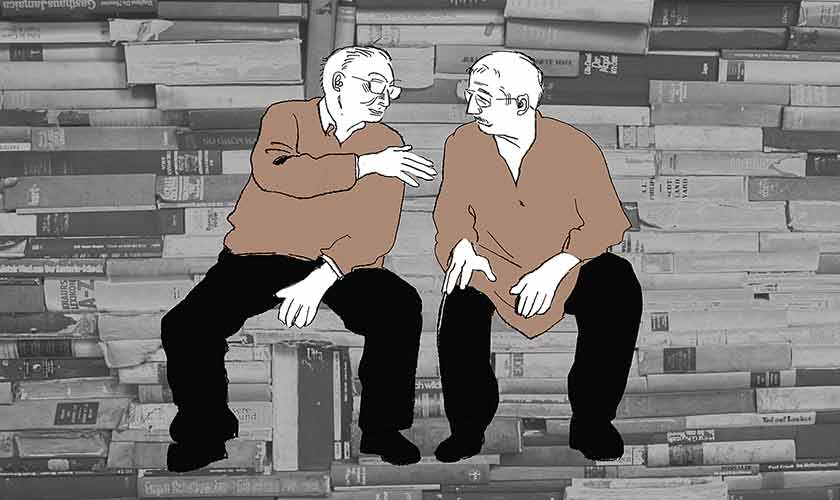
e entered the bookstore. It was vast and spread across several floors. Long rows of shelves stood on every floor. Walking between them felt like wandering through narrow streets built out of books. As we kept moving, I suddenly wondered: why is it that, in the end, we always arrive at some sort of alleyway?
I picked up a book. It was about the very city in which the bookstore stood. Yet it struck me as foolish to know a city through books alone rather than through its streets, bazaars, cafés, shrines, tombs, deserted rooftops, half-open windows on upper floors and the secret ballrooms hidden inside old hotels. I put the book back.
He looked at me and smiled. Several books were tucked under his arm. I remembered something he had once said: “I read books not only with my eyes, but through touch as well.”
We continued walking slowly through those alleys of books. It felt as though some fragment of the bookstore’s atmosphere had quietly entered us and was now guiding us from one aisle to another. Certain spaces within us seemed to open there, before our very eyes.
Earlier that day, we had wandered for hours through the streets of the city itself. We were searching for the oldest street. But an old street is not recognised merely by crumbling houses, broken buildings or even an ancient tree that people have begun to consider sacred, tying coloured threads and scraps of cloth to its rough trunk.
An old street reveals itself through its scent. We agreed that the scent of cooking rose each morning from a particular shop, where food was cooked until noon. At last, we found that street.
It was narrow, paved with uneven stones and lined with leaning houses whose walls carried the dust of time. Smoke drifted from certain windows; muted voices floated from behind old wooden doors. I ate wild beans with barley bread and a little honey. He contented himself with the aroma alone.
The people there had unfamiliar faces. No one paid attention to us, nor did we pay attention to them. In strange cities, perhaps this is the greatest comfort.
We were still walking through that ancient street, its fragrance moving with us, when he suddenly said:
“These days, literature is being taught terribly.”
His tone, the slight thunder in his voice, the way a suppressed laugh flickered as he spoke, it was all exactly as it had been years ago. Even after leaving this place behind, neither his ideas nor the way he expressed them had changed.
“A bad thing only grows worse. Evil is not like good. It neither remains the same nor fades away. Evil spreads. Look around, people now write literature carelessly and without devotion.”
I let the stream of thought flow silently through my mind, but said nothing. Some things are better left unspoken.
I was also astonished that not a single word of his betrayed how utterly unlike our earlier meetings this one was. Familiar places always carry some new strangeness about them. Perhaps that was why I could not say what I truly thought.
In the bookstore, we came upon some old books. They were thin but oversized, all hardbound. Their cardboard covers had softened with age; the paper had yellowed and turned grimy. Some corners were torn, the cardboard beneath protruding like a swelling beneath the skin.
The books dealt with ways of reading poetry, novels and autobiographies. They had been written in a simple style for students and ordinary readers, those accustomed to learning everything from others and frightened by anything unfamiliar. The typography was a beautiful blend of Naskh and Nastaliq scripts and some pages carried illustrations.
“More books like these should be written,” he said with a faint smile. “Only the titles should change. How to Escape Bad Poetry. How to Avoid Bad Fiction. How to Protect Yourself from Bad Autobiographies.”
Saying this, he took all the books from me and stuffed them into his bag.
At that moment, I noticed his clothes. He wore loose brown trousers, slightly dirty, as though they had been worn for days. His checked shirt had brown stripes. I suddenly wondered whether the colour brown had something to do with the place he had come from.
But I said nothing. I did not have the courage to speak about that place.
Then, abruptly and casually, he said:
“Give me your ATM card.”
I slipped my hand into my pocket and took out my wallet. A hesitation stirred inside me. I remembered that earlier, too, I had bought books for him and sent them over, but he had never repaid me. I also wondered: if he had no money, why was he buying so many books?
But I did not say any of this aloud.
Unaware, or perhaps indifferent, to my hesitation, he placed the bag of books on the counter and wandered off to browse again.
Meanwhile, I noticed an elderly writer sitting nearby. How had he arrived here, at this bookstore in the city? Had some fragment of him, too, remained lodged somewhere inside us?
He was speaking to a small group in his characteristic tone, measured, yet forceful. Seeing me, he greeted me warmly, then interrupted himself to say:
“My dear fellow, once upon a time, Visit Freil wrote about our literature. He never even came here, yet he knew every detail of this place. There was no literary journal, no book, no newspaper connected to our literature that escaped his attention. What extraordinary people they were.”
I told him I had never heard the name before and asked him to repeat it. He did so, then continued speaking about the man’s ideas on our literature. As I listened, I felt – for reasons I could not explain – that he was really expressing his own thoughts beneath the veil of a foreign name.
Why had he not mentioned one of our own critics? Was a critic writing in our language somehow not authoritative enough?
“How much can a person possibly read?” I asked.
“One must read the greats,” he replied gently, almost admonishingly.
“The great do not remain great forever,” I said playfully.
“Some do,” he shot back immediately.
“A truly great person,” I said, “has no need for certificates of greatness.”
Then he turned towards my friend, who had quietly come to stand beside me.
“Why are you silent?” he asked.
But my friend said nothing. It was as though he had not even heard the question.
Soon afterwards, we left. Ahead of us stood another bookstore. This one carried books in many languages, all of them new; bright covers, fresh paper, shining titles.
“So much is being written in every language of the world,” my friend murmured. “Who can possibly read it all? How much should a person read?”
I looked at him and felt that his heart was still trapped in this world, even though years had passed since he had left it behind.
He was walking quickly now, always a few steps ahead of me, just as he used to. He had grown thinner, perhaps weaker, but the quickness in his movements remained.
I wanted to ask whether he was working on a book. Once, that question had been essential to all our conversations. He was forever planning new books, forever speaking passionately about unwritten projects. Every book of his remained postponed. He seemed to believe that he had an endless life: one half to be spent planning books, the other finishing them.
Yet he had remained so absorbed in his ambitions that he never fully realised how other ambitions and designs were also being woven around him.
We had often spoken about education, literature, society, politics, love and travel, but never about this: that deep within us there exists a hidden mechanism that causes the arrows of our ambitions to miss their mark. Nor had we ever discussed why every place of rest secretly contains a journey within it, the way sleep contains dreams, and dreams contain the strange logic of disorder.
Now another curiosity seized me: did he still remember the outlines of his unfinished projects? Had he discovered anything about the forces that reduced them to dust?
I also wished to ask whether he had ever thought of writing a book there, wherever he now was, and what its subject might be. A book is really a doorway, opening from one world into another. That is why every book carries us from one world towards the next.
And then another thought stopped me abruptly:
Was there yet another world beyond the place where my friend now existed?
I kept looking at him. He seemed lost in thought.
Then a strange curiosity overtook me. Did words from the books written here ever reach that place? And if they did, how were they read, how were they understood? Were reviews written there, too? Or had all the books written here had, in the beginning, come from that world?
I swear this thought would never have occurred to me had he not accompanied me into those bookstores in search of books. Yet almost immediately, I became aware of the absurdity of my imagination. If books truly existed there, why would he have come here looking for them?
He had come for books alone.
I could not even ask whether it had been difficult for him to return, let alone why he wished to read there the books written by the people here.
I shared none of my thoughts with him. Nor did I place any of my questions before him. Perhaps it was better this way. Why should he carry the burden of another man’s thoughts and questions back with him now? Books were a different matter.
Then suddenly, while we were still walking through the street where we had unexpectedly met, he disappeared.
The street itself vanished from sight. The bookstore was nowhere to be seen.
Only the elderly writer remained, dozing alone in a desolate place like a shadow, perhaps the shadow of a thought.
What astonished me most was this: he did not stop for coffee. He had loved espresso. There were two cafés on that street, yet he did not even glance towards them.
I try to remember whether, at the moment of departure, he was still carrying the bag of books he had left at the counter of the first bookstore before wandering towards the second. But I cannot recall.
Perhaps certain experiences can only be lived, never fully remembered afterwards.
I planted seeds of magnolia in my heart
Some springs ago
I walk head tilted, as the magnolias now grow
Little do I water
Little do I tend
A nurturing soil for my magnolia I deem to pretend
Rosy petals sprout each dying day
April has come and gone
Here comes May
Home for the doves, shade for the troubled
There is a bittersweet ache lingering on my shoulders
For having to rest my head all day long
Spring may be cruel
But so is God.
For entrusting me to home a magnolia tree
Sprouting from my heart
Mahnoor Rehan is an Islamabad based poet. Her work has appeared in The Missing Slate and Aleph Review. Her collection Eclipse and Apocalypse is available now.
The writer is a Lahore-based critic and short story writer.He edits Bunyad, the Urdu journal of LUMS. His latest book is Mera Daghestan-i-Jadeed