Print Story
X




Wardha Shabbir transforms botanical life into a metaphor for survival
| I |
magine a world in which humans and vegetation have, by some secret miracle, exchanged places. Roles, responsibilities, ambitions and emotions traditionally associated with humankind now belong to plants. Flowers, fruits, vegetables, trees and crops are no longer planted, pruned, cultivated or harvested by humans. Nor are they grown in pots, parks or fields to be consumed as food or admired as decorative objects. Instead, these entities possess independent identities of their own and have domesticated humankind.
This idea recalls an observation made by Yuval Noah Harari in his bestselling book Sapiens: “A handful of plant species, including wheat, rice and potatoes, domesticated homo sapiens, rather than vice versa.”
In that scenario, plants fall in love with one another, sometimes across species and climates, destroy their enemies, strive for immortality and seek to spread, prolong and reproduce their existence. They voyage to distant locations, settle on alien terrains and eventually become native to those lands. Plants subjugate humans, enslave them, confine them to artificial environments and influence them. In some instances, they become attached to them, from affection to pure love.
If, for a moment, we detach ourselves from our familiar surroundings, we may notice that this is not such a far-fetched fiction after all; some of its features are already noticeable. A mere change in perspective transforms the imaginary scenario into a tangible reality. We have become tools of the botanical kingdom. We carry seeds to unfamiliar soils, remain fixated on our food, depend on crops for survival and fill our homes, workplaces, public spaces and towns with plants of one kind or another. It is a form of control, dependence and quiet servitude.
Looking out from the windows of Wardha Shabbir’s apartment, a visitor is met with a dense spread of shrubs, stems, flowers and leaves, offering a rich expanse of greenery within a residential neighbourhood. Shabbir’s example is not unique; similar sights can be found across the world in varying forms and dimensions. For Shabbir, however, such surroundings are essential to her art. Since her years at the National College of Arts, she has been drawing plants as she encounters them in books containing Mughal miniature paintings, in parks, along roadsides, outside houses, on balconies and arranged in living rooms. Shabbir regards them not merely as objects of beauty, but as subjects of curiosity.
She studies the anatomy of plants and constructs a parallel world in which they are not confined but move freely, at times overtaking entire spaces. Plants of one species merge with others, evolving into rare breeds and hybrid forms. The wide variety of plants, un-nameable to ordinary people but instantly recognisable to the artist, that populate her paintings can also be seen while walking along the lane near her apartment block.
Much like other parts of the world, South Asia has long been shaped by invaders, traders and travellers who introduced species from distant lands while also transporting indigenous seeds elsewhere. The Portuguese, in particular, brought a number of vegetables, fruits, flowers and plants of foreign origin to the subcontinent, many of which eventually became part of everyday life and staple diets. These included the potato, tomato, chilli, capsicum, guava, papaya, pineapple, maize and cashew. The list would grow longer if one were to include the flowers, shrubs and trees introduced to the subcontinent by other foreigners.
Wardha Shabbir, in turn, has carried a variety of plants, both local and assimilated, back to Europe, particularly to Italy and Venice. Her work on paper and a sculpture was selected by Koyo Kouoh for the 61st edition of the Venice Biennale, being held from May 9 to November 21. Before her unexpected death in May 2025, Kouoh had chosen Shabbir’s sculpture and paintings for the Biennale’s main curated exhibition, a prestigious inclusion often regarded as more significant than selection through national pavilions organised by governments.
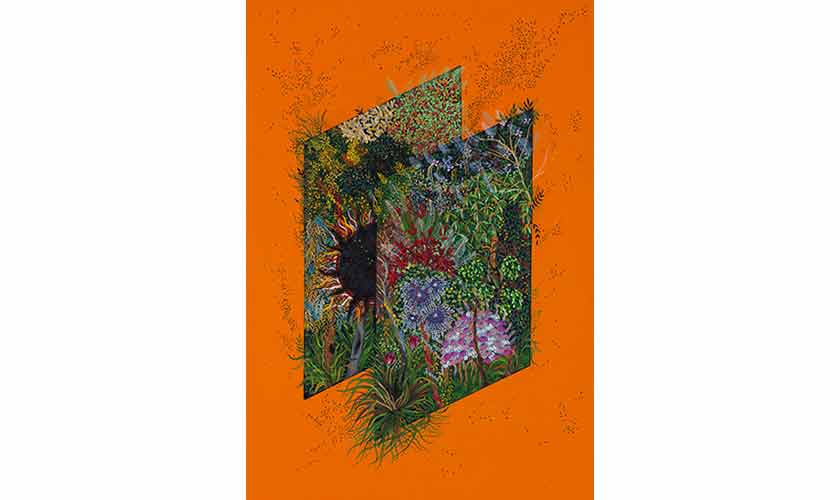
Wardha Shabbir’s sculpture is displayed at the Arsenale, one of the two principal venues of the Venice Biennale. Her paintings are being shown at the Giardini, the Biennale’s second site. The five works on paper are constructed through complex layers of foliage, occasionally accentuated by dark passages. Branches of Becoming, for instance, is composed of 10 A4 sheets strategically joined through a narrative structured around a dark converging stripe, derived from the artist’s journeys mapped and saved on Google Maps on her phone. These geometric passages contain different varieties of foliage, their sharp edges serving as meeting points between sheets of multiple hues. Towards the left of the composition appears a mysterious dark circular form that could be read either as a decayed sunflower or as the mapping of a black hole.
Shabbir’s training in the traditional practice of miniature painting has enabled her to transform the reality around her into a profound and imaginative realm. It is a desirable world that appears to await humanity after death, paradise as described in sacred texts, or perhaps a regenerated form of life emerging after an environmental catastrophe on a planetary scale, as imagined by scientists. Her miniature-based paintings, however, offer glimpses of the former possibility: a flourishing habitation crowded with leaves, flowers and stems of every kind, intermingled with droplets of water and rain. This ideal landscape is animated by clusters of tiny flies dispersed across the composition.
Flies, those irritating yet unavoidable creatures of tropical regions, have remained central to Shabbir’s work to such an extent that the recurring motif has become, to borrow Henry James’s phrase, “the figure in the carpet.” They were also present in Shabbir’s solo exhibition at Rohtas 2, where the artist filled sections of the gallery walls with delicately rendered flies because, for her, their incessant noise complemented the visual atmosphere of the exhibition.
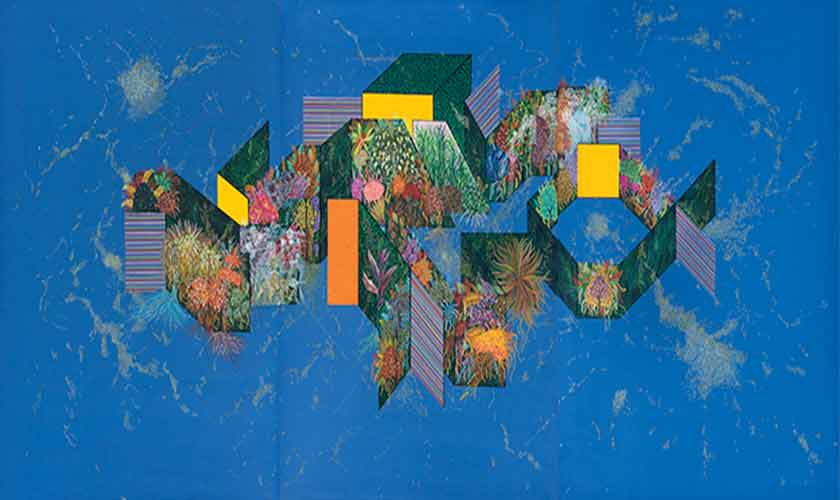
Wardha Shabbir’s paintings at the Venice Biennale demonstrate her meticulous study of plants and human organs, alongside a highly sophisticated chromatic sensibility. The surfaces of all five paintings, Branches of Becoming, Return to Source, A Tapestry of Resilience, Symphony of Silence and The Veil, reveal how the artist conceives of a tree beside a shrub, a flowering plant next to a climbing vine, a budding stem winding around a trunk and resilient cacti emerging amid lush jungle growth to evoke an ideal space inhabited by infinite flora.
This vision becomes especially apparent when one observes, as a landscape painter might, the thousands of shades of green contained within a small stretch of land: dark and light, muted and luminous, bright and deep, and countless variations in between.
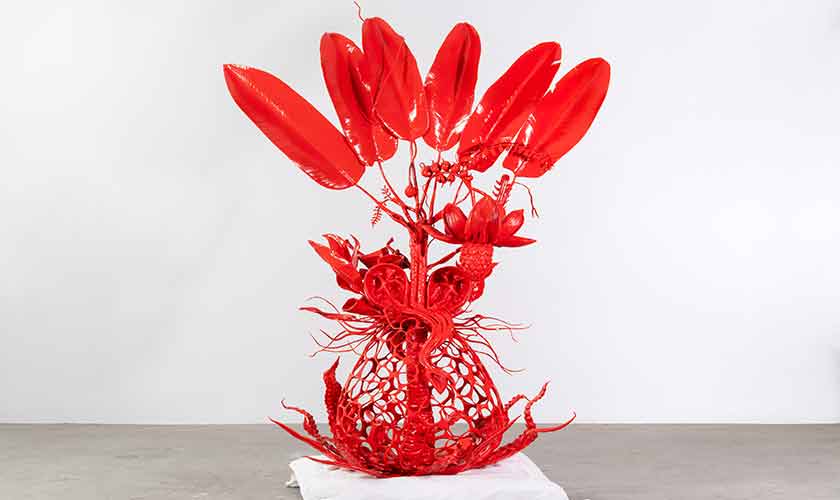
For Wardha Shabbir, this world is not merely a landscape but a symbol of survival, of the individual as well as of the human species as a whole. Her six-foot-high bronze sculpture, A Home is Where My Leaves Are, displayed at the Arsenale of the Venice Biennale, suggests the possibility of perseverance through the collection and fusion of essential elements from living beings, much like DNA preserved beyond the temporal world in the event of an insurmountable catastrophe. She combines human organs, such as spinal cords and bones, that are resistant to decay with plants capable of surviving harsh conditions and enduring long periods without water. Shabbir incorporates flora from across continents to emphasise the fundamental survival instinct. Certain plants, including species from the Amazon and aquatic varieties, continue to thrive because of their ability to reproduce independently.
A Home is Where My Leaves Are is coated in a blazing red pigment that evokes the blood coursing through a living body. The sculpture’s central motif resembles a spinal stem partially veiled by a bulbous form suggestive of an organic membrane. The upper section is composed of plant stumps that resemble blood vessels or fragments of flesh. Shabbir undertook extensive research into the origins of plants while creating this work, resulting in a hybrid form that exists between the human and botanical realms. Crowned with banana leaves and projecting human ears, the sculpture represents a fusion of what we are, what we consume and what will ultimately consume us. Through this work, Shabbir appears to have imagined an eternal refuge for humanity in Venice and beyond.
The writer is a visual artist, an art critic, a curator and a professor at the School of Visual Arts and Design, Beaconhouse National University, Lahore. He can be contacted at [email protected].