Print Story
X




Field Marshal Syed Asim Munir’s Tehran visit revives hopes of a US-Iran peace deal

| O |
n February 28, the United States and Israel launched coordinated military strikes against Iran, initiating one of the most consequential armed conflicts in the Middle East. Sustained bombardment throughout March and into early May inflicted devastating losses on Iran, including the killing of its supreme leader, Ali Khamenei.
However, contrary to the expectations of Israeli and American war planners, the Iranian state did not collapse. It devised a strategy of decentralised command in terms of devolving operational authority to the unit level. It retaliated with waves of missiles and drones targeting US military bases across the Gulf while effectively blockading the Strait of Hormuz.
Pakistan, sharing a long border with Iran and deeply embedded in the Gulf’s political economy, found itself at the epicentre of the crisis. The compulsions driving Islamabad’s engagement with the combatants were strategic, economic and geopolitical. Pakistan had recently signed a mutual defence agreement with Saudi Arabia, obligating it to provide military support in the event of foreign aggression against the Kingdom. This commitment became a powerful restraining factor; Iran exercised a degree of caution in targeting Saudi installations, resulting in comparatively fewer attacks on Saudi Arabia than on the United Arab Emirates. Had the conflict go on, there would have been increasing pressure on Pakistan to honour its alliance obligations.
The economic dimension was equally pressing. The Persian Gulf region accounts for more than 20 percent of global LNG, crude oil and fertiliser exports. Sustained disruption sent petroleum prices in Pakistan soaring past Rs 400 per liter, placing severe strain on ordinary citizens. The consequences extended well beyond Pakistan. Regional economies from Egypt to India felt the pinch of rising energy costs. Even American consumers faced inflationary pressures. There was no mistaking the fact that a prolonged war in the Gulf would exact costs on all parties; the international community had a shared interest in its swift resolution.
By late March, the conflict had acquired a distinctly regional character. Houthi forces in Yemen had intensified strikes on commercial shipping lanes; Iraqi militia factions aligned with Tehran were targeting US forward operating bases in Syria and Iraq; and the GCC states found themselves navigating an increasingly untenable position between their American security guarantors and the Iranian war machine. The war, in other words, was no longer a bilateral confrontation but a systemic disruption threatening to engulf the entire Gulf region in a wide conflagration.
It was against this deteriorating strategic landscape that Pakistan recognised an opening for diplomatic intervention. Pakistan and Iran share a long border and have maintained broadly cordial bilateral relations. The two states have never fought a war against each other. Meanwhile, Pakistan’s ties with the Trump administration, cultivated through consistent high-level engagement on the Gaza peace plan, had conferred upon Islamabad a degree of credibility in Washington. This gave Pakistan a diplomatic space of considerable strategic value.
Mediation by Pakistan assumed a tangible character with the Islamabad Talks of April 11-12, convened against an acutely volatile strategic backdrop. President Trump had by then set several deadlines for Iran to accept American terms. He had also threatened to destroy Iranian energy infrastructure should no agreement be reached. In this coercive context, Pakistan brokered a two-week ceasefire on April 8. The conditional ceasefire, subsequently extended, was accompanied by a 10-point Iranian proposal that the US described as a workable basis for negotiation. Though the Islamabad Talks did not produce a final settlement, they established the normative framework and diplomatic momentum for subsequent rounds of engagement.

Despite maximalist opening positions, both sides have shown signs of pragmatic recalibration. The US seemed to have softened its demands for unconditional Iranian capitulation and demonstrated flexibility on the sequencing of sanctions relief. Iran signalled a willingness to accept phased nuclear assurances in exchange for sanctions relief and the release of frozen assets estimated at over $100 billion.
In addition, Pakistan convened a regional gathering on March 29, bringing together the Foreign Ministers of Saudi Arabia, Egypt, Turkey and Pakistan to deliberate on de-escalation measures.
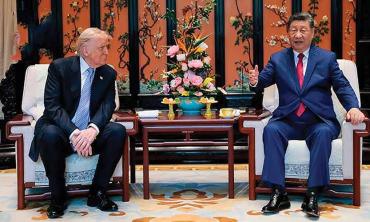
Prime Minister Shahbaz Sharif’s visit to China added a critical multilateral dimension to this mediatory endeavour. As a major strategic partner of Tehran, Beijing is uniquely positioned to encourage Iranian flexibility at the negotiating table. President Trump’s recent visit to China — during which he urged President Xi Jinping to press Iran toward a settlement — reflected Washington’s recognition that Chinese leverage over Tehran could prove decisive.
The negotiations since the ceasefire have been characterised by fundamentally divergent positions. The US demanded the unconditional reopening of the Strait of Hormuz; verifiable constraints on Iran’s nuclear programme; and a cessation of its ballistic missile development. President Trump grew increasingly impatient with the pace of diplomacy, variously describing Iranian responses as “totally unacceptable” and threatening to resume military operations. Iran, for its part, insisted that a full ceasefire — encompassing the lifting of the US naval blockade and the removal of sanctions on oil exports — was an essential precondition for substantive talks. It also said its missile programme was a non-negotiable instrument of sovereign deterrence.
Despite the maximalist opening positions, both sides have shown signs of pragmatic recalibration. The US seems to have softened its demands for unconditional Iranian capitulation and demonstrated flexibility on the sequencing of sanctions relief. Iran has signalled a willingness to accept phased nuclear assurances in exchange for sanctions relief and the release of frozen assets estimated at over $100 billion. President Trump has since announced that a deal has been “largely negotiated” and will be formalised shortly. The reopening of the Strait of Hormuz is a central pillar of the emerging framework.
Ultimately, both the United States and Iran must demonstrate the political will to transcend their maximalist positions and identify common ground necessary to transform a fragile ceasefire into a durable peace settlement. The contours of an emerging Memorandum of Understandin offer a qualified basis for cautious optimism. The proposed framework is envisaged to unfold in stages — formally ending the war, resolving the Strait of Hormuz crisis and opening a 30-day negotiation window for broader agreement on sustained peace. Draft proposals call for Iran to commit to surrendering its stockpile of highly enriched uranium, retain the ability to freely sell oil; the US is to lift its blockade on Iranian ports and waive select sanctions on Iranian oil. Tehran has cautioned that significant disagreements persist — particularly over the Strait of Hormuz, the nuclear programme and the situation in Lebanon. It says that so far it has not accepted any concrete obligations on the nuclear front. It says the agreement provisionally allocates 30 days for Hormuz-related talks and 60 days for nuclear negotiations.

Beyond the US and Iran, critics have repeatedly warned that Israel’s acquiescence remains a decisive and uncertain variable. Tel Aviv is reportedly seeking to obstruct any agreement. Continued intransigence from any quarter risks reigniting a conflict humanitarian, economic and geopolitical consequences of which can be deeply destabilising for the entire region. Pakistan’s mediatory role in navigating this adversarial divide merits unequivocal recognition.
Enduring regional stability can, however, not be achieved, unless the Palestinian question is simultaneously and earnestly addressed.
The writer has a PhD in political science from Heidelberg University and post-doc research experience at the University of California, Berkeley. He is a DAAD and Fulbright fellow and an associate professor. He can be reached at [email protected].