Print Story
X

When we talk about cricket, we are normally talking about a numbers game. Metrics like who scored how much, runs needed per over, wickets taken, and boundaries hit often matter most during crunch moments, especially in the ODI and T20 formats of the game.
However, in these number-crunching moments that are crucial in deciding the fate of a match, situations sometimes occur where the true ‘spirit of the game’ comes into sharp focus.
THE COST OF THE WICKET:
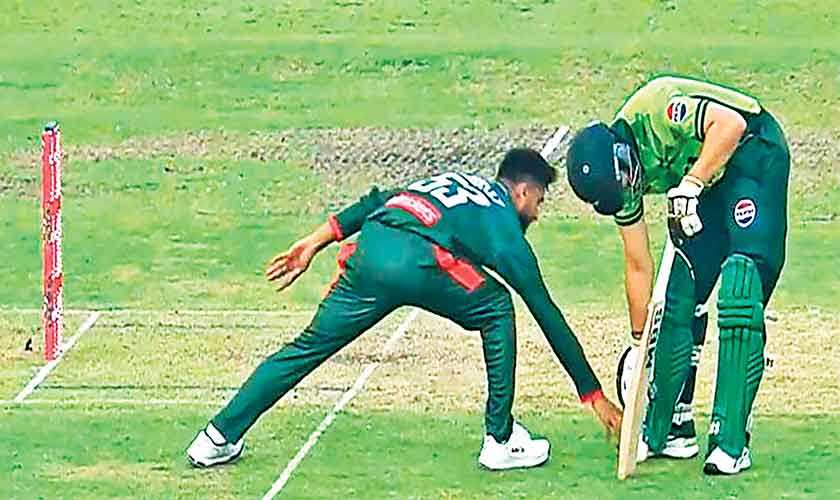
Such a moment arose during the final stages of the recently concluded ODI series between Pakistan and Bangladesh. Pakistan captain Salman Agha was in full flow and for a moment it looked like he was going to take the match away from the opponents. However, at a score of 64 he lost his wicket, not through bad play but because of his gentlemanly intention of picking the ball up for the Bangladeshi bowler Mehidy Hasan Miraz while completing a straightforward run. His only mistake was that he committed this act just outside the crease. The bowler seized the opportunity, picking up the ball before Agha could react and throwing it at the stumps, thus catching the batsman out of his ground. Though technically he ran the batsman out, fair and square, one must ask: at what cost? The unsporting act by Miraz provoked an emotional and somewhat ungentlemanly response by Agha, who showed his frustration by throwing his gloves and helmet to the ground and got reprimanded for breaching the code of conduct. So while the unsporting act by Miraz proved to be a game changer for the Bangladeshis, it was a blemish on what the game of cricket traditionally stands for - a gentleman’s sport. In a way it brought the game into disrepute, reminding us that winning matches is not everything. There are certain human norms and values which transcend the scoreboard, even if that means losing a match.
THE VICTORIAN
DIVIDE GENTLEMEN VS PLAYERS:
The latest episode involving the runout controversy once again underscores the issues related to the increasingly unsporting behavior of players in a game whose roots are deeply entrenched in the spirit of sportsmanship and fair play - an attitude that historically went far beyond personal ambitions or match winning considerations. Looking back with a bit of nostalgia, this gentleman’s approach, sometimes considered too idealistic in today’s win-at-all-costs environment, can be traced back to the Victorian era. Around the 19th century cricket began as a contest between the ‘Gentlemen’ and the ‘Players’. The ‘Gentlemen’ in the Victorian era were the wealthy, aristocratic amateurs, who played the game for leisure. Because their livelihoods did not depend on winning, they were expected to play purely for the love of the sport, embodying ‘fair play’ and ‘sportsmanship’. On the other hand, the ‘Players’ were mostly working-class professionals who were paid to play. For them, winning meant everything. As their livelihoods depended on it, this objective led to a more aggressive and at times ruthless style of play. For decades, this segregation continued in Victorian England and particularly at Lord’s in London, traditionally regarded as the headquarters of Cricket. So much so that, during annual tournaments held at Lord’s between the Gentlemen and the Players, both teams used different locker rooms and made separate gate entries into the ground. Eventually, the upper class ‘gentlemen’ label stuck and Cricket came to be known as the ‘gentlemen sport’ with its spirit taking precedence over everything. This noble mindset in Cricket got further ingrained into British culture by Elite British public schools (like Eton and Harrow) who used cricket to mold young boys into stoic, honorable, and disciplined gentlemen.
ICONIC MOMENTS
OF FAIR PLAY:
Fast-forward from those Victorian days to the present, we have many iconic examples in Cricket which resonate the true essence and spirit of the game. Prominent examples in modern times include:
1987 World Cup group match at the Gaddafi Stadium in Lahore: Particularly, in the context of Salman Agha’s unsporting runout, another example with similar circumstances but a starkly contrasting display of sportsmanship was witnessed in the 1987 World Cup match between Pakistan and the West Indies. In this tense match, Pakistan needed just two runs off the last ball to win. The victor would advance to the semi-finals, highlighting the immense stakes. West Indies fast bowler Courtney Walsh ran in to bowl the final delivery of the match when he noticed the non-striker, Saleem Jaffar, backing up, way out of his crease. Instead of just throwing the ball at the stumps and running Jaffer out, Walsh stopped during his run-up, warned Saleem Jaffer with a smile, and walked back to start a new runup. Consequently, West Indies lost the match and Pakistan went through to the semi-finals. This remains as one of the greatest examples of a player living up to the true spirit of the game.
The 2003 World Cup Semi-Final (Australia vs. Sri Lanka): Australian wicket-keeper Adam Gilchrist edged the ball, but the umpire ruled him not out. Despite the umpire’s decision, Gilchrist tucked his bat under his arm and walked off anyway, thus showcasing the ultimate act of sportsmanship.
PAKISTAN VS INDIA (LAHORE DECEMBER 1989):
Pakistan cricket has also had many such iconic moments where our players have demonstrated exemplary gentlemanly traits. One such phenomenal example, showcasing the highest level of sportsmanship, occurred during an ODI when Waqar Younis was bowling at full throttle against the Indian captain Kris Srikkanth. Umpire Khizer Hayat gave Srikanth out LBW. The Indian captain gestured that the ball had touched the bat. In the absence of the DRS in those days, and no third umpire to appeal to, he started walking dejectedly towards the pavilion. Realizing that there was indeed an inside edge, the Pakistan captain Imran Khan withdrew the appeal against the batsman and Srikkanth was asked to return to the batting crease (he got out the very next ball, but that’s another story). This gesture by the Pakistan captain showcased exemplary fairness and sportsmanship, especially considering that there was no DRS or Third Umpire option in those days and that the roaring Gaddafi Stadium crowd was all screaming for the wicket. In short, fairness and sportsmanship reigned supreme on that day.
Cricket is traditionally labeled as a gentleman’s game. But with fierce international rivalries and intense pressure to win at all costs, it is becoming exceedingly difficult to maintain the high standards of fairness and sportsmanship which once were the very soul of cricket. However, players such as Imran Khan, Adam Gilchrist, and Courtney Walsh have shown that despite extreme modern-day pressures and rivalries, it is still possible to stay steadfast in sticking to the values of integrity, sportsmanship, and fair play, which are the hallmarks of this gentlemanly game.