Print Story
X




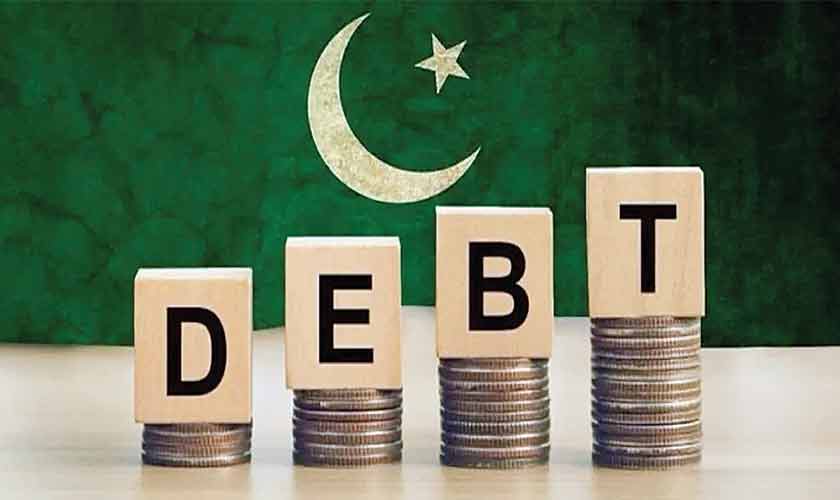
The country’s total debt is now equal to 80 percent of everything we produce in a year
| E |
very Pakistani carries a share of the country’s debt - more than Rs 300,000. The newborn child clearly did nothing to deserve this. None of us, for that matter, signed for it by hand. Yet the bill is real, and it belongs to every one of us.
This is the heart of Pakistan’s debt story. You do not need an economics degree to understand it. You only need to picture a single household.
Imagine a family that earns Rs 100,000 a month but spends Rs 130,000. Every month it falls short by Rs 30,000. It borrows to cover the gap. The next month the same thing happens, except that now there is last month’s loan to repay as well. Slowly the family starts borrowing not to buy anything new, but simply to pay the interest on what it already owes. This, in plain terms, is where Pakistan as a country has landed.
Let us look at the size of it. Pakistan’s total public debt now stands at around Rs 80 trillion. A number that big loses all meaning, so think of it another way. It is close to 80 percent of everything the entire country produces in a year. Spread across roughly 240 million people, it works out to more than Rs 300,000 owed by every man, woman and child.
The size of the debt is not even the worst part. The real pain is the interest. More than half of all the money the government collects in a year now goes straight to paying interest on old loans. Out of every 100 rupees that comes in, more than 50 leave before a single school is built, a single nurse is paid or a single road is repaired. The money is spoken for before the work can even begin.
How did we get here? Not overnight, and not because of any single person or any single government. This burden built up slowly across decades, under leaders of every party and every stripe.
The root cause is simple. Year after year, the country has spent more than it earns. One big reason is that very few Pakistanis actually pay direct taxes. The government never collects enough to cover its bills. To fill the gap, it borrows. Once you are borrowing every year, you fall into the same trap as that imaginary family: borrowing fresh money just to pay the interest on the old money. That is the cycle Pakistan is now fighting to break.
It helps to know who we actually owe, because the debt comes in two kinds.
The first is domestic debt. This is money borrowed inside the country, mostly from local banks and from the savings of ordinary Pakistanis. The second, and the more worrying kind, is external debt, which is money borrowed from abroad. Pakistan’s foreign debt is now more than $130 billion.
The root cause is simple. Year after year, the country has spent more than it earns. One big reason is that very few Pakistanis actually pay direct taxes.
Why is the foreign debt the scarier one? Because it must be paid back in dollars, not rupees. Pakistan cannot simply print dollars. It can only earn them, mainly by selling goods abroad and through the money our workers overseas send home. When those dollars run short, the country struggles to pay on time, and that is when you hear that frightening word: default. To avoid that Pakistan once again leans on an IMF programme. This brings in emergency dollars but also strict rules on how the country must handle its money.
Now connect all of this to your own life, because the debt is not some distant thing happening far away. It reaches right into your kitchen.
At this point it is easy to feel hopeless. Please do not. Debt is a serious illness, but it is not a death sentence. Pakistan is far from the only country that has ever faced it.
The way out is not magic. It is the same plain, boring wisdom that rescues any struggling household, only applied to a whole nation. Three things must happen together.
First, the country must earn more and it must earn more dollars. That means selling far more to the world, and not only cotton and rice, but software, services and the work of our millions of online freelancers. Every extra dollar we earn is a dollar we do not have to borrow.
Second, the burden must be shared fairly. No country can stand when only a handful of people carry the entire tax load. If more of those who can clearly afford to pay actually did so, the government could finally meet its own bills and stop reaching for the loan book every year.
Third, the country must spend with discipline and keep inflation under control. When prices are stable, interest rates come down. When interest rates come down, those crushing interest payments shrink. That alone can free up enormous sums for schools and hospitals.
The question before Pakistan now is a simple and very human one. Do we have the courage, and the discipline, to slowly reduce our debt burden?
The writer is a chartered accountant and a business analyst.