Print Story
X




The federal allocation for education has reached a nominal high. Inflation, composition and classroom reach will determine its real value
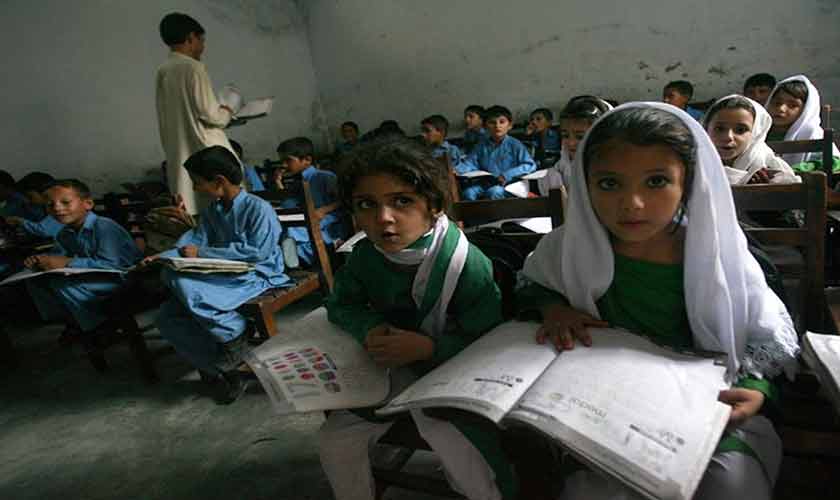
Pakistan’s education crisis is no longer only about children being out of school. It is also about children spending years in school without learning enough. The World Bank estimates that around 78 percent of the children of primary school age in Pakistan are not proficient in reading. Federal and provincial governments have acknowledged this challenge and prioritised foundational learning in their education policies. The question now is whether public financing is beginning to follow that policy commitment.
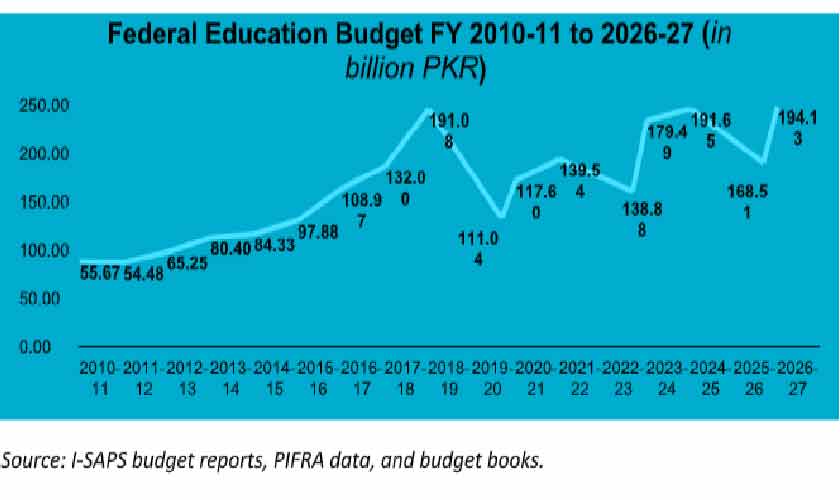
At Rs 194.13 billion, the 2026-2027 federal education allocation, is the first useful test. After falling by 12 percent to Rs 168.51 billion in 2025-2026, it is the highest nominal federal education budget since 2010-2011. The share of education in the federal budget has increased marginally from 0.7 percent to 0.8 percent. That recovery is real.
The harder question is what it finances.
Beneath the headline figure is a shift in composition that matters as much as the increase itself. The recurrent allocation, which sustains salaries, operating costs and the routine functioning of schools and institutions, has grown by 4.5 percent to Rs 117.75 billion. The development allocation has grown by 37 percent to Rs 76.38 billion. Around 80 percent of the nominal increase comes from the development side.
The real value of this increase depends on inflation. The Pakistan Economic Survey reports average CPI inflation of 6.2 percent during July to April 2026. The Pakistan Bureau of Statistics reports 10.9 percent year-on-year inflation in April 2026 and 11.7 percent in May. A 10 percent inflation adjustment is, therefore, a cautious working assumption, reflecting both the lower July to April average and the more recent double digit monthly readings. On that basis, the total allocation records only a modest real increase. In real terms, the recurrent allocation has declined by nearly 5 percent.
Within the recurrent side of the functional classification, the school education picture merits closer reading. Spending on primary education has grown from Rs 5.841 billion to Rs 6.275 billion, a nominal 7.4 percent that at 10 percent inflation translates into a real decline of 2.3 percent. Allocation for secondary education has grown from Rs 14.420 billion to Rs 16.015 billion, a nominal 11.1 percent and a real increase of barely 1 percent. Together, allocations for primary and secondary allocations have grown from Rs 20.261 billion to Rs 22.290 billion, a nominal growth of 10 percent—effectively flat in real terms.
Given the federal government’s foundational learning commitments, a primary allocation that declines in real terms carries more than fiscal significance. It is a signal that budget alignment has not caught up with policy ambition.
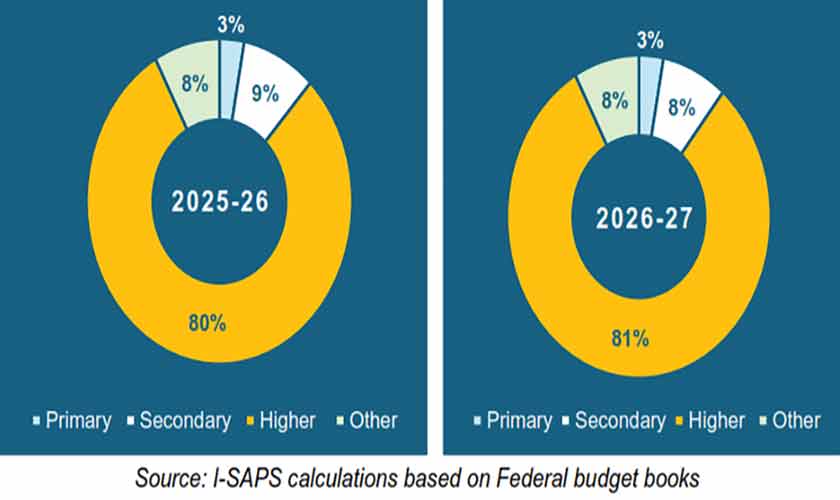
The Higher Education Commission’s recurrent allocation stands at Rs 66.43 billion, almost unchanged from last year. At 10 percent inflation, a nominally flat grant translates into a real decline of 9 percent in its operating resources. Functionally, higher education accounts for 81 percent of the total allocation; secondary education for 8 percent; and primary education for 3 percent. At the development level, 94 percent goes to higher education, leaving a small residue for other education-related functions.
These are federal figures. Since provincial governments carry most of Pakistan’s public education spending, the fuller story will emerge only when provincial budgets are read alongside.
More than half of the Rs 28.411 billion development envelope of the Federal Education and Professional Training Division—Rs 14.8 billion—is earmarked for the Prime Minister’s Daanish Schools programme.
In this context, the development allocation’s largest commitment to school education carries particular significance. More than half of the Federal Education and Professional Training Division’s Rs 28.411 billion development envelope—Rs 14.8 billion—is earmarked for the Prime Minister’s Daanish Schools programme. Under the current budget, new residential schools are to be built in Azad Jammu and Kashmir, Balochistan, Gilgit-Baltistan and Khyber Pakhtunkhwa. What this initiative represents matters as much as what it costs. For years, direct federal financing of school education beyond its own institutions remained limited. The Daanish Schools programme marks a meaningful shift, directing federal development resources toward Pakistan’s most underserved education territories. The principle of federal co-financing to reinforce underserved education systems is sound and deserves to be developed further.
The question, however, is one of reach. These residential schools will serve a limited number of students. Comparable allocations channelled through a performance-linked grant supporting structured teaching and teacher coaching across thousands of existing primary schools could reach far more children. The next step is developing this commitment into instruments designed to reach millions.
The development increase also carries a sustainability question, especially because the recurrent allocation is already declining in real terms. Development allocations create operating commitments that recurrent budgets must eventually carry, including staffing, maintenance, utilities, management and student support. If recurrent allocations are not keeping pace even before these new commitments mature, today’s capital investment can become tomorrow’s operating pressure.
Closing the learning gap Pakistan faces is not unprecedented. Kenya’s structured teaching reforms improved literacy outcomes across public schools. Brazil’s Ceara state linked transfers to verified learning progress, not inputs, sustained gains over time. Vietnam consistently outperforms comparable economies on learning assessments, supported by sustained attention to curriculum quality and teacher support. The common thread is not aggregate spending. It is protected learning priority, school level resources and accountability for results. That is the budget logic this evidence points toward.
The Global Education Evidence Advisory Panel’s 2023 review of over 550 evaluations from more than 13,000 studies identifies the same high-return interventions, including structured teaching, regular coaching and grouping children by learning level rather than grade. Some have been documented at costs below $10 per child per year. The National Achievement Test, showing only 49 percent of Grade 4 students reaching minimum mathematics benchmarks in 2024, confirms the domestic urgency. The case for these investments is not external to Pakistan. It is written in our own data.
Targeted investment, anchored in accountability for results rather than inputs, is what converts a larger budget into better outcomes. Pakistan’s governments have made the policy commitments. The federal education budget has grown. The test now is whether that growth reaches the ordinary classroom, where Pakistan’s learning crisis will either be solved or reproduced.
The writer is affiliated with the Institute of Social and Policy Sciences (I-SAPS). He can be reached at [email protected].