Print Story
X




Ancient tombstones offer a glimpse into the rich cultural heritage of one of Gujar Khan’s oldest villages
| J |
attal is one of the oldest villages in Rawalpindi’s Gujar Khan tehsil. It is among the few villages in the tehsil known mostly for its cultural heritage. It is located about four kilometres northwest of Sukho Mor. I recently visited this village. My hosts were Raja Abdul Qadeer Janjua, the lumberdar, and his son Raja Khawar Qadeer Janjua. The village is noted for the historic houses of Janjua Jattal Rajputs and Sasral Rajputs. Despite large-scale migration and transformation of the village, a few ancient houses have survived, reflecting its glorious past. The village is noted not only for its historical houses but also for ponds (locally called ban), wells, mosques, shrines and tombstones.
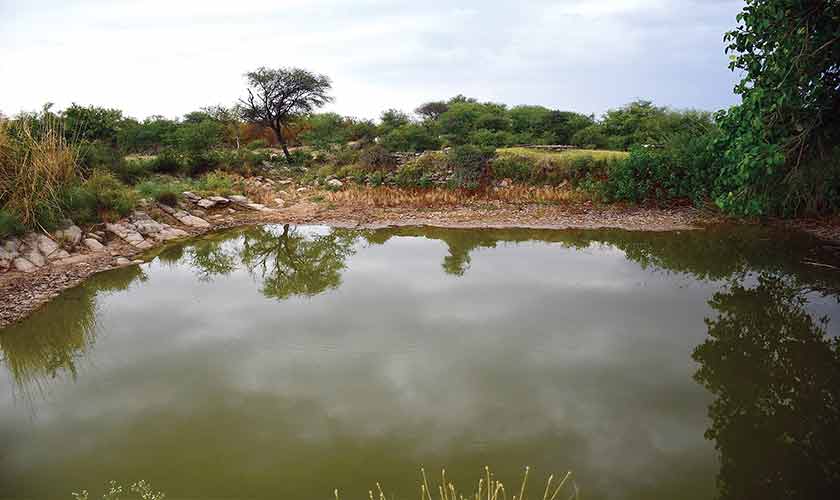
Wells and ponds (bans) are important features of the village’s cultural landscape. These were dug due to perennial water scarcity in the village. One of the earliest wells is located adjacent to the house of lumbersdar Raja Abdul Qadeer Janjua, who says, it was dug in 1920. Lumberdar Raja Mirza Khan Janjua, a notable of the village, donated land for it. The well was meant to benefit the villagers. After his death, Raja Roshan Ali Janjua took over the responsibility to maintain the well. When Raja Roshan Ali Janjua grew old, his son, Raja Haji Muhammad Nazir Janjua, was entrusted with maintaining the well and renovated the well. This well has been in operation since 1920. It is now maintained by Lumberdar Raja Abdul Qadeer Janjua.
There are four ponds in the village: Malkan Wali Ban, Mochian Wali Ban, Upri Ban, and Sar. Sar is one of the largest. The construction of wells and ponds has long been considered a form of charity. Some of the wealthiest in the villages would undertake the excavation of wells for villagers to draw water from. Planting trees in the village was also considered an act of charity, as they provided shade for those who fetched water from the wells and bathed in the ponds. A beautiful banyan tree, planted over Mochian Wali Ban, has survived. The Mochian Wali Ban is located in the picturesque village of Jattal. A few stone slabs lie beneath the banyan tree, one of which is engraved with a Barma game board, a traditional game played in the village.
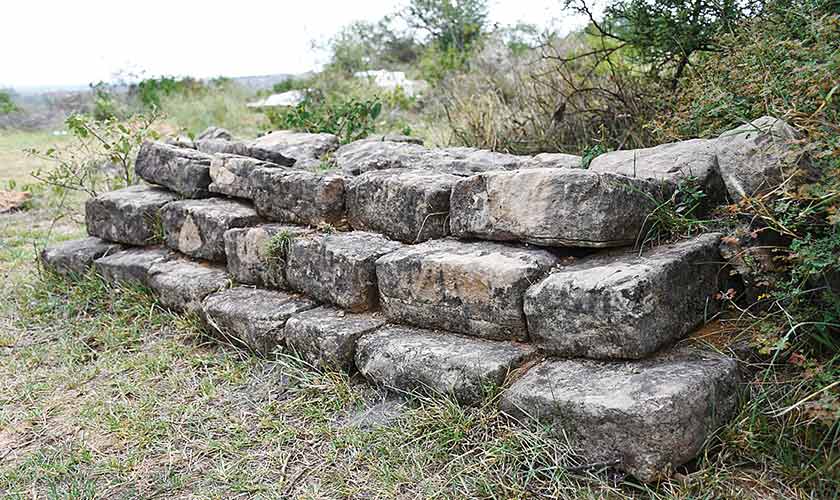
To the south of the ban is Musalla for offering prayers, constructed using stones. To the east of the Mochian Wali Ban is the historic cemetery of Jattal village, where Janjua Jattal Rajputs, Sasral Rajputs and local dignitaries of some other castes are interred. Some of the old graves are constructed of grey sandstone quarried from a nearby nullah. The distinctive feature of these stone graves is the tombstones at the northern and southern ends. These tombstones bear the names of the deceased and carry floral and geometric patterns. Jattal is one of the few villages in the Gujar Khan tehsil that has such old tombstones with intricate carvings. Most of the stone graves are in deplorable disrepair. The earliest tombstones date back to the first and second quarters of the 19th Century. Those constructed before the 19th Century have disappeared. The local sandstone is not very durable; it may last for a few centuries before beginning to disintegrate. Imported stone has also been used in a few graves located to the south of the cemetery. That area is locally called Goron Wala Las. Local legend has it that the interred dignitaries died in an encounter with the British.
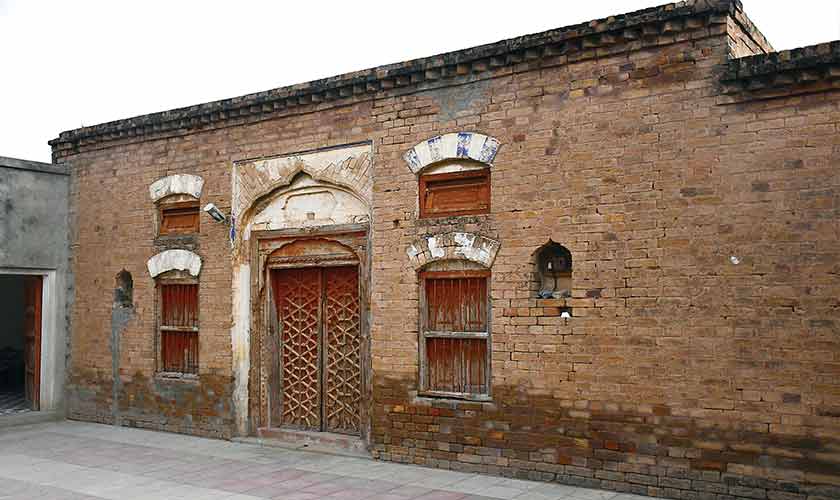
Apart from wells, ponds and tombstones, Jattal village has many houses built before 1947 that are noted for their distinctive woodwork and ornamentation. These houses are famous for their wooden doors, windows and ceilings. I visited several houses known for their wooden doors. The house of Sultan Ali Sasral Rajput was built a century ago and has an intricate wooden door. Likewise, the house of Thanedar Fazl Hussain is also distinguished for its wooden doors, windows and ceiling. The doors and ceiling of this house stand out. Thanedar Fazl Hussain was a notable member of the Sasral Rajputs clan in Jattal village. He had three sons, Muhammad Anwar, Javed Iqbal and Ahmad Hussain. I met Ahmad Hussain and interviewed him about the historic houses of Jattal village. During a conversation with him, I learnt ed that most of the houses were built by the Mistri community of Jattal village. Prominent masters among them were Sultan Mahmood, Alam Din, Khuda Bakhsh and Ahmad Ji. Ahmad Ji was skilled in the construction of mosque minarets and domes. He also built several houses in the village. Ahmad Hussain told me that Ahmad Ji also had built his house. It is noted for its wooden ceiling and doors. The house has some of the most intricate woodwork in Jattal village. The door leading to the main hall is also carved with geometric designs.
Despite these changes, a few historic houses have survived, with their wooden doors still intact, offering a glimpse into the glorious past of Jattal village.
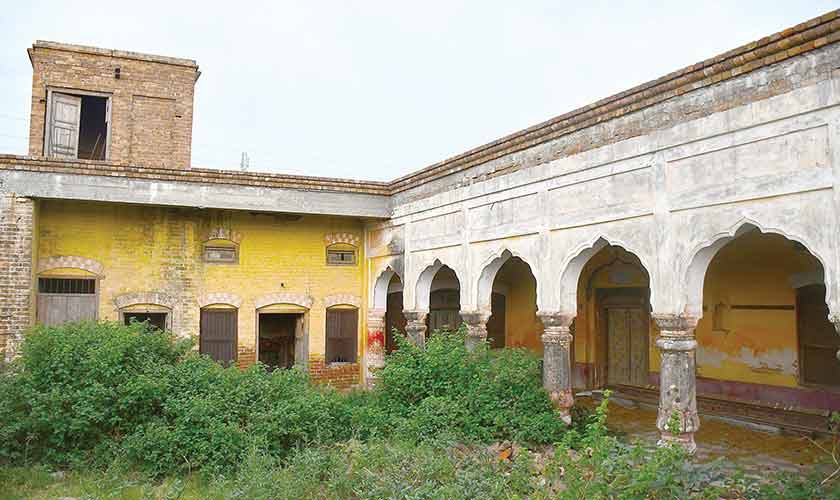
One of the most impressive and magnificent mansions of the Sasral Rajputs in the village was that of Raja Abdur Rehman. It was built in 1939. According to Aamir Zaman, a notable of Jattal village, Noor Bakhsh, son of Karmatullah, was a patwari. He had four sons-Muhammad Ji, Muhammad Hafeez, Muhammad Akbar and Abdur Rehman. Three brothers - Muhammad Hafeez, Muhammad Akbar and Abdur Rehman - built the house together. The younger son of Noor Bakhsh, Abdur Rehman, was a DSP in the Punjab Police. He retired in 1953.
The mansion is one of the most imposing structures in Jattal village. It has six rooms, each with an impressive wooden ceiling and doors. One does not find such refined craftsmanship in any other house in Jattal except for the houses of Lumberdar Abdul Rasheed Janjua and Raja Amir Akbar Janjua. The Abdur Rehman mansion is noted for its intricate wood carvings. The door leading to the mansion’s main hall is exquisitely carved. These carvings reflect the mastery of local artisans.
According to Aamir Zaman, Allah Ditta, the famous mason from Sakrila village, near Jajja, built this house.
The house of Lumberdar Abdul Rasheed Janjua is another splendid structure noted for its carved wooden door. Gheba Khan, the grandfather of the lumberdar, constructed this house. One does not find such an exquisitely carved door in the entire village or in the neighbouring villages. I have seen such ornately carved doors only at the mosques in the Fim Kassar, Ranjha and Chawli villages in Chakwal district. The door in the house of Lumberdar Abdul Rasheed Janjua is carved with geometric and floral designs. It also features stylised trees, a motif rarely seen on any other carved-wood door in the Gujar Khan tehsil. The floral scroll, which begins at the bottom and runs over the entire frame of the door, is remarkably carved.
The rosettes carved on the arches of the upper section of the door are magnificently executed, making the door a fabulous work of art and reflecting the mastery of the woodcarvers of Jattal village.
According to Lumberdar Abdul Rasheed Janjua, the father or grandfather of Mistri Ahmed Ji built the house and carved all the doors. Ahmad Ji was a master mason who died in 2006.
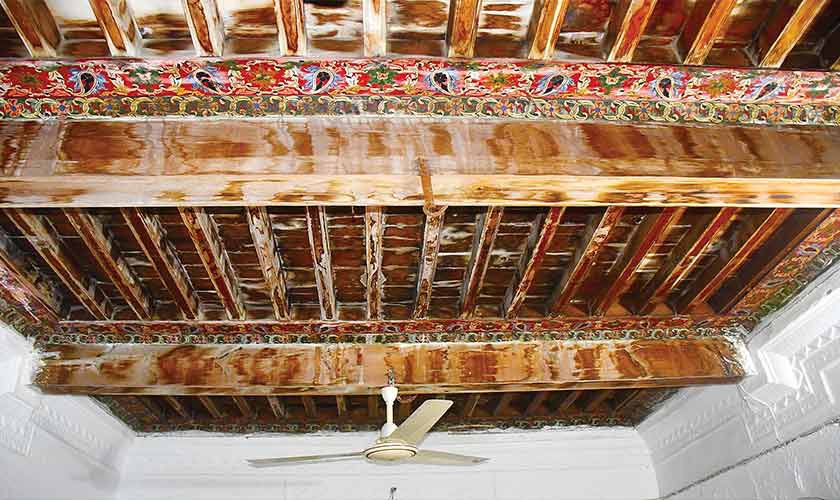
Raja Amir Akbar Janjua, another notable of Jattal village, told me that Mistri Ahmad Ji also constructed his house. The house of Raja Amir Akbar is noted for its ornately carved door, painted wooden ceiling and stucco work. A similarly painted wooden ceiling was is to be found in the Jamia Masjid of Jattal, which was rebuilt in 1970 by Mistri Ahmad ji. The mosque was one of the earliest built in the village. It has been renovated and rebuilt several times. According to Mahmood Sultan of Jattal, Ahmad Ji and his relative, Faqir Muhammad of Manghote village in Gujar Khan, had carved and painted the mosque ceiling. The ceiling was lost when the mosque was demolished in 1970. The mosque had also featured beautifully crafted wooden doors that were removed during its reconstruction. An inscription in Urdu on one of the verandah walls notes that Maulvi Abdus Sattar Chishti Sabiri Kalyami observed i’tekaf (spiritual retreat) at the mosque.
Maulvi Abdus Sattar Chishti Sabiri Kalyami (d. 1941) was a deputy of Khawaja Fazluddin Shah Chishti Sabiri (d. 1891), who was a deputy of Khawaja Hafiz Muhammad Sharif Khan Chishti Sabiri. The shrines of both Khawaja Fazluddin Shah Chishti Sabiri and his spiritual mentor are located at Kalyam Sharif.
Maulvi Abdus Sattar had a large following in Jattal village. One of his disciples gifted him 80 kanals of land, locally called Sain Wali Tarot.
Apart from wells, ponds, historic houses, mosques and historic tombstones, the village hosts three shrines. At the centre of the village is located a baithak of Pir Sohawa. Nothing is known about him but the baithak is greatly revered.
There was a Sikh household named after Bhagwan Singh in the pre-Partition Jattal. He had a shop in Jattal village. His sister Lali Kaur’s house was behind Lumberdar Abdul Rasheed’s house. Bhagwan Singh left Jattal after the 1947 Partition.
The historic mosques, houses, tombs, wells and ponds are part of Jattal’s identity. Modernisation and migration have significantly transformed the village. Some of the people who migrated from the village decades ago have returned with a lot of money and are changing the socio-economic landscape; leading to the construction of new houses, shops and other structures. Despite these changes, a few historic houses have survived, with their wooden doors still intact.
The writer, an anthropologist, is an associate professor at the Pakistan Institute of Development Economics, Islamabad. He has authored 18 books on Pakistan’s cultural heritage and anthropology. He tweets @kalhorozulfiqar. He may be contacted at [email protected]