Print Story
X




The shrine of Pir Syed Ameer Shah near Jatli is home to one of the most remarkable contemporary mosques in the Potohar region
| R |
ising above the surrounding countryside near Jatli, the shrine complex of Pir Syed Ameer Shah is one of the most important centres of the Naqshbandiyya order in the Gujar Khan tehsil. The complex comprises a mosque, wells, a hujra and the tomb of Pir Syed Ameer Shah. During a recent visit, I spoke with Pir Syed Anwar-ul Haq Shah, the shrine’s custodian, about the former’s life and legacy, as well as the history of the mosque and the mausoleum.
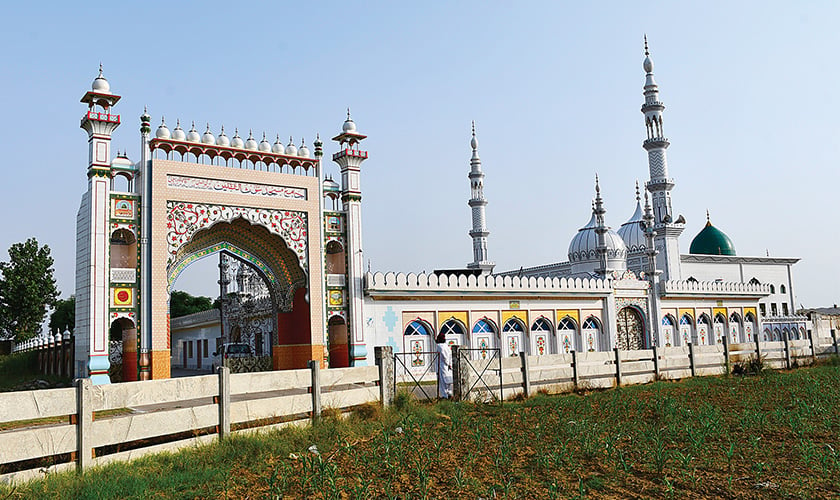
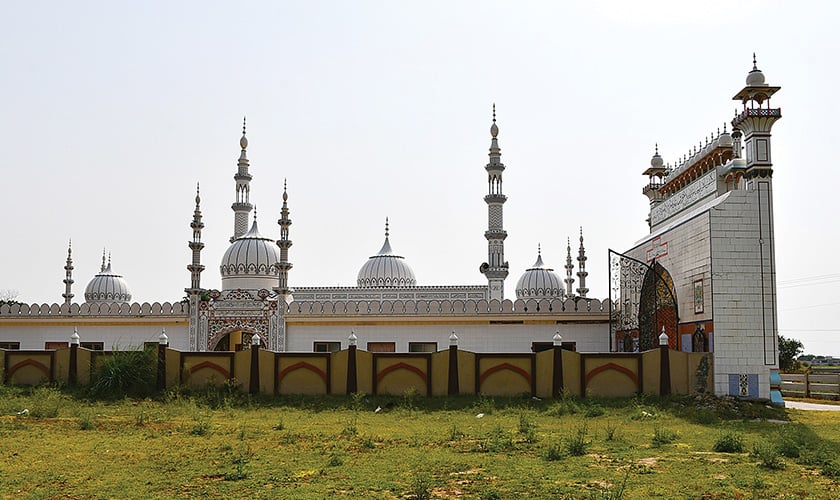
Seen from a distance, the mosque’s minarets and domes dominate the landscape. Richly decorated with glasswork, tiles, paintings and calligraphy, it is among the most striking contemporary religious buildings in the Rawalpindi district, distinguished further by its recently constructed domed entrances.
According to Pir Syed Anwar-ul Haq Shah, Pir Syed Ameer Shah, who later founded the khanqah at Ameerabad, was born in 1936 in Jabalpur, India, where his father, Syed Akbar Shah, served in the British Army. The family hailed from Tatral Kahoon, a village about 7 kilometres east of Choa Saidan Shah town. Pir Syed Ameer Shah was still young when his father died.
Known for his piety and devotion, he became a deputy of Zinda Pir Sahib (1912-1999), whose shrine is located at Ghamkol Sharif in Kohat. Zinda Pir Sahib was a deputy of Khwaja Muhammad Qasim Moharvi (d 1942), linking Pir Syed Ameer Shah to a distinguished spiritual lineage.
At the request of his followers, Pir Syed Ameer Shah settled near Jatli at Sohawa in 1983 and established a khanqah. The settlement subsequently became known as Ameerabad. According to local accounts, Mai Ghulam Bi, donated the land on which the khanqah was built. She was the mother of Subedar Mushtaq Hayal Rajput and Subedar Mumtaz Hayal Rajput.
Astana Aliya Naqshbandiyya Ameerabad, as it is locally known, is distinguished by-its impressive mosque and mausoleum. The mosque is among the most remarkable examples of contemporary religious architecture in the Gujar Khan tehsil, noted for both its design and decorative artistry. Despite migration and the gradual decline of traditional building crafts, a small number of members of the Mistri community continue to preserve the skills inherited from earlier generations. The mosque at Ameerabad stands as a testament to the enduring craftsmanship of the Pothohari Mistris, reflecting a building tradition passed down through generations. The foundation stone of the mosque was laid by Pir Syed Ameer Shah in 2006.
Several eminent masons from across the region were consulted and later engaged in its construction. Among them was Haji Ghulam Hasan of Raika Maira village, one of the most respected master builders in the Rawalpindi district, who was then residing in Dhoke Syedan, Rawalpindi. Because of his advanced age, Haji Ghulam Hasan was unable to undertake the project himself. Instead, he entrusted the work to his most accomplished pupil, Thakedar Abdul Latif of Kohinoor Mills, Chakwal, while continuing to supervise the construction and ensure that it adhered to his vision and exacting standards.
Thakedar Abdul Latif began construction of the mosque in 2006. Drawing on the guidance of Haji Ghulam Hasan and the rich architectural traditions of the Potohar plateau, he played a central role in shaping the building into a notable example of local craftsmanship. Haji Ghulam Hasan, associated with the project, regularly inspects the work. Several other skilled masons also contributed to the project, particularly the decorative work that adorns the mosque’s walls.
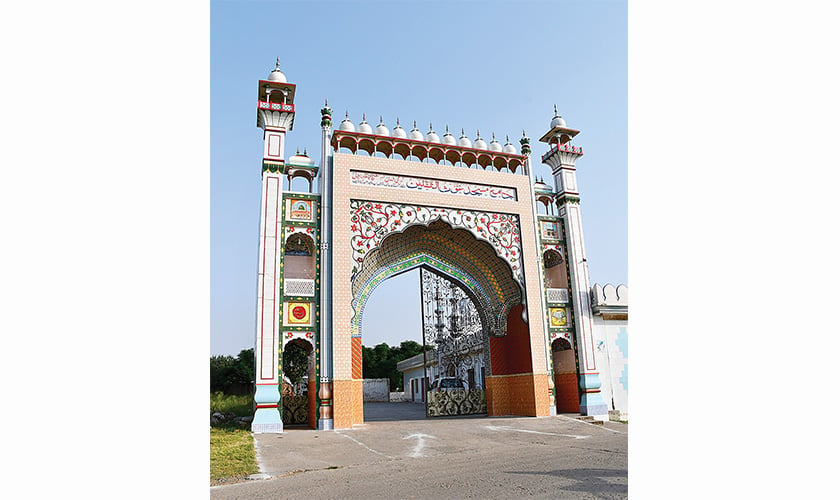
The Jamia Mosjid Ghaus-ul Saqlain at Ameerabad is a striking example of contemporary Islamic architecture, blending local Pothohari building traditions with influences drawn from some of Punjab’s most celebrated religious monuments. During an interview, Pir Syed Anwar-ul Haq Shah explained that he wanted the mosque’s entrance gateway to reflect the grandeur of Lahore’s Badshahi Masjid. To realise this ambition, he commissioned local craftsmen to study the historic structure in detail.
Seen from a distance, the mosque’s minarets and domes dominate the landscape. Richly decorated with glasswork, tiles, paintings and calligraphy, it is among the most striking contemporary religious buildings in the Rawalpindi district.
Among them was Muhammad Tanveer Ijaz, who recalled his first visit to the Badshahi Masjid in an interview. Confronted by the scale and intricacy of its monumental gateway, he initially found it difficult to imagine how such a design could be adapted for Ameerabad. Undeterred, however, he spent several days examining the mosque’s portico, photographing and filming its architectural features and discussing possible adaptations with Pir Syed Anwar-ul Haq Shah. Those observations would later play a significant role in shaping one of the most distinctive elements of the Ameerabad mosque.
After several visits to Lahore and a close study of the Badshahi Masjid’s architectural details, Muhammad Tanveer Ijaz returned to Ameerabad determined to translate that vision into a local context. With the exception of the stairways, he succeeded in recreating a gateway that closely echoes the design and proportions of the celebrated Mughal monument. A native of Bhagwal village in Chakwal district, Ijaz is widely recognised for his expertise in mosque construction, particularly the design and execution of domes and minarets.
At the direction of Pir Syed Anwar-ul Haq Shah, he also visited the Jamia Masjid at Chawli and the shrine of Khwaja Ameer Ahmad Basalvi to study their architectural features. Elements drawn from both structures were subsequently incorporated into the design of the Ameerabad mosque, creating a distinctive blend of regional influences. The mausoleum of Khwaja Ameer Ahmad Basalvi was constructed by the renowned master builder Haji Ghulam Hasan. Khwaja Ameer Ahmad Basalvi (d. 1939), whose shrine is located in Basal village near Jand, was a disciple of Khwaja Ahmad Mairvi (d. 1911). He was initiated into the Chishti order by Khwaja Allah Bakhsh Taunsvi.
Visitors enter the Jamia Masjid at Ameerabad through a monumental portico whose soaring arch and balanced proportions recall the grandeur of Lahore’s Badshahi Masjid. The gateway serves not merely as an entrance but also as a statement of architectural ambition, reflecting the craftsmen’s determination to adapt one of the subcontinent’s most celebrated architectural forms to a contemporary religious complex in rural Potohar.
Beyond the monumental gateway, a second entrance opens onto the mosque’s spacious courtyard, at the centre of which stands a fountain embellished with geometric star motifs. The marble-paved courtyard forms the heart of the complex and is approached through three principal entrances. The eastern portal, crowned by a dome, serves as the main approach. It is distinguished by an intricately painted ceiling. Similar paintings adorn the domed ceilings of the other two portals, the work of an artist brought from Multan specifically for the project.

The southern portico also opens onto the courtyard. The northern portico leads to the ablutions area. The painted domes are particularly noteworthy, as decorative painting of this kind is rarely found in contemporary mosques in the Jatli region. Encircling the courtyard is an elegant arcaded passageway whose arches are enriched with floral scrollwork enclosing the word Allah, blending calligraphy with ornament in a manner characteristic of Islamic artistic tradition.
The mosque is a two-storey structure distinguished by its richly tiled façade and carefully balanced design. Rising from the northern and southern walls are two elegant minarets, both constructed by Muhammad Tanveer Ijaz, whose craftsmanship is evident throughout the complex. He also built the smaller domed minarets that flank the entranceways, contributing to the building’s harmonious skyline. Three arched doorways open onto a covered verandah that leads into the main prayer hall beneath a large central dome.
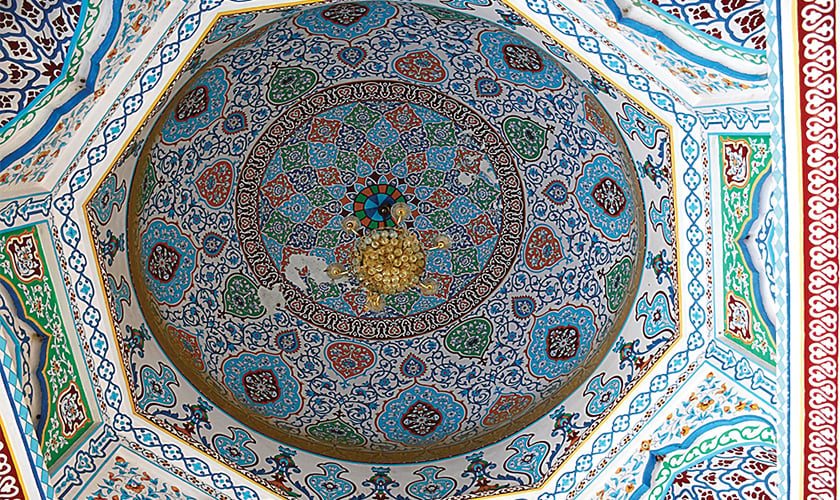
The interior is lavishly ornamented with glasswork and tile-work. The dome’s ceiling is embellished with painted glass panels. Its soffit is decorated with stylised floral vases. Around the lower section of the dome, the names of Allah and the Holy Prophet Muhammad (peace be upon him) are inscribed, combining calligraphy with decorative ornament. The mosque’s glasswork was executed by Mistri Muhammad Shabbir of Gheela Kalan village near Chakri in Rawalpindi district. Widely regarded as one of the region’s finest artisans, Shabbir was renowned for his intricate glasswork in mosques and shrines across the Rawalpindi district. His contribution added another layer of craftsmanship to one of the area’s most remarkable contemporary religious monuments.
The tile-work was executed by Mistri Haji Aftab and his brother Muhammad Ramazan. They are both widely respected for their craftsmanship across the Rawalpindi district. The brothers hail from Harniawala village, near Dhadambar. Another notable contributor was Muhammad Siddiq of Gheela Kalan, a celebrated painter whose work can be found in numerous mosques throughout Rawalpindi and Chakwal districts.
The mihrab of the Jamia Masjid Ghaus us-Saqlain is particularly striking. It is adorned with intricate tile-work featuring the names of the Panjtan Pak. Quranic verses embellish the walls of the prayer hall, adding to the mosque’s rich decoration. The paintings, glasswork and tile-work testify not only to the skill of the artisans involved but also to the vision of Pir Syed Anwar-ul Haq Shah. Deeply invested in the project, he closely supervised the work and travelled extensively across the Potohar region, particularly in Rawalpindi district, studying mosques to draw inspiration from their designs, motifs and architectural features, many of which were subsequently adapted for the mosque at Ameerabad.
Behind the mosque stands the tomb of Pir Syed Ameer Shah, where decorative work is still under way. One of the region’s most respected Naqshbandi elders, Pir Syed Ameer Shah, was widely known for his piety and spiritual influence. He died in April 2021, leaving behind four sons — Pir Mahmood Hasnain Shah, Pir Tassadduq Hussain Shah, Pir Syed Anwar-ul Haq Shah and Pir Sibtain Mahmood Shah — as well as two daughters.
Muhammad Tanveer Ijaz and his brother were also responsible for constructing the tomb of Pir Syed Ameer Shah. Built on a square plan, the mausoleum is crowned by a hemispherical dome. Four smaller domes rise from the corners of the parapet, creating an elegant five-dome composition. The structure features four entrances. Each of its sides is punctuated by six windows, giving the tomb a total of twenty-four openings. It is among the most impressive mausoleums in the Gujar Khan tehsil, where tombs of this scale and design are rare.
The northern exterior wall is further embellished with decorative tiles depicting stylised floral vases, a motif that echoes the ornamental programme of the adjacent mosque. Beside the tomb stand the wells and the hujra associated with Pir Syed Ameer Shah, completing the shrine complex.
The writer is an associate professor and anthropologist at the Pakistan Institute of Development Economics, Islamabad. He has authored 18 books on Pakistan’s cultural heritage and anthropology. He tweets @kalhorozulfiqar.He may be contacted at [email protected]