Print Story
X




Mohsin says, this honour belongs to every unnoticed athlete fighting for recognition in Pakistan. I want young Pakistani athletes to believe that no dream is impossible
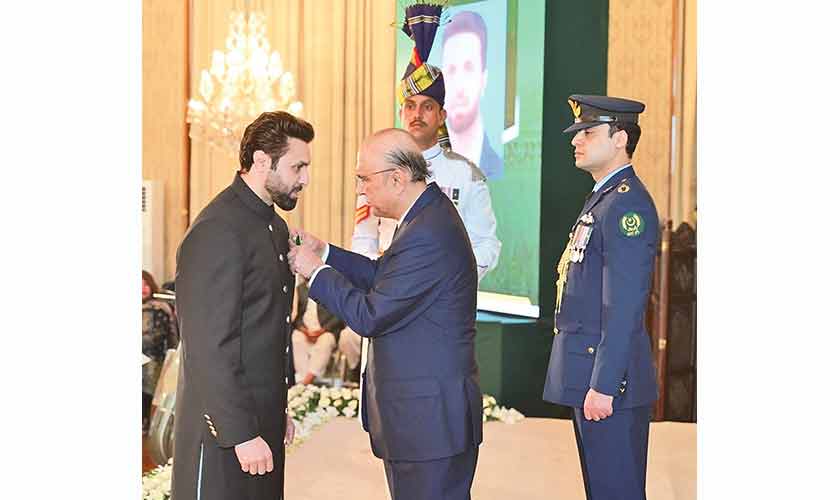
Pakistan’s sporting history has largely revolved around cricket, hockey and squash. Athletes competing in lesser-known disciplines have often spent years fighting not only international opponents, but also neglect, financial hardship and institutional indifference at home. That is why the moment Mohsin Nawaz received the Tamgha-e-Imtiaz in Islamabad this week carried significance far beyond an individual achievement.
For the first time in Pakistan’s history, a shooting sports athlete has been awarded one of the country’s highest civilian honours. It was more than a medal ceremony. It was recognition for an entire sport that has remained invisible despite producing international-standard talent.
The award was conferred by Asif Ali Zardari during the Presidential Awards ceremony in Islamabad, officially placing Pakistan shooting sports into the national conversation for perhaps the first time.
For Mohsin Nawaz, however, this recognition did not arrive through privilege or institutional backing. It came after years of persistence in a discipline where Pakistani athletes have traditionally struggled to even find a platform.
Born in Faisalabad in 1986, Mohsin began his competitive journey at the Pakistan Ordnance Factory shooting club in Wah in 2004. At a time when Pakistan offered little infrastructure for precision shooting, he pursued the sport through self-discipline, private sponsorships and personal investment. Unlike athletes in mainstream sports, shooters in Pakistan often have to finance their own international campaigns, arrange overseas coaching independently and import expensive equipment under difficult conditions.
Yet despite those barriers, Mohsin Nawaz steadily transformed himself into Pakistan’s most successful F-Class long-range shooter. Today, he holds 10 international individual medals, the highest tally achieved by any Pakistani athlete in the discipline. His achievements across Europe, South Africa and the United States have established Pakistan as a respected emerging nation in long-range shooting competitions.
Among his most notable performances were a silver medal at the 2019 CIHPRS Shooting Championship in Indianapolis, multiple medals at the prestigious 68th Western Bisley Long Range Championship in 2022, and a silver medal at the European Long Range Shooting Championship in 2023 where he equaled a European record.
His rise has not been accidental. Mohsin’s career reflects a level of professionalism rarely seen in Pakistan’s individual sports athletes. Beyond shooting, he is also a certified sports psychologist, sports nutritionist and emotional wellness coach, qualifications that underline his scientific and disciplined approach toward elite competition.
Internationally, he has become one of Pakistan’s most respected sporting ambassadors. He serves as a global brand ambassador for Austria-based KAHLES Sports Optics and South Africa’s Peregrine Bullets, while also becoming the first Pakistani to secure lifetime memberships with both the NRA UK and NRA USA. But perhaps the most important aspect of Mohsin Nawaz’s success is that it has changed perceptions.
For decades, shooting sports in Pakistan were viewed as a niche activity with limited competitive relevance. Mohsin’s international medals, record-breaking performances and now the Tamgha-e-Imtiaz have challenged that mindset completely. His recognition has effectively proven that Pakistani athletes can excel globally even in highly technical and specialized disciplines, provided they receive opportunities and support.
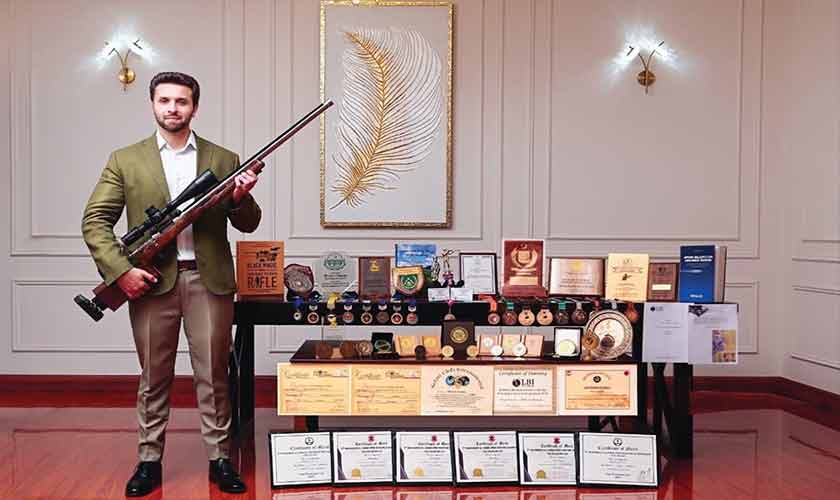
Speaking after receiving the honour, Mohsin described the award as a historic breakthrough not only for himself but for future generations of athletes. He acknowledged the prayers and sacrifices of his parents and expressed hope that this moment would open doors for young Pakistani competitors who continue to perform without recognition. That sentiment reflects the deeper reality of his journey.
Unlike athletes from countries with structured shooting programs, Mohsin spent years building his career with limited domestic facilities and minimal governmental attention. Even now, he continues advocating for reforms in Pakistan’s sports infrastructure.
He has repeatedly called for reduced import duties on specialized sporting equipment, arguing that excessive customs taxes make competitive shooting financially impossible for many talented youngsters. He has also emphasized the urgent need for accessible shooting ranges in major cities, insisting that Pakistan possesses abundant raw talent but lacks development systems. His concerns are valid.
In many countries, precision shooting is treated as a structured high-performance sport supported through academies, national federations and scientific training programs. Pakistan, by comparison, remains at a developmental stage despite its growing talent pool. That is why the role of the Pakistan Long Range Rifle Association has become increasingly significant.
Mohsin Nawaz openly credited the Patron-in-Chief of the PLRA, Syed Asim Munir, for helping establish the institutional platform that allowed Pakistani shooters to compete internationally. According to Mohsin, Pakistan previously lacked a formally recognized structure for long-range rifle shooting. Without federation recognition or affiliation with international governing bodies, athletes had no official route to represent Pakistan abroad.
The PLRA’s affiliation with the International Confederation of Full-bore Rifle Associations changed that reality. It enabled Pakistani shooters to compete internationally under the national flag and gain recognition within the global shooting community. The impact has been immediate.
Pakistan now possesses international medal winners, national records are regularly being broken, and for the first time a shooting athlete has received the Tamgha-e-Imtiaz. These developments indicate that the sport is finally moving beyond obscurity.
Mohsin himself continues to push new boundaries. In 2025, he set national records during the 3rd F-Class National Long Range Shooting Championship in Jhelum, once again reinforcing his status as Pakistan’s premier shooter. He has also joined Hawksmith Gun & Shooting Club DHA Karachi as a brand ambassador, supporting efforts to develop world-class tactical and precision shooting facilities in Pakistan.
Importantly, Mohsin’s ambitions extend beyond personal achievements. He is currently preparing for the 2026 F-Class World Championship in the United Kingdom while training under 2023 world champion Hermann Rolfes in South Africa. But even while competing at the highest level, he continues speaking about the next generation.
His long-term objective, he says, is to create pathways for young Pakistani shooters who might otherwise never discover their potential. That may ultimately become his greatest contribution. Pakistan has produced countless talented athletes whose careers disappeared because systems failed them. Mohsin Nawaz’s story is different because he refused to allow those limitations to define his journey.
His Tamgha-e-Imtiaz is therefore not simply a personal honour. It represents recognition for persistence, professionalism and a sport that fought for relevance in a country where mainstream attention rarely extends beyond cricket.
The challenge now is whether Pakistan can build on this moment.
If institutions, sponsors and policymakers genuinely wish to diversify Pakistan’s sporting culture, then shooting sports deserves sustained investment, modern facilities and structured talent development. Mohsin Nawaz has already proven that Pakistani athletes can compete with the world’s best. The responsibility now lies with the system to ensure he does not remain the exception.