Print Story
X




Colonial and post-colonial knowledge formations have historically reduced the Punjab to simplistic categories such as ‘agrarian’ and ‘martial’
| T |
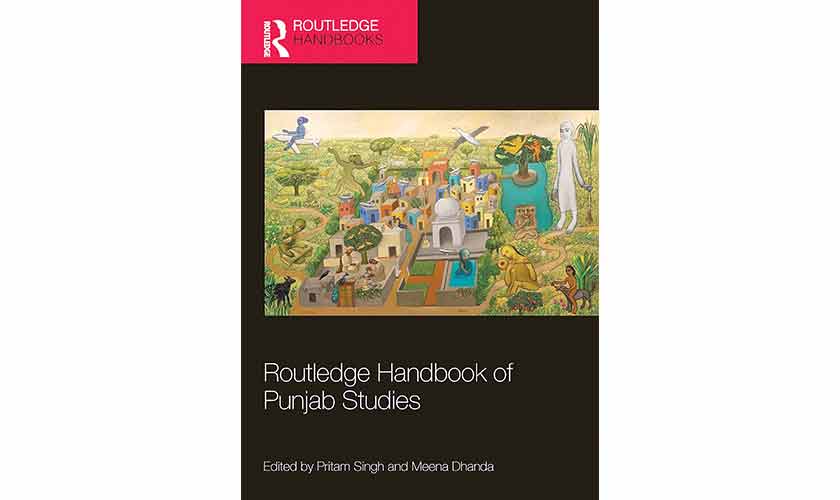
he Routledge Handbook of Punjab Studies (2026) is of great historical significance in the interdisciplinary field. Forty-eight scholars from Canada, Europe, India, Pakistan, Singapore, the United Kingdom and the United States have tried to capture the multi-dimensionality of the concept of the Punjab as a knowledge project that encompasses all forms of historical and socio-economic transformations, political agendas, cultural products and Diaspora experiences that define the Punjab across time and space.
The handbook is divided into six thematic sections (partition, economic development, political movements, cultural expression, religion, social hierarchies and diaspora). Despite the limitations of such a gigantic project in overcoming disciplinary fragmentation to arrive at a holistic and critical understanding of the region, it is a remarkable success. The editors have compiled articles rooted in specific disciplines but engaging with one another on shared platforms such as identity, power, ecology and memory. Given the intersectional nature of the project, the chapters in each section are linked to the themes covered in the other parts.
The preface and introduction effectively contextualise the handbook’s intellectual interests. The intellectual orientation of the editors - Pritam Singh and Meena Dhanda - reflects a consciously interventionist and theoretically grounded project that seeks to reconfigure the epistemological foundations of Punjab studies. Anchored in Marxist political economy, anti-caste critique and eco-socialist thought, their framework moves beyond descriptive regional scholarship toward a normatively charged, critical inquiry into structures of inequality and power. They explicitly challenge methodological nationalism and disciplinary fragmentation by foregrounding the interconnectedness of class, caste, gender, ecology and identity within historical and global processes. This synthesis is not merely analytical but also programmatic, as it advances an alternative vision that contests neoliberal developmentalism, centralised state power and sectarian politics.
By mobilising the concept of Punjabiyat as a plural, shared cultural ethos, the editors attempt to destabilise religion-based and statist narratives that fragment the region, instead emphasising a historically embedded yet dynamic collective consciousness. In doing so, they position their work as a transformative scholarly intervention that bridges academic inquiry with political and ethical commitment to social justice and sustainability.
At an analytical level, the editors critique both colonial and post-colonial knowledge formations that have reduced the Punjab to simplistic categories such as “agrarian” or “martial,” thereby obscuring its complex socio-cultural and intellectual traditions. Their argument underscores the persistence of historical ruptures—colonialism, partition and post-colonial restructuring. It simultaneously highlights the continuity of a fluid Punjabiyat that transcends political boundaries. However, they avoid romanticising this cultural unity by critically acknowledging its internal fractures along lines of religion, caste, class and gender that both colonial epistemologies and contemporary political economies have intensified. Their insistence on an interdisciplinary and intersectional methodology responds to the inadequacy of older analytical frameworks in addressing emergent challenges such as ecological degradation, Diaspora transformations and uneven development.
Furthermore, by advocating a trans-national and collaborative research agenda—exemplified by initiatives such as the Punjab Research Group—they reconceptualise the Punjab as a global, Diaspora formation embedded within capitalism, migration and climate change. Their position calls for a democratised, critically engaged field of Punjab studies that integrates marginalised voices and aligns scholarly production with the pursuit of more equitable and sustainable futures.
The first part of the book - Punjab, Partition and Beyond - covers the partition and its aftermath. Departing from the usual studies on partition, the first chapter (on ecology) is an attempt by the editors to demonstrate their overarching perspective in situating Punjab studies within the growing global scholarly awareness regarding the need to embed ecology in current social science research.
Anchored in Marxist political economy, anti-caste critique and eco-socialist thought, the writers’ framework moves beyond descriptive regional scholarship toward a normatively charged, critical inquiry into structures of inequality and power. It challenges methodological nationalism and disciplinary fragmentation by foregrounding the interconnectedness of class, caste, gender, ecology and identity.
This first part intertwines macro-studies - state formation and political ideology - with micro-historical studies. The use of personal accounts and oral histories is especially interesting in that it subverts the supremacy of historical research conducted by elites and offers new avenues for approaching Punjab studies. Although the section focuses on contemporary politics, such as the emergence of Hindutva and the controversial heritage of anti-colonial movements, it also demonstrates the significance of historical research in dealing with modern problems.
The second section - Economic Development: Labour, Resources and Challenges - critically examines the way the Punjab has become a post-colonial site of agrarian economy and ecological crisis. The authors present a spirited critique of the Green Revolution, blaming it for long-term environmental degradation, resource depletion and social imbalances. This section, too, is disproportionately concentrated on Indian Punjab, with only one contribution, albeit a brilliant one, explicitly devoted to Pakistani Punjab.
The third section of the Handbook - Political Contestations and Movements - addresses a wide range of political developments, including communist mobilisation, farmers’ protests, militancy and counter-insurgency. Across these chapters, contributors closely examine the interplay between state power, popular resistance and identity politics. This is particularly evident in their attention to subaltern movements and alternative political imaginaries that challenge mainstream, elite-centred narratives. The discussion of digital media and the memory of the 1984 anti-Sikh violence is especially illuminating. It shows how political engagement is being reshaped in the digital age.
The fourth segment - Cultural Repositioning: Language, Literature and the Arts - is both prolific and diverse. It covers language, literature, cinema and the arts. It illuminates culture as a form of resistance and, importantly, as a negotiation with colonial and post-colonial European ruling systems. The anti-establishment status of language and the preoccupation with the political implications of linguistic identity have allowed Punjabi in Pakistan to develop an anti-establishment linguistic status and identity. Meanwhile, the notion of Dalit literary traditions foregrounds voices that have historically been excluded from Punjabi cultural production. The chapters on cinema and theatre highlight the significance of visual and performance media.
The penultimate portion of the volume - Religion, Caste and Gender - engages with major fields of thought, including feminist theology, caste and gender discrimination; and the intersection of sexuality and culture. Various theoretical approaches to confronting hierarchy within the Punjabi society include feminist theory, post-colonial theory and critical race theory. The focus on caste is a pivotal addition to the current project of Sikh studies aimed at reducing caste-based inequalities.
The last section - Diaspora Dilemmas - takes the Handbook further geographically, examining the experiences of Punjabis in the United Kingdom and beyond. It makes a formidable contribution to global issues in Punjab studies by discussing themes of trans-national identity, multiculturalism and the politics of belonging. The discussion of caste in the diaspora, particularly the replication and reworking of hierarchies in new settings, is especially significant. Equally, the study of queer politics and gender-based violence highlights the inter-relation of identity and power in Diaspora contexts. This section successfully demonstrates how the Punjab is not confined to a territorial location but also exists as a trans-national network of culture and social relations.
The handbook has numerous strengths, albeit with some limitations. There is an imbalance in the coverage of Indian and Pakistani Punjab in some parts of the volume. The editors state in the Introduction that despite their best efforts to secure contributions from West Punjab, the imbalance could not be rectified. This may partly be due to the greater availability of scholarly work on East Punjab. While some contributions are rigorous in their theoretical engagement, others are relatively descriptive. I recommend re-reading the Introduction after all the chapters to gain a more synthetic understanding of the project.
Some areas remain underexplored. The book could have included greater detail on how digital technologies and social media contribute to the construction of Punjabi identities in the contemporary society. Similarly, although the ecological crisis is addressed in several chapters, a more sustained engagement with environmental humanities would have added further depth to the analysis.
Mazhar Abbas, author of The Aftermath of the Bangladesh Liberation War of 1971: Enduring Impact (Routledge, 2024), has a PhD in history from
Shanghai University. He is a lecturer at GCU, Faisalabad, and a research fellow at PIDE, Islamabad. He can be contacted at [email protected]. His X-handle is @MazharGondal87.