Print Story
X




Campaigns by the Women’s Action Forum and Sindhyani Tehreek exemplify organised opposition to state-backed patriarchy
| R |
ecently, incidents of Karo-Kari have been reported from across Sindh. In Tando Masti near Khairpur, a girl, Khalida Rubina Chandio, was shot dead in public. A video of the incident circulated on social media, exposing not only the brutality of the act but also the insensitivity of the society. Instead of intervening to save her life, many people continued recording videos on their phones. Sadly, this was not an isolated incident.
Witnesses typically refuse to intervene. Some of them dismiss the violence as a “personal matter.” It was against this mindset that the feminist movement coined the slogan: “The personal is political.” The phrase highlights how domestic violence and all forms of oppression against women are falsely labeled as private issues. Such violence is deeply political because it is rooted in patriarchy. Restricting women to the four walls of their homes and depriving them of their rights speaks of an organised structure of male domination. Challenging this system, therefore, requires a political struggle.
There has been extensive research on the origins of the Karo-Kari custom in Sindh. According to some historians, the practice began during the Kalhora period and spread during the Talpur era. Formal attempts to abolish it were first undertaken by Governor Charles Napier between 1843 and 1847.
In a letter written to his brother Richard in April 1844, Napier described the horrifying reality: “There is one crime here [in Sindh] which I can hardly bring myself to describe—wife killing! The people here think killing a cat or dog is wrong, but [they see no issue in killing a woman]. I have hanged at least six men for murdering women. Here, even the slightest quarrel may result in a wife being chopped to pieces. Yesterday, a chief came to recommend one of his followers involved in wife murder. I told him I would hang him. He exclaimed in astonishment: ‘What! Hang him? He has only killed his wife!’ His face showed utter surprise.”
To curb this brutal practice, Napier issued a declaration on August 6, 1844: “All Muslim inhabitants of Sindh should know that I am the conqueror of Sindh, but I do not intend to interfere in your religion. I respect your religion, but it is necessary that you also respect mine. We both worship one God, and that God has forbidden us from taking innocent life. Yet you mercilessly kill your wives. I tell you plainly, I will not tolerate this. I am the ruler of this country. If anyone kills his wife here, the matter will be investigated and the guilty will be punished according to their crime. This order must be fully enforced throughout Sindh. No one will be allowed to violate it.”
In response, many influential landlords and tribal elites developed new tactics to evade punishment. They began claiming that the women had died by suicide. Many women killed under this custom were hanged from trees to make their deaths appear as suicides. Napier understood these tactics and reportedly ordered that if any woman committed suicide in a village, the village chief would be held accountable. For some time, such measures reduced the killing of women. However, after Napier’s removal, the crisis resurfaced.
After the creation of Pakistan, women across Sindh and the country continued to be killed, though on a lesser scale. The campaigns by the Women’s Action Forum and Sindhyani Tehreek exemplify organised opposition to state-backed patriarchy.
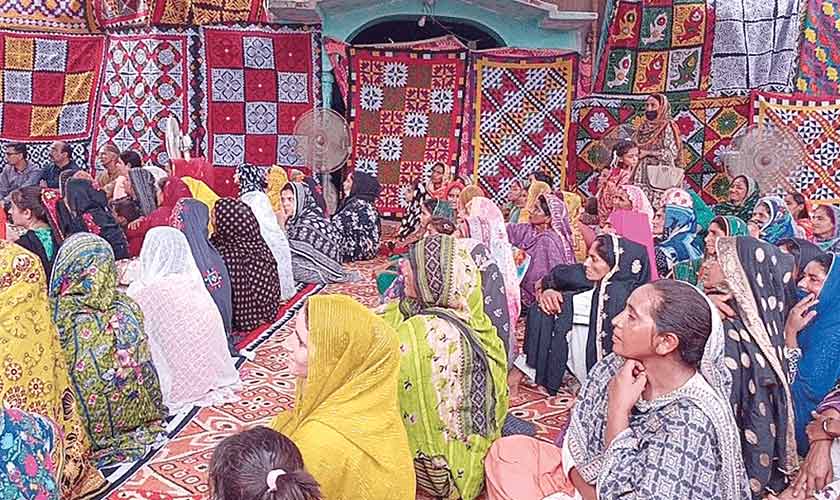
Today, organisations such as Sindhyani Tehreek, Women’s Action Forum and Women’s Democratic Front continue to raise their voices against misogynistic customs, so-called honour killings and sexual harassment. A recent example of this was the participation of WAF and Sindhyani Tehreek activists in the mourning gathering for Khalida Chandio in Tando Masti.
There has been extensive research on the origins of the Karo-Kari custom in Sindh. According to some historians, the practice began during the Kalhora period and spread during the Talpur era. Formal attempts to abolish it were made by Governor Charles Napier between 1843 and 1847.
The families of murdered women are often pressured into pardoning the killers. According to reports and eyewitness accounts, Khalida Chandio was murdered by her maternal uncles. Her mother now faces the unbearable reality that while her daughter has been killed, the accused are her own brothers. In such situations, there is great pressure on the surviving relatives to remain silent.
The responsibility cannot therefore rest solely on the victim’s family. The entire society must take responsibility. Political and social organisations, intellectuals, media, lawyers, teachers and the civil society must wage a sustained struggle against the injustice.
While provincial and federal governments continue making laws aimed at women’s protection, some of the ministers, MNAs and MPAs themselves violate or undermine these laws, strengthening rather than dismantling patriarchal structures.
The scale of violence has become deeply alarming. On Sunday, April 19, while WAF leaders were present at Khalida’s grave, news simultaneously emerged on social media regarding the murder of a mother and daughter from the Jatoi community in Larkana. Around the same time, a girl named Ujala reportedly went missing in Mehar.
Beyond the murders, countless women continue to endure physical and psychological violence within their homes, fighting daily battles for dignity and survival.
The Progressive Thinkers’ Forum organised an online session on April 18 with participants from Pakistan and abroad to discuss the issue. Among the proposed solutions was the promotion of education to combat gender-based violence and Karo-Kari. While education is undoubtedly important, the issue is not merely illiteracy. Violence against women is not committed by uneducated individuals alone. Educated people — including doctors, engineers, professors and university graduates have been involved in crimes against women.
The issue, therefore, is not simply formal education, it is education that develops awareness about gender equality, sexuality, ethics, citizenship and the harm of patriarchy. The gap between boys’ and girls’ education must be eliminated. Governments must show greater seriousness in implementing the women-protection laws.
These measures alone may not establish equality among women, men and transgender people. That ultimately requires a deeper transformation of political, economic and social structures. Until such structural transformation is achieved, it is essential to defend and implement the women-friendly laws.
Political parties, women’s rights organisations, intellectuals, journalists, teachers, youth and other sections of the society must play an active role each in this regard. Only through sustained collective struggle can meaningful and lasting change become possible.
The writer is an assistant professor and chairman of the Department of History and Pakistan Studies at Aror University of Art, Architecture, Design and Heritage, Sukkur. He can be reached at [email protected]