Print Story
X




In 150 of West Bengal’s 294 seats, voter deletions exceeded the eventual winning margins
| I |
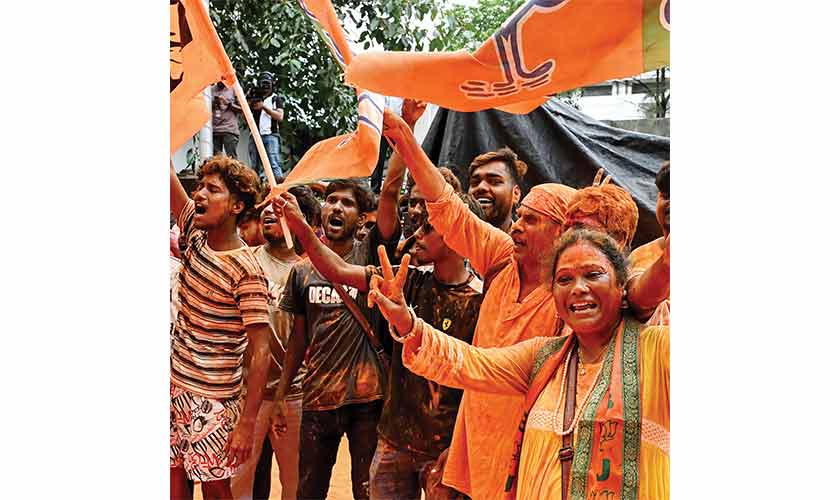
was on a work trip to Bangkok the day votes were counted in India’s recent four-state elections. As we waited to disembark, a man shouted in excited tones: “BJP [the Bharatiya Janata Party] is winning with a massive sweep in West Bengal!” A buzz went through the cabin. Everyone began talking at once, most voices bright with celebration.
An elderly Sardar gentleman, however, said in a tired voice, “For as long as they hold the Centre, no one can beat them.” Protests erupted immediately: things had been so bad in West Bengal; the BJP had lost before, so clearly they did allow others to win. The old man retreated into grumpy silence. Then someone asked about Assam. “They’re already touching 100 — a third sweep, imagine!” I looked around at the cabin — overfed, well-heeled men heading happily to Bangkok. The irony was entirely lost on them.
It is hard to reflect on these results in any more nuanced a way than to recall that moment and that crowd: the debacle of a Congress-led opposition in Assam — again at the hands of former Congressman-turned-BJP operative, Himanta Biswa Sarma; the fall of DMK’s Stalin in Tamil Nadu to the new political entrant Vijay; TMC’s defeat in West Bengal at the hands of former TMC man Suvendu Adhikari. Only Kerala went as expected, falling to Congress at the Left Alliance’s expense.
This is not the moment for conventional election analysis — anti-incumbency, caste arithmetic, gender calculus. Yes, years of BJP’s Hindutva campaign consolidating upper-caste Hindu votes and targeting minorities, particularly Muslims, mattered. This was on open display: in Assam, Chief Minister Himanta railed against Muslims in every speech; in Bengal, Adhikari, Modi and Amit Shah relentlessly accused Mamata Banerjee of appeasing Muslims. However, these elections were decided by something more systematic than rhetoric. The foundation had been laid during Bihar’s state elections the previous year through a mechanism called the Special Intensive Revision — a bureaucratic instrument that declared some 4.6 million voters ineligible on grounds of duplication, migration and other administrative technicalities. The majority were Muslims. Most appeals to restore deleted names went nowhere. The results in Bihar tilted accordingly.
The formula was then scaled up.
In West Bengal, more than 8.3 million voters were deleted — a reduction of nearly 11 percent. Beyond routine deletions, the Election Commission introduced new categories such as “logical discrepancy,” backed by deliberately opaque digital datasets that made independent scrutiny near-impossible. In 150 of the state’s 294 seats, the deletions exceeded the eventual winning margins. The BJP reportedly won 99 of those seats. The deletions were notably concentrated in Muslim-majority areas and TMC-strongholds — border districts like Murshidabad and Malda. TMC challenged these rolls in court; the Supreme Court noted irregularities in certain constituencies but directed the matter to election petition proceedings. One judge reportedly observed that it was a one-time anomaly and voters could simply re-register after the election. Nothing came of it.
Years of BJP’s Hindutva campaign consolidating upper-caste Hindu votes and targeting minorities, particularly Muslims, mattered. It was on open display: in Assam, Chief Minister Himanta railed against Muslims in every speech; in Bengal, Adhikari, Modi and Amit Shah relentlessly accused Mamata Banerjee of appeasing Muslims.
In Tamil Nadu, 7.4 to 9.7 million voters were deleted — roughly 10.6 to 11.5 percent of the electorate, reducing it to 56.7 million. Tellingly, deletions were concentrated in DMK strongholds, including Chennai. The outgoing chief minister’s own constituency was among the hardest hit.
In Assam, while a full SIR was not deployed, approximately 1-1.3 million deletions resulted from a separate, equally consequential exercise: fresh delimitation of assembly constituencies in 2023, the first in decades. Assam has more than 30 percent Muslim population — significant for any electoral calculation. The redrawn boundaries reduced Muslim-majority constituencies in the 126 set assembly from roughly 35 to 20. Muslim communities — many Bengali-speaking — were either concentrated into fewer seats or diluted across others, weakening their aggregate voting power. Critics have called it communal gerrymandering. The redrawn boundaries routinely split rivers, roads and communities along lines that defy geographic or administrative logic, producing dramatic population variances between seats. Combined with voter deletions, the exercise ensured the ruling BJP returned to power with comfortable margins.
These elections, then, were not fought primarily on the campaign trail or at the ballot box. They were decided beforehand, through a quieter and more durable strategy: the redefinition of citizenship itself. The new “authoritarian democracy” does not simply win elections; it also determines (i) who counts as a voter; (ii) who gets documented; (iii) and who remains within the system.
The Sardar on the Bangkok flight understood something the celebrants around him did not. What he may not have fully grasped is the mechanism. The Centre’s grip is no longer merely political. It has become administrative, demographic and constitutional. The counting of votes is, increasingly, the least of it.
The author has been in the development sector for more than a decade. He currently works with an international non-governmental organisation based in Delhi. He may be reached at: [email protected].