Print Story
X




From franchise owners to ball pickers, every hand contributed to making PSL 11 a symbol of Pakistan’s resilience, passion and cricketing excellence. Babar Azam lifted the trophy, but the real triumph belonged to everyone who kept Pakistan’s premier cricket league alive and thriving
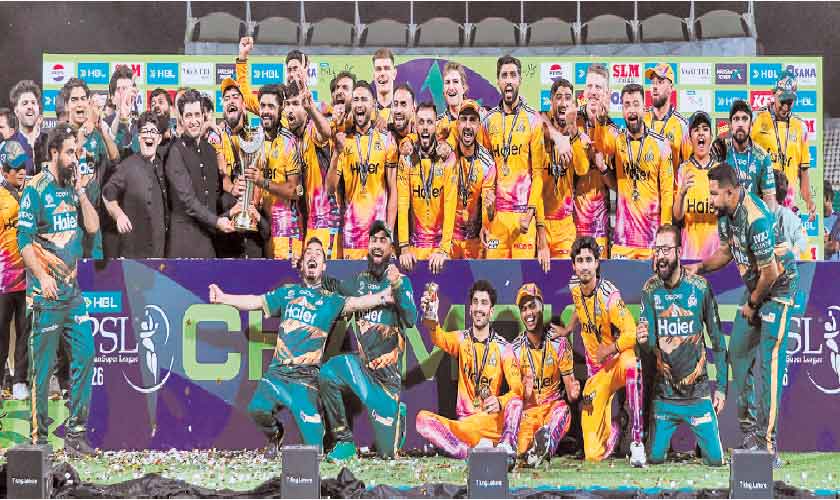
The Pakistan Super League (PSL) has always been more than a cricket tournament. It is emotion, identity, resilience and hope wrapped into a few weeks of electrifying cricket. PSL Season 11 once again reminded the world that Pakistan is capable not only of producing world-class cricketers but also of delivering a sporting spectacle that reflects the spirit of the nation itself.
When the fireworks lit up the skies and Babar Azam lifted the trophy for Peshawar Zalmi, it marked the culmination of a remarkable season. Yet the true beauty of PSL 11 was that the success belonged to far more people than just the champions standing on the podium. This was Pakistan’s collective victory.
From the Patron Shehbaz Sharif, Prime Minister of Pakistan, and PCB leadership, especially Chairman Syed Mohsin Naqvi, PSL head Salman Naseer, COO Syed Sumair Ahmad, to the groundsmen working tirelessly through sleepless nights, from security personnel (Pakistan Army, Rangers and Police) to commentators (Urdu Commentators: Tariq Saeed, Shoaib Malik, Marina Iqbal, Sana Mir, Salman Butt, Shah Faisal and Ayaz Chaudhary and English Commentary Panel; Wasim Akram, Ramiz Raja, Bazid Khan, Aamir Sohail, Urooj Mumtaz Khan, Sikandar Bakht (locals), Carlos Brathwaite, Lisa Sthalekar, Michael Haysman, Dominic Cork, Nick Knight, Mark Butcher, Martin Guptill, Greg Blewett, Athar Ali Khan and Jean-Paul Duminy (foreigners)).
And from presenters (Zainab Abbas, Jess Crowe, Neroli Meadows and Sikandar Bakht) and from match officials to young ball pickers led by Rana Farhan Masood, representing schools across the country, every individual became part of a larger national mission. PSL 11 succeeded because thousands of unseen hands ensured that Pakistan’s cricketing identity continued to shine before the world.
On the field, Peshawar Zalmi were undoubtedly the standout side of the tournament. They lost only one match throughout the campaign and played with consistency, aggression and clarity. It was the kind of domination rarely witnessed in franchise cricket. Their triumph was not based solely on star power; it was built on planning, balance and belief.
Babar Azam, often criticised unfairly in recent months, responded in the best possible manner, with runs, leadership and composure. Great players always answer critics through performances, and Babar did exactly that. Finishing as the tournament’s highest run-scorer with 588 runs, he once again proved why he remains the face of Pakistan cricket.
More importantly, this PSL title carried personal significance for him. It was his first PSL trophy as captain, and perhaps the most emotionally satisfying achievement of his franchise career. Throughout the tournament, Babar looked like a leader enjoying his cricket again. There was calmness in his batting, authority in his captaincy and maturity in the way he guided young players.
However, Zalmi’s success was never a one-man story. Aaron Hardie produced one of the greatest performances ever seen in a PSL final. A four-wicket haul followed by a composed unbeaten fifty under pressure made him the undeniable hero of the final night. His contribution reflected the character of the entire Zalmi side, fearless, composed and relentless.
Then there was Sufiyan Muqeem, arguably the breakout star of the season. Winning both the player of the tournament and bowler of the tournament awards, the young spinner displayed remarkable courage and intelligence beyond his years. Pakistan cricket has always thrived on producing fearless talent, and Sufiyan appears to be another exciting addition to that tradition.
Equally impressive was the rise of Nahid Rana, whose raw pace brought excitement and intimidation to the tournament. Bowling above 150 kph consistently is no ordinary skill. Players like him elevate the standard and intensity of franchise cricket. Yet while Peshawar Zalmi deservedly celebrated, enormous credit must also go to the debutants, Hyderabad Kingsmen. Their journey from four consecutive defeats to reaching the final was one of the most inspiring stories of the season.
Led admirably by Marnus Labuschagne, Hyderabad displayed courage, resilience and unity. Many teams collapse after losing four straight matches, but Hyderabad reinvented themselves midway through the competition. They played fearless cricket and earned the respect of fans across Pakistan.
In many ways, Hyderabad’s campaign reflected the unpredictable beauty of T20 cricket. One week you are struggling for survival; the next, you are fighting for the trophy. Even in defeat, they left the tournament with dignity and admiration. PSL 11 also proved another important point, Pakistan’s cricket infrastructure and organizational capabilities continue to improve.

The groundsmen at both Gaddafi Stadium and National Stadium deserve immense appreciation. Their relentless work behind the scenes ensured that matches continued smoothly despite pressure, weather concerns and logistical challenges. Often, the spotlight never reaches those who prepare pitches, manage drainage systems or maintain outfields late into the night. But without them, there is no PSL.
The same appreciation must extend to umpires, match referees, security personnel, district administrations, paramedical staff, transport teams and volunteers. Modern tournaments are massive operations, and PSL 11 demonstrated that Pakistan can handle such responsibilities professionally.
One particularly heartwarming aspect was the involvement of school students and club cricketers as ball pickers. For many of those children, standing inches away from their cricketing heroes was likely the experience of a lifetime. And such talented youth was well managed and supervised by their head Rana Farhan Masood and some very professional PCB officers. PSL continues to inspire the next generation, and that emotional connection is invaluable for Pakistan cricket’s future.
The media also played a crucial role. Broadcasters, presenters, analysts and journalists helped project a positive image of Pakistan to global audiences. The production quality, crowd atmosphere and competitive cricket collectively strengthened PSL’s reputation internationally.
Especially the way local media under the leadership of SJAL President Aqeel Ahmad and Secretary M Yousaf Anjum, along with PCB media officials present always to serve media at Gaddafi Stadium and led by Raza Kitchlew, was fantabulous as collectively, they also played their great role in making the PSL a huge success especially the start and end part of the PSL 11. Similarly, the same staff with the help of Karachi media, made the Karachi part of the PSL 11 very successful.
And what an atmosphere it became by the final. The rain that arrived during the celebrations could not dampen the emotions of the night. Fans stayed, players danced, fireworks exploded and chants echoed across the stadium. It felt symbolic, nothing could stop Peshawar Zalmi, just as nothing could stop PSL 11 from becoming a success story.
This season had everything: dramatic upsets, one-sided demolitions, last-over thrillers and unforgettable individual performances. But above all, it had heart. That is what separates PSL from many leagues around the world. The emotional investment in Pakistan is different. Cricket here is deeply personal. Every victory feels national, every tournament becomes cultural and every emerging player carries the hopes of millions.
As PSL 11 concludes, Pakistan cricket must recognise the larger lesson from this successful season. Stability, merit, professionalism and continuity produce results. When management, players and organisers move in the same direction, success follows naturally.
For Babar Azam and Peshawar Zalmi, this title will remain historic. For Hyderabad Kingsmen, the future already looks promising. But for Pakistan, PSL 11 represented something even bigger: proof that despite all challenges, the country’s passion for cricket remains unstoppable. And perhaps that is the greatest victory of all.