Print Story
X

| A |
narrow, winding road stretches westward from Pakpattan. Alongside this road runs a century-old railway line, leading to Karachi. The train chugging through the wheat fields looks like a toy gliding over a soft, green carpet. Plumes of smoke rise from the chimneys of nearby brick kilns and drifting through the air like stray clouds.
A small village sits perched on a mud mound near the railway line. It is home to a small Gurudwara that holds a significant place in history. It is said that Guru Nanak, the founder of Sikhism, and his Muslim companion, Bhai Mardana, stayed here on their way to the shrine of Baba Fariduddin Ganj Shakar. They met the caretaker of the shrine, Ibrahim (also known as Farid Sani), who shared some verses of Baba Farid with them. Those later became part of the Guru Granth Sahib—the sacred scripture of the Sikhs.
The place symbolises the enduring bond between Muslim Sufis and Sikh adepts. Following the historic visit, the village came to be called Tibbba Nanaksar.
Beyond this mound lie other settlements with charming names like Bhubhar, Pakka Sadhar and Azmat. These names evoke a sense of nostalgia, hinting at stories lost in the dust of time.
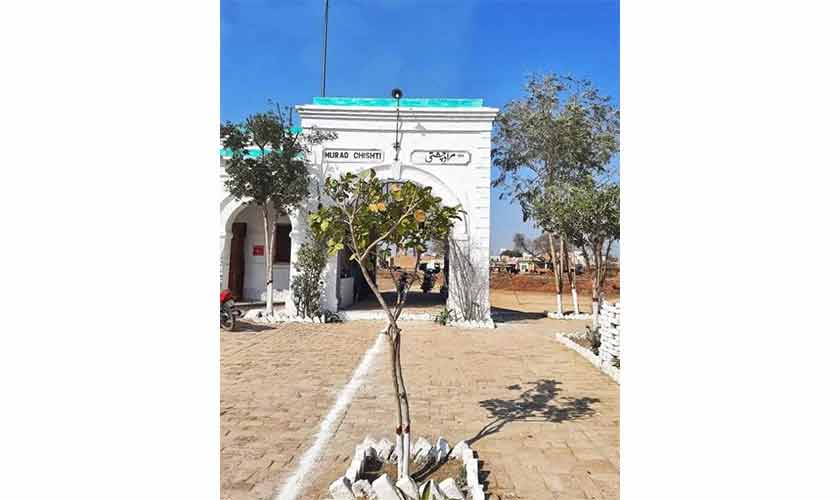
Past these villages, one comes across Chak Datar Singh Railway Station, built in 1924. It stands quiet and still. Its small, milky-white building is nestled among lush neem trees. On the sun-drenched forehead of the building, the name Chak Murad Chishti is written in black Urdu script. A local landlord had the name changed a few years ago. It had earlier been Chak Datar Singh. If one looks closely, the original name remains faintly legible beneath layers of whitewash.
Baba Farid Express is the only train that visits here. The station is often deserted but not entirely devoid of life. Empty clay pots sit in the veranda. These were meant once to store drinking water for the passengers. The ticket window is closed. A faded notice on the wall lists the stations between Lahore and Karachi along with their fares. It is said that this list of destinations was once much longer.
The station’s beauty remains undiminished as leafy trees host large numbers of crows, sparrows and bulbuls.
The place symbolises the enduring bond between Muslim Sufis and Sikh adepts. Following the historic visit, the village came to be called Tibbba Nanaksar.
This village was founded by Rai Bahadur Sardar Datar Singh. His father, Sardar Hukam Singh, had owned thousands of acres between Pakpattan and Arifwala. Chaks Machi Singh, Datar Singh, Kalyana, Amar Singh, Tehi Javind Singh and Bara, were all named after various members of his extended family.
Datar Singh studied in Montgomery town (now Sahiwal) and Amritsar before travelling to England in 1919. He returned to India in 1921 with an education in agriculture and a National Dairy Diploma. Upon his return, he established in Montgomery what was likely the first modern dairy farm in India. His passion for animal welfare and breeding took him close to Gandhi.
Datar Singh represented India at international dairy conferences in Copenhagen (1934) and Berlin (1937). He also installed a tube well in his native village. This was the first engine-operated tube well in the region. Since the Punjabi word for a tube well is Bamba, locals began calling the village Bamba. Some elderly villagers still refer to Chak Datar Singh by this nickname. For his contributions to agriculture extension and dairy farming, the British government conferred knighthood upon him.
Baba Muhammad Fazil, a local elder, recalls that Datar Singh intended to build a grain market in his village. The plans were registered and the site was marked. Then came independence and partition, and Datar Singh’s family was forced to leave Bamba and flee across the new border. They would continue their work on the other side.
Datar Singh’s legacy of animal care has survived. His granddaughter, Maneka Gandhi, is a prominent politician and activist in India. The widow of the late Sanjay Gandhi and daughter-in-law of Prime Minister Indira Gandhi, she is also a prolific writer on animal care.
While much has changed in the village, the name Chak Datar Singh still resonates with those familiar with its history. The likes of Baba Fazil refuse to call it anything else. However, should Maneka Gandhi or some other descendent of Datar Singh try to look up their ancestral village on Google Maps today, they might not find it. The map lists it as Chak 3-EB and identifies the station as Chak Murad Chishti.
The writer teaches at Government Faridia College, Pakpattan.