Print Story
X


| E |
id in a big city now increasingly begins with an eerie kind of absence. Not the obvious one, but something more than the relatives you couldn’t visit this year.
It’s a quieter absence, harder to name. You wake up in an apartment building, and for a few seconds everything feels suspended. There is no immediate sound of doors opening, no neighbour calling out Eid Mubarak from across a courtyard, no clatter of dishes travelling between homes before you’ve even brushed your hair.
Eid was never meant to be quiet like this. It’s a feast designed for overflow. Too many people in one house, too much food for one table, too many interruptions to any plan you might have made. It spills out of homes into streets, because the architecture of it is collective by design. Which is why, in Pakistan’s metropolitan spaces, it now sometimes feels slightly misplaced.
In older parts of Lahore, you can still catch glimpses of the rhythm. A lane where children are already out in their new clothes, comparing Eidi before noon. A door left ajar because someone is expected, or because someone might just walk in anyway. Kitchens that have been active since before sunrise, where sheer khorma or sawaiyyaan are made to be carried in steel bowls across thresholds. But move into the newer parts of the city, into apartment complexes and gated enclaves, and the texture shifts. You might know the family next door but you are unlikely to knock without sending a message first. Food is still prepared, but often in smaller quantities, sometimes replaced by a quiet dine out. Even generosity becomes something that is organized. The warmth unfortunately seems to be disappearing.
There is another change happening here, one that has less to do with distance and more to do with aspiration. In a metropolitan city like Lahore, Eid is sometimes a performance of so-called modernity. The old village or mohalla self, with its loud hospitality and crowded rooms, can start to feel like something to outgrow. In apartments and drawing rooms, people try to be more refined, less ‘backward,’ less like the life they came from.
For some families, it offers a chance to ‘edit’ the festivity: to choose whom to invite, how long to keep the visit, how much to reveal of oneself. In that sense, the lonelier Eid is also a freer Eid. While not everyone might agree with it, we can respect people for aspiring to adapt to their version of maturity.
Part of this is practical. Urban life runs on constraint where time, space and energy are all rationed in ways that older neighbourhoods didn’t demand as strictly. Many households no longer have the extended family structures that made large-scale cooking and hosting feel effortless. The women who once anchored Eid kitchens are now working, or living far from the support systems that made those kitchens possible. And yet, one could argue that there’s a difference between adapting and replacing.
Because alongside this quieter, more contained Eid, there exists another movement that seems to resist it entirely. In the days leading up to the festival, highways and motorways typically fill up. Buses and trains fill up, out of the cities and back towards smaller towns and villages, towards places that are still referred to simply as home or apna gaon, even by people who have spent most of their lives elsewhere.
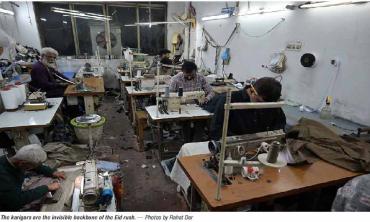
Eid in the city is also the day the invisible machinery of urban life vanishes for a moment. The driver is off; the domestic worker is home; the security guard is in another town… Suddenly the upper middle-class apartment that feels polished and complete on normal days looks a little helpless, a little under-built. Our metropolitans that imagine themselves as self-sufficient, discover that they are built on the labour of people they do not fully see.
It happens every year — offices and neighbourhoods empty out early, the city begins to lose its grip on the people who sustain it and people return not just to family but also a different version of Eid that still unfolds in courtyards and open spaces: where the boundaries between homes are more porous; where a visit does not need to be negotiated in advance; where food is not plated individually but served in a way that assumes sharing…
There is, of course, a tendency to romanticise this contrast. To imagine the ‘small-town Eid’ as untouched, more authentic; somehow closer to the essence of the feast. The reality is more complicated. These places are changing too. Migration, media and economics are reshaping them in subtle ways. The distance between the two Eids is not as absolute as it might seem, though the discrepancy remains.
Even people who insist they prefer staying in the city will often admit that something is slightly off. It shows up in small ways: in the way conversations drift towards memories rather than present plans; in the way people scroll through pictures of gatherings happening elsewhere; in the way the day seems to end a little earlier than expected.
It is not loneliness in the conventional sense — cities are full, after all. But there is a difference between being surrounded and being held.
The occasion shows us how much of our idea of celebration is tied to forms of living that cities do not easily allow. The mohalla, with its informality and constant negotiation of space and relationships, created a kind of social density that cannot be replicated in vertical living. Apartments offer privacy, security and efficiency. They do not, by design, offer interruption; celebrations like Eid thrive on interruption.
It would be easy to frame this as a loss. For many, the urban Eid is one of chosen families, of friends who step into roles that geography has made difficult for relatives to fill. It can be quieter, yes, but also more intentional.
In between these two versions - the city and the return; the apartment and the ancestral home - most people seem to move back and forth, year after year. Leaving, coming back, carrying fragments of one into the other.
Kiva Malick is an academician and a writer who focuses on education, philosophy, music and culture