Print Story
X




For the average tailor, the thirty days of Ramazan are not a month of fasting so much as a fiscal sprint that must sustain his household for the next six months or so. The economics are staggering
“Baji, it’s being pressed right now. My boy is bringing it from the warehouse,” the head tailor, whom everyone calls Master Sahib, says into the receiver, his voice reaching a pitch of sincerity that could win an Oscar.
It is, of course, a lie. The suit in question is currently a stack of flat, un-cut fabric sitting at the bottom of a plastic crate; not forgotten, but definitely ignored. In the ecosystem of the Eid rush, the truth is a luxury Master Sahib cannot afford. To admit the delay is to invite a sit-in protest; to lie is to buy six hours of silence. He hangs up, wipes the sweat from his forehead with a measuring tape, and turns back towards the table where the measurements of half the neighbourhood are scrawled like ancient, frantic hieroglyphics.
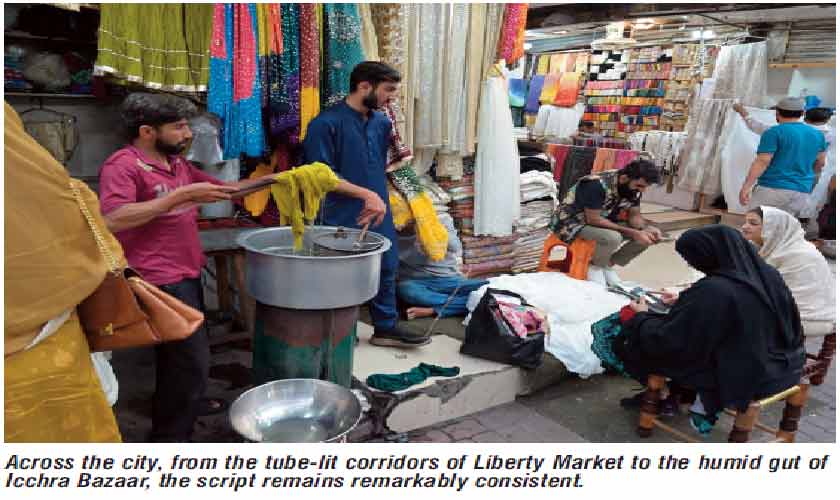
Across the city, from the tube-lit corridors of Liberty Market to the humid gut of Icchra Bazaar, the script remains remarkably consistent. The tailor’s defence mechanism is built on a foundation of creative tragedy and infrastructure critique.
In his 4x4 booth somewhere in a Muslim Town market, inch tape around his neck, scissors in hand, the Master Sahib doesn’t even look up from a flower-printed qamees when his phone pings with a frantic voice note. He already has a ready-made explanation for the delay. “Baji, someone passed away in my helper’s house,” he says, his voice dropping to a sombre, rehearsed register. “He went on leave, I’ve been working alone ever since.”
In the world of Eid tailoring, the ‘village funeral’ is a recurring plot point — a convenient, unverifiable catastrophe that buys Master Sahib another 48 hours of grace.
A few miles away, in the commercial blocks of DHA, Naveed, who specialises in “high-end lawn,” uses the city’s collapsing grid as his shield. “There’s been no bijli since yesterday; you may ask anyone in the neighbourhood,” he says, gesturing vaguely at a silent ceiling fan. It doesn’t matter that the shop next door is humming with a private generator. In the moment of the confrontation, the bijli is a sentient, malicious force that specifically hates his sewing machines.
The most audacious move in the tailors’ repertoire is the ‘style pivot’. When a neckline is cut too deep or a sleeve is accidentally shortened, the tailor becomes a fashion visionary. A veteran tailor of (admittedly) “30 Eids” in Anarkali, handles a disgruntled customer with the confidence of a Parisian designer: “Baji, this is the style of the season. Everyone who is anyone is wearing this [style]. The cut you told me to do is out of fashion now. At least try it on, I’m sure it will look great.”
It’s masterful gas-lighting. By the time the customer leaves, she is halfway convinced that her ruined silhouette is actually a bold, avant-garde statement.
| B |
ehind the choreographed drama of the village funeral and the faulty transformer lies a brutal, red-eyed arithmetic. In the humid basements of Ichhra, where the sunlight never reaches and the air is thick with the lint of a thousand unstitched dreams, the Master is less a tailor and more a triage manager.
For the average tailor, the thirty days of Ramazan are not a month of fasting so much as a fiscal sprint that must sustain his household for the next six months or so. The economics are staggering: a single shop might take in five hundred suits in three weeks, each one a complex puzzle of lace, panels and fashion-forward demands. While the designer lawn in the customer’s bag costs upwards of Rs 15,000, the tailor’s stitching fee — often a fraction of that — must cover the skyrocketing cost of industrial thread, the ‘generator surcharge’ that eats into every profit margin and the seasonal wages of his karigars (workers).
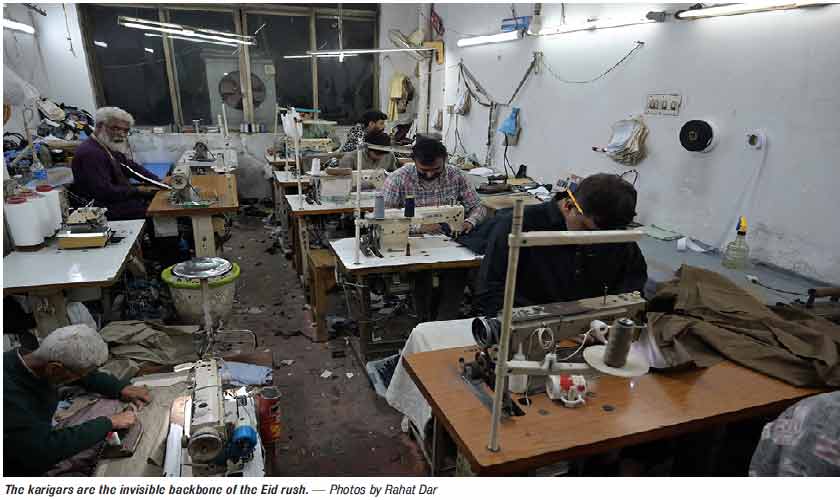
These karigars, the invisible backbone of the Eid rush, are often young men from precarious rural backgrounds who sleep on the very cutting tables where they work, using rolls of cloth as pillows. They exist on a diet of dhaba chai and sheer adrenaline, their fingers mapped with needle-pricks and their backs often curved from the labour of perfection.
“They see the excuses, but they don’t see the sweat,” notes Abdul Rehman, who oversees a team of six in a cramped upper-story flat. “If I tell a baji her suit isn’t ready because we took our first lunch break in six days, she will scream. If I tell her there was a death in the village, she might give me another day. We have to fib, otherwise nobody cares about us; just what we can do for them.”
When the power goes out and the heat in the workshop hits 40 degrees Celsius, the tailor isn’t just fighting a deadline; he is fighting a physical collapse. We demand that they be the custodians of our vanity, yet we haggle over the price of their sleep. In the socioeconomics of the Pakistani Eid, the tailor is the ultimate shock absorber. He is the man who absorbs the city’s collective anxiety and stitches it into a garment, one dishonest “Ho jayega!” at a time.
By the time Chand Raat arrives, the theatre has begun to fold. The frantic voice notes fall silent, replaced by the white noise of a city finally heading home to dress up. The last baji has snatched her shopping bag, perhaps still grumbling about a misplaced button. The iron has hissed its final cloud of steam.
In a small shop tucked away in a shadowed crevice of Ichhra, the fluorescent light flickers and finally dies. Master Sahib does not rush out to join the festivities. Instead, he sits on his wooden stool, the space around him suddenly, unnervingly vast without the piles of unstitched lawn. His right thumb, calloused and permanently stained with the blue of a marking pen, finally rests.
There is no glory in this exhaustion, only a quiet, mechanical pride. On a nearby stool sits a single cup of lukewarm chai, the surface filmed over, forgotten in the final rush.
Outside, the street is a riot of bangles and bikers, but inside the tailor’s workplace, the only sound is the cooling metal of sewing machines; a faint, rhythmic ticking as these shed the heat of a 20-hour shift.
Eid morning, the city will wake up and look into its mirrors, admiring the crisp fall of a trouser or the perfect symmetry of a neckline. They will take their selfies and praise the “fit,” rarely remembering the persons who lied to them but also bled for them under a basement bulb.
Master Sahib reaches for his waistcoat, switches off the main breaker and locks the shutter. The “backbone of Eid” is going home to sleep, his part in the feast finished long before the prayers begin.
Nadia Ahmed Uqaili is a content strategist with over five years of global agency experience. She also writes short fiction on Substack. She can be reached at [email protected]
caption
The karigars are the invisible backbone of the Eid rush. — Photos by Rahat Dar
caption
Across the city, from the tube-lit corridors of Liberty Market to the humid gut of Icchra Bazaar, the script remains remarkably consistent.