Print Story
X




Peggy Fletcher Stack has worked full-time as a religion writer for The Salt Lake Tribune since 1991, launching the newspaper’s award-winning Faith section. Stack has reported from Brazil, Chile, Ghana, Zimbabwe, South Africa, Norway, Denmark, Germany, Switzerland, Vietnam, China, Indonesia and Russia. She also served on the executive board of the Religion Newswriters Association and has won the Cornell Award for the best religion reporting at mid-sized papers four times. In 2013, she collected the American Academy of Religion’s top award for religion writing. She was also a co-author of one of the stories in the Tribune’s recent Pulitzer Prize-winning investigation of sexual assaults at Utah colleges. She is the executive director of the International Association for Religion Journalists.
For 14 years now, she has been fasting in the month of Ramazan and observing practices of other faiths. Recently she spoke with The News on Sunday about her experience.
Excerpts:
| T |
he News on Sunday: What motivated you to observe Ramazan fasts?
Peggy Fletcher Stack: I started following the practice in 2012, fasting initially not during the actual time but in January, which has the shortest days. I had been reporting about Muslims and the holy month since I started as a religion reporter at The Salt Lake Tribune in 1990 and had mostly focused on fasting. I wondered if I had the discipline to do it. I started fasting after reading a book about interfaith practices. I wanted to know how hard a task it was. I tried it with my Muslim friends, who taught me how to do it. Not only fasting, but also reading the Holy Quran, giving alms and doing charity. Most interestingly, being kind to our partners. The next year, I did it at the same time as Muslims. It was much harder because the days were longer and hotter. The experience transformed my habits, my thinking, my approach to journalism, my marriage and, most importantly, my heart. In America, it is hard because of the society. Our social experiences are different. However, now I feel that it is a pretty small sacrifice compared to the benefits. All my friends want to help. Now all my Christian friends expect me to do this every year. I follow during Ramazan: make charitable gifts, avoid cross words, pray five times a day, give thanks to God and try to read the Quran. I read the whole Quran during Ramazan in 2013, but now I just read select passages.
TNS: Has it been a learning experience?
PFS: It has helped me think about hunger in the world. This time of fasting touched my heart. That is why I took to doing it every year. Other faith also practice fasting, but not for a full month from sunrise to sunset. It has been an experience that has taught me more about other people - those less fortunate and hungry. Fasting has made me give alms to the poor; watch the natural wonders of sunrises and sunsets; and think about God continuously.
TNS: How did your family and community react to your decision to fast during Ramazan?
PFS: I have done it every year since then, always with Muslim friends and advisers. My family is Christian, so they don’t do it with me, but they respect me for doing it to learn spiritual discipline and empathy. They congratulate me for the ability to forgo eating and drinking during daylight hours for 30 days. Sometimes they remark on my stamina or joke about my lunacy.
This is a wonderful practice. It should not be taken for granted. It creates empathy for people in circumstances different from your own. There are so many misunderstandings between faiths. This helps us understand those.
TNS: Practicing the Islamic fasting must be very challenging as a non-Muslim, particularly in a predominantly non-Muslim society.
Peggy: Because I am not a Muslim, it is a little tough to do it. For Muslims, it is a family and community practice that brings people together. I do have many chances to dine with them, but I don’t have that kind of time in the evening. In my faith, we fast for 24 hours on the first Sunday of every month and give the money we save by not eating (equivalent to two meals) to the poor. That has been a practice of mine since I was a child. No one else in my family fasts with me.
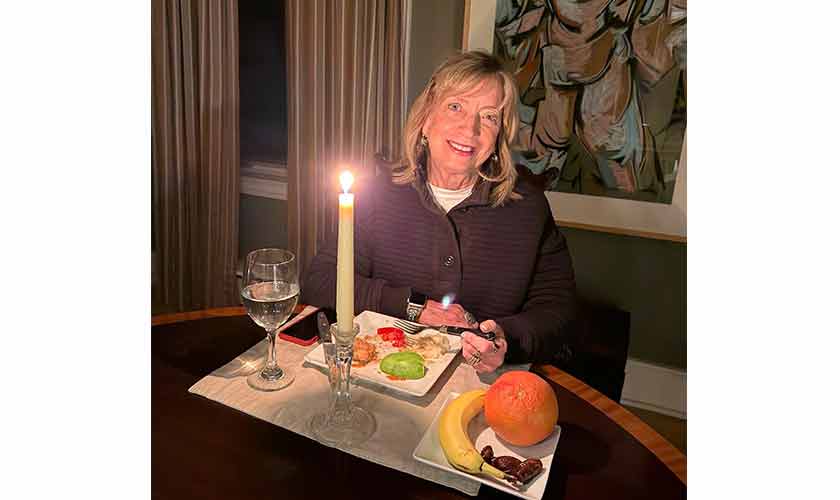
I prepare meals myself both times. Sehri (pre-dawn meal) is a challenge. Getting up is harder than waiting all day for food. However, it is a great thing to sit at my desk and watch the sunrise from the mountains after the pre-dawn meal, and later watch the sunset. In iftar, I normally have a simple meal and start with dates - but not a feast like some Muslims. I make sure I have a good, balanced diet. I recall that in my first year, a Muslim friend invited me to iftar. We had an extensive feast of lamb, beef, chicken, lentils, potato pancakes, naan and many more dishes. Sometimes I wonder how Muslims could break their fast with such rich foods every night and not gain weight.
TNS: What other challenges have you faced while fasting during Ramazan?
PSF: I feel that praying five times a day is a challenge for Muslims. For me, reading the Quran was a challenge, but a good one. In my second year of fasting, I read the whole of it. In a Muslim society, it is easier.
TNS: Is there a message that you would like to share with those observing Ramazan, or those who do not know much about it?
PSF: This is a wonderful practice. It should not be taken for granted. It creates empathy for people in circumstances different from your own. There are so many misunderstandings between faiths. This helps us understand them. I would love it if more people did it. It’s a good tradition. That is what I have learnt. I hope that by telling others about my Ramazan experience, it will teach others how impressive and important it is.
You see, the Muslim yearly practice of Ramazan is about so much more than fasting. It is coupled with praying five times a day, reading the Quran, doing good deeds, giving to the poor and controlling negative thoughts and actions. Any angry exchanges, crankiness, complaining, lying, cheating, gossiping or hurting others undo the good accomplished by the fast.
TNS: Do you also celebrate Eid?
PSF: I recall that after my first month of fasting, more than 30 Muslims from around the valley joined me and my editors in a kind of Eid. They brought the food and told me that they practice elements of their holy fast throughout the year.
TNS: Do you try to observe and practice the activities of other faiths/ religions as well?
PSF: I have practised some Catholic traditions. In Christianity, it sometimes involves making personal sacrifices or fasting before Easter. Sometimes I give up sugar for a month. Some people give up alcohol, some give up video games. I have done such practices. I have tried 10 different religious services to understand different religious values. Recently I went to a Hindu festival.
The interviewer is a staff reporter. He can be reached at [email protected]