


Print Story
X




A UN report warns that the world has entered the era of serious global water shortage
| T |
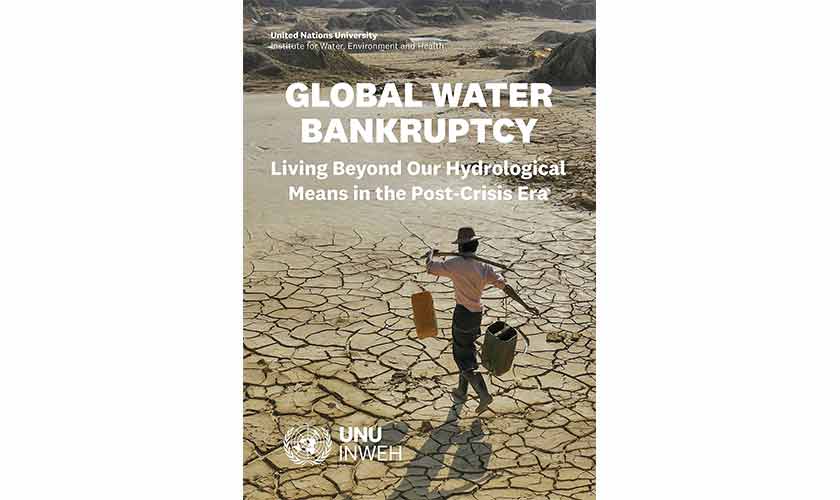
wo recent reports have revealed alarming data on rapidly worsening water balance of the world. United Nations University Institute for Water, Environment and Health has just released a startling report: Living Beyond our Hydrological Means in the Post-Crisis Era. Prior to this, World Bank had released a report: Continental Drying: A Threat to Our Common Future. Both these reports paint a grim picture of global freshwater inventories.
Water bankruptcy refers to a situation where water consumption dwarfs renewable water supply and causes irreversible depletion and degradation of the precious resource. It is an advanced stage of water crisis, which is a temporary emergency that could be reversed through some mitigation measures or some natural phenomenon. The UN Institute’s report warns that the world has entered the era of global water bankruptcy. It has elevated water risk bar from stress and crisis to a higher level. The report says the global water order has irreparably malfunctioned and the present models of water management by governments and societies have failed.
Globally, freshwater bodies are shrinking at an alarming pace. Gravity of this phenomenon is evident from the fact that more than half of the world’s large lakes have lost water during the last three decades, affecting around a quarter of the global population. The World Bank report puts the net annual loss of global freshwater at 324 billion cubic metres. A steep rise in water consumption has added complexity to this challenge. Between 2000 and 2019, water consumption increased by 25 percent.
As average global temperature continues to rise, surface water resources are experiencing increased stress. During the last 50 years, the world has lost more than 30 percent of its glaciers. This has led to reckless ‘mining’ of groundwater deposits. River flows are diminishing and farmers are pumping larger volumes to water their crops. Reliance on ground water has been rising so that 40 percent of irrigation water and half of the domestic water needs are now being met through ground water. Consequently, around 70 percent of the world’s major aquifers are exhibiting long-term decline.
Heavy abstraction of ground water is not only emptying critical underground reservoirs but also resulting in geological deformation known as subsidence. The phenomenon results from overdrawing from aquifers that develop subsoil cavities and ultimately sinking of earth surface. Excessive groundwater mining has resulted in a staggering subsidence of over 6 million square kilometers of global land mass. This includes densely populated urban areas of over 200,000 square kilometers inhabiting more than two billion people.
The report puts the net annual loss of global freshwater at 324 billion cubic metres. A steep rise in water consumption has added complexity to this challenge. Between 2000 and 2019, water consumption increased by 25 percent.
The freshwater situation in Pakistan is not much different from the global scenario. The country is located in the Hindu Kush-Himalaya region where glacial melting has accelerated in recent years. According to International Centre for Integrated Mountain Development, with a global warming level between 1.5°C to 2°C, the HKH glaciers are expected to lose 30-50 percent of their volume by 2100.
A landmark study by the ICIMOD, The Hindu Kush Himalaya Assessment, laid bare the scale of the vulnerability of glaciers in this region. The HKH region is spread over 3,500 square kilometers. Its glaciers feed ten most populated river systems including Indus, Ganges, Yellow, Mekong and Irrawaddy. Water and food security of at least two billion people in this region is exposed to long term effects of climate change. The region has seen astronomically high impoverishment. More than 30 percent of the people lack assured access to adequate food; half of the population is malnourished.
The report depicts an ominous prognosis for the Indus River basin. 70-80 percent of annual flows of Indus are generated through snow and ice melting. This highlights the extent of its vulnerability to glacial retreat. The report alarms that with the prevalent trend of emissions, the basin can experience substantial glacier loss, potentially as high as 80 percent by the end of century.
The alarming scenario warrants urgent action. There is no dearth of diagnostic data, reports and policies. Political leadership and planners ought to move towards result-oriented strategies, robust actions and consistent stewardship. Unfortunately, water debates have so far been limited to new dams and canals. Water resource planning in Pakistan needs to broaden from engineering structures to better governance through effective and credible institutions. Our colossal water losses through archaic farming practices and poorly managed infrastructure need to be fixed. Storages without conservation will only end up in wasteful use of our water resources. Pakistan’s water challenge is multifarious. It requires multi-dimensional remedies to overcome the crisis and to avert potential water bankruptcy. Responsible use of water resources, regulation of groundwater exploitation, reducing water losses, conserving wetlands, improving water productivity and arresting population growth rate could realign our water trajectory.
The writer is a senior advisor on water governance at Sustainable Development Policy Institute. [email protected].


