Print Story
X




Many progressive statutes in Pakistan’s labour legislation remain unenforced
| F |
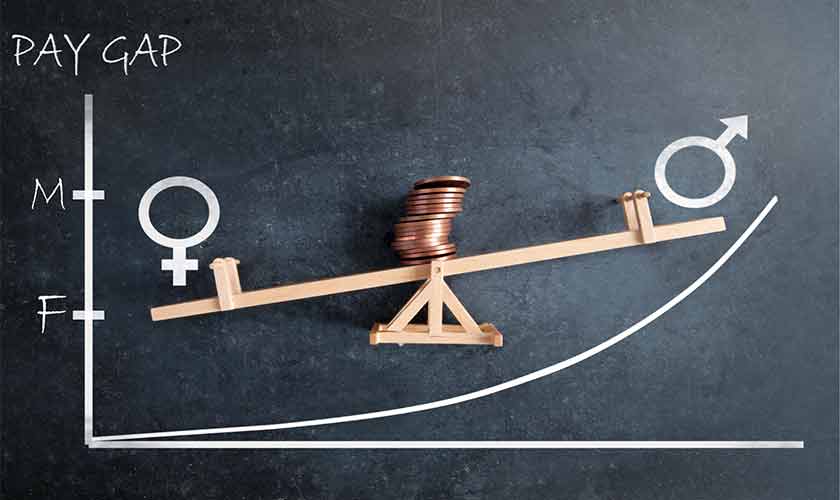
or every hundred rupees a Pakistani man earns, a woman takes home just seventy-five. That stark number, a gender pay gap of 25 per cent by hourly wages and 30 per cent by monthly wages, is not merely a statistic. It is a verdict on the structural failures of a country that ranked 148th out of 148 nations on the World Economic Forum’s 2025 Global Gender Gap Index. Most of this disparity cannot be explained by differences in education, skills or the types of jobs women hold. It is, in significant part, the residue of discrimination, which means it can be changed by deliberate policy action.
An IMF study estimated that closing the gender employment gap could boost Pakistan’s GDP by30 percent. Women, Business and the Law 2026 report by the World Bank, launched on February 24, shows that global GDP could increase by 20 percent if the gender gap in employment and entrepreneurship is closed. According to WBL, Pakistan’s legal frameworks score is 47, supportive frameworks score is 51, and enforcement perceptions score is 27. This indicates that gaps persist between law and practice.
The recent enactment of the Punjab Labour Code 2026, a consolidation of more than two dozen provincial labour laws into a single modern statute, offers a rare opening. If its provisions are enforced, and if other provinces follow suit, the Code could become the most consequential piece of gender-equality legislation Pakistan has promulgated in decades. PLC 2026 directly affects the lives of the province’s 48 million-strong labour force and indirectly affects the other 50 million working-age people.
Understanding the pay gap requires looking beyond headline numbers. Pakistan’s female employment rate stands at roughly 26 percent, compared with 80 percent for men, a 54-percentage-point chasm that is among the widest in South Asia. Of the women who do work, 50 percent are classified as “contributing family workers,” performing unpaid labour inside family enterprises, compared with just 10 percent of men. Women constitute less than 15 percent of all wage employees in the country. Even within this select group, the numbers are damning.
Even when the ILO applies its factor-weighted methodology, comparing men and women of similar ages, educational levels and occupational groups, women earn roughly 75 rupees for every 100 rupees paid to a comparable man. The gap widens sharply for older workers (reflecting the “motherhood penalty” that pushes women into part-time or flexible roles after childbirth); for those with low levels of education (exceeding 40 percent); and for informal-sector workers, where the gap balloons to approximately 50 percent. In the formal economy and the public sector, where labour laws are better enforced and pay scales do not discriminate against women, the gap shrinks to nearly zero. That single fact carries an enormous policy implication: when the law does not discriminate between people based on gender and is applied, it works.
A decomposition exercise conducted by the ILO confirms that most of Pakistan’s gender pay gap, especially at the bottom of the wage distribution, is “unexplained” by observable factors and is therefore likely driven by pure discrimination, occupational segregation and the systematic undervaluation of feminised occupations such as domestic work, home-based work, teaching and healthcare. While the overall gender pay gap has decreased from 18 percent in 2020-21 to 5 percent in 2024-25 (as shown by recent LFS data), it still ranges from 7 percent for technicians to 45 percent for craft and trade workers. Therefore, it is important to consider occupational and sectoral gender wage gaps rather than focusing solely on the mean gender wage gap.
Reducing the gender pay gap demands coordinated action on multiple fronts. No single intervention will suffice. The foundational reform is embedding the principle of equal pay for work of equal value, not merely equal pay for equal or identical work, into the labour legislation of every province. Pakistan ratified the ILO’s Equal Remuneration Convention (No 100) in 2001, yet until recently, only Balochistan’s legislation contained explicit provisions on equal pay for work of equal value. The Khyber Pakhtunkhwa Payment of Wages Act and the Sindh Payment of Wages Act lack such provisions. Without a legal mandate, employers face no obligation to compare the value of different jobs and no penalty for paying women less in occupations they dominate.
The Punjab Labour Code 2026, enacted on February 10, explicitly states that “an employer, principal or occupier shall pay equal remuneration to workers of all genders for work of equal value.” In line with ILO Convention 100, it defines remuneration broadly, encompassing “the ordinary wage or salary and any additional emoluments whatsoever payable directly or indirectly, whether in cash, negotiable instrument or in kind,” precisely mirroring the ILO Convention’s expansive definition. More importantly, the PLC 2026 mandates objective, gender-neutral job appraisals that consider professional ability, skills, work effort, responsibilities and working conditions. It requires the provincial government to develop implementation guidelines in consultation with workers’ and employers’ representatives. If enforced, these provisions will close a legislative gap that has persisted for a quarter-century since ratification. The PLC 2026, for the first time, also prohibits discrimination based on sex/ gender, pregnancy, age and family responsibilities.
International evidence shows that pay transparency laws requiring employers to report gender-disaggregated wage data can reduce the pay gap by roughly 2 percentage points in the early years of implementation. The recent Pakistan Gender Pay Gap Report 2025 and National Action Plan on Equal Pay already call for fair and transparent wage-setting systems. Yet we still have no legal requirements for gender pay-gap reporting or pay transparency for all types of enterprises.
SECP’s Circular 10 of 2024 directs all listed companies to disclose gender pay gap data in their annual reports. Early disclosures are revealing: most companies reported a mean gender pay gap of around 30 percent. However, this requirement applies only to a very limited number of enterprises, i.e., the listed companies. According to the 2023 Economic Census, more than 95 percent of economic establishments in the country are micro-enterprises employing fewer than 10 people. There are only 7,086 large employers in the country employing more than 250 people.
The PLC 2026 takes a promising first step: it includes an explicit prohibition of pay secrecy, barring employers from preventing employees from discussing their remuneration with others. This is a necessary precondition for transparency, since women cannot challenge unfair pay if they do not know what their colleagues earn. While it does not have mandatory pay-gap reporting provisions, the PLC 2026 allows the department to collect sex-disaggregated statistics on different work-related matters, especially remuneration and earnings. Hopefully, the rules drafted under PLC 2026 require mandatory pay gap reporting more explicitly from all types of enterprises.
Minimum wage policy is one of the most powerful tools for reducing the gender pay gap. Because women are overrepresented among low-wage workers, an adequate and uniformly applied minimum wage compresses the bottom of the wage distribution where gender disparities are largest. Yet in Pakistan, minimum wage legislation is a provincial responsibility, with variation in scope and coverage. Some categories of workers, among whom women are overrepresented, notably domestic workers, home-based workers and agricultural labourers, have historically been excluded from minimum wage protections.
PLC 2026 addresses this partly by requiring the Minimum Wage Board to “adhere to the principle of equal remuneration to workers of all genders for work of equal value” when recommending minimum wage rates. It also extends the Code’s coverage to agricultural workers, domestic workers, home-based workers and platform workers, categories previously invisible in Punjab’s minimum wage law. It must, however, be clearly stated that the minimum wage for domestic, home-based and agricultural work should be set with consideration of the working conditions and locations of these workers.
Women in Pakistan perform more than 90 percent of the unpaid care work. The ILO data shows that the pay gap widens significantly for women over 35, largely due to childbirth-related career breaks and the shift to lower-paying, flexible work. The “motherhood penalty,” the well-documented decline in women’s earnings after childbirth, is a principal driver of the gender pay gap among older workers in Pakistan. Addressing it requires a three-pronged approach: adequate maternity leave; meaningful paternity leave; and accessible childcare.
The PLC 2026 provides 14 weeks of paid maternity leave (six weeks pre-natal, eight weeks post-natal), protection from dismissal during pregnancy and for four months after return, two 30-minute paid nursing breaks daily for twelve months and a provision for shared daycare facilities among clusters of small enterprises. It also introduces seven calendar days of paid paternity leave.
It is important to tackle the ‘sticky floor’ in women’s work by the provision of childcare, safe transport and the formalisation of women-dominated sectors. Women are only about 23 per cent of the employed population and 13.5 per cent of wage employees. They’re concentrated in low-paid, informal jobs, i.e., home-based work, domestic work and piece-rate supply chains. The pay gap here is the widest.
The strongest levers for pay parity in Pakistan are not entirely new laws; they are effective enforcement of equal pay and minimum wage, wage transparency and formalising and supporting the sectors where women actually work. The government’s 2025 National Action Plan on the gender pay gap gives us a roadmap. What we need now is sustained implementation; resources for inspection and data; and social dialogue so employers, workers and the state move together.”
Pakistan’s labour inspection system is chronically underfunded and understaffed. Labour inspectors are tasked with monitoring compliance across a sprawling economy, from factories and mines to home-based stitching units, and are rarely trained to detect gender-based wage discrimination.
PLC 2026 establishes an Equal Employment Opportunity Office with powers to investigate discrimination complaints, conduct training, produce studies on objective job evaluations and provide legal aid to victims of discrimination. This is a structural innovation that could give women a dedicated institutional channel for redress. However, the Office’s effectiveness will depend on budgetary allocation, staffing and political will. In addition to the EEOO, PLC 2026 also requires the establishment of a Grievance Redress Committee at the workplace to receive complaints of discrimination, violence and harassment at work.
The Punjab Labour Code 2026 is, on paper, the most comprehensive labour reform Pakistan’s largest province has undertaken. Its gender-equality provisions, equal remuneration obligation, job appraisal framework, pay secrecy prohibition, anti-discrimination chapter, expanded coverage and parental leave architecture collectively represent what the ILO has described as full compliance with the Equal Remuneration Convention. If Sindh’s parallel draft code is also enacted in its current form, two of Pakistan’s four provinces (covering 80 percent of the total labour force) will have legislation that meets international standards.
Yet laws do not enforce themselves. Many progressive statutes in Pakistan’s labour legislation remain inoperative for want of rules, institutions or political commitment. We conclude this article by quoting the lines from Tea Trumbic’s speech at the launch of Women, Business and the Law 2026 report: “We must turn legal rights into lived realities. Passing reforms is only the beginning. Enforcement mechanisms, functioning institutions, and services determine whether rights translate into real opportunities. Investing in implementation is what transforms legal equality into economic impact.”
Iftikhar Ahmad is the founder of the Centre for Labour Research, Pakistan. He can be reached at [email protected]
Sobia Mir is the director at Labour Lens, Pakistan.