Print Story
X




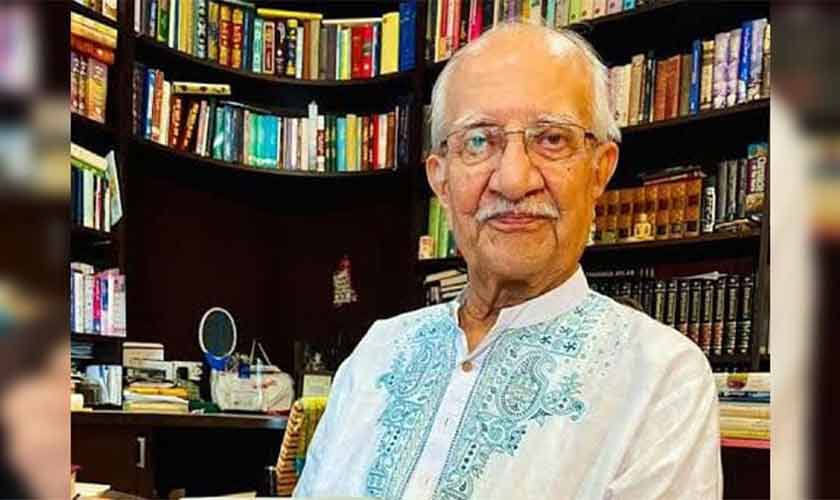
Mazhar ul Haq Siddiqui was an example of public servants holding the state together through discipline, continuity and the quiet power of administration
| T |
he passing away of Mazhar ul Haq Siddiqui on February 26 marked not merely the death of an individual but also the closure of an epoch in Pakistan’s institutional history. He belonged to a generation of civil servants for whom the state was not an abstract idea but a living structure sustained through rules, files, budgets and continuity. His career traversed the commanding heights of Pakistan’s bureaucracy, the turbulent terrain of public universities and the governance of a major family-owned media enterprise. In doing so, he left behind an imprint that continues to shape Sindh’s administrative and educational architecture.
Siddiqui was neither a populist reformer nor a public intellectual driven by some ideological manifesto. He was an administrator in the classical sense, firmly believing that institutions endure not through inspiration but through discipline. In a polity where institutions repeatedly fracture under political stress, his career offers a rare longitudinal insight into how bureaucratic power can stabilise, adapt and reproduce itself across regimes and generations.
Born in 1935, Siddiqui witnessed the twilight of colonial rule and the fragile dawn of Pakistan. This historical setting contributed to the development of an administrative temperament rooted in the belief that party politics is transient, whereas the civil service constitutes the permanent state. His induction into the Income Tax Department in 1957 placed him at the fiscal heart of the new republic. Authority was exercised through assessments, audits and statutory enforcement rather than rhetorical assertion.
This grounding in revenue administration shaped his lifelong conviction that fiscal discipline forms the spine of governance. It also explains why, later in life, he approached universities less as intellectual commons and more as public institutions that required managerial coherence and financial sustainability.
Siddiqui’s rise through the tax hierarchy coincided with Pakistan’s attempts at state-led development and industrial expansion. His most consequential transformation, however, occurred with his movement into the Sindh secretariat, where he served as secretary for Education, Finance and Services Departments.
As education secretary, he confronted the structural erosion of public education in the form of ghost schools, politicised campuses and administrative paralysis. His conclusion was unequivocal. Academic decline, in his view, stemmed less from a failure of intellect and more from a failure of governance. This diagnosis would later define his formative, if controversial, role at the University of Sindh.
Siddiqui’s first term as vice-chancellor was from 1984 to 1988 - a period when campuses were securitised and student politics suppressed. His mandate was stabilisation rather than reform. His primary task involved imposing procedural order on a university long shaped by ideological mobilisation.
His second tenure, 2001-2008, proved transformative. Coinciding with the national expansion of higher education, this period witnessed unprecedented funding, large-scale infrastructure development, and systematic faculty advancement. Under his stewardship, campus expansion, faculty regularisation and overseas doctoral training programmes were institutionalized. This helped reshape the university’s academic demography for an entire generation.
To some, he symbolised stability in an unstable polity. To others, he embodied the bureaucratisation of intellectual life. History is likely to judge him less by sentiment than by structural impact. He was not merely an administrator within institutions; he was an architect of institutional form.
This era also exposed the core tension of his career. Faculty bodies accused him of governing through bureaucratic fiat and reducing academic life to administrative compliance. The conflict was structural rather than personal. It reflected a clash between the logic of the generalist administrator and the autonomy-seeking academic community.
Beyond Jamshoro, Siddiqui’s civil service career placed him at the strategic nerve centres of the state. As head of Establishment Division, he exercised decisive influence over postings, promotions and career progression within the civil service. His subsequent leadership of the Economic Affairs, Education, Statistics and Youth Affairs Divisions expanded his horizons into international development finance, census governance and inter-provincial policy coordination.
For Siddiqui, governance was never a matter of ideological alignment; it was a question of managerial capacity and the ability to keep the machinery of the state functioning despite persistent political turbulence.
In acknowledgment of his sustained contributions to public administration and higher education, he was awarded the Sitara-i-Imtiaz in 2005.
Beyond formal decorations, his recognition lay in institutional trust. He was repeatedly appointed to sensitive federal divisions, entrusted with repeat vice-chancellorship at a politically volatile university and retained as a permanent member of statutory search committees. Such distinctions are rarely accorded without deep confidence at the highest levels of the state. Universities leaders across Sindh have acknowledged his role in institutional consolidation and administrative reform through public tributes and commemorative events.
Retirement did not diminish Siddiqui’s influence. Through permanent membership in vice-chancellor search committees, he continued to shape higher education governance in Sindh. Over time, candidates with administrative stamina increasingly displaced purely academic profiles, gradually bureaucratising university leadership. This trajectory ultimately found legislative expression in the Sindh Universities Amendment Bill of 2025, which formally opened vice-chancellorship to senior bureaucrats. The law did not invent a new model. It only codified an administrative logic that Siddiqui had embodied for decades.
It is essential to situate Siddiqui’s role in Hum Network Limited within its correct framework. It had been a family enterprise, founded and creatively led by Sultana Siddiqui. His chairmanship represented continuity rather than departure. It marked the transfer of bureaucratic discipline from the state to family-owned corporate space. Siddiqui’s role provided governance stability, regulatory compliance and institutional credibility as the network matured into a publicly listed media organisation.
Mazhar ul Haq Siddiqui’s death marks the passing of one of the last custodians of Pakistan’s post-independence bureaucratic ethos. He leaves behind universities shaped by administrative logic, a civil service influenced by his decisions and governance frameworks that privilege order over deliberation.
His legacy will remain contested. To some, he symbolised stability in an unstable polity. To others, he embodied the bureaucratisation of intellectual life. History is likely to judge him less by sentiment than by structural impact. He was not merely an administrator within institutions; he was also an architect of institutional form.
He belonged in an era when governance was exercised through documented discipline in the shape of files rather than platforms, and authority rested in procedure rather than performance metrics.
The writer is a member of Indus River System Authority