Print Story
X




Punjabi language and culture are in visible retreat in urban Punjab
| T |
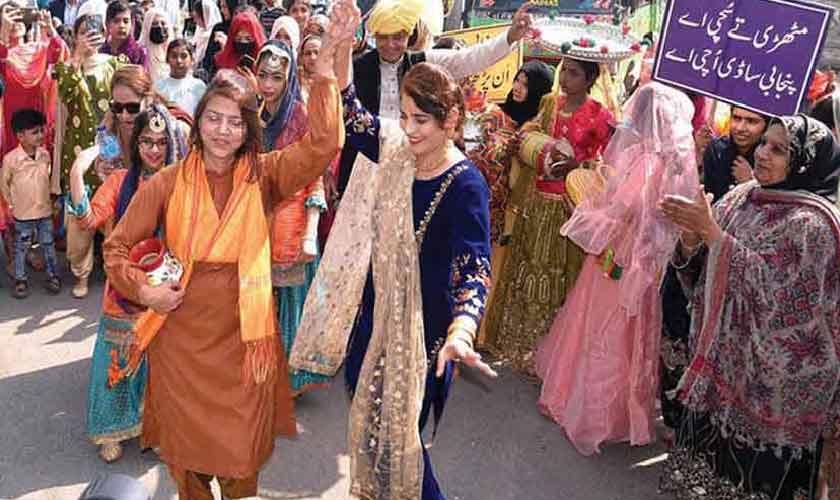
his is a story of a civilisation slowly losing its rhythm, especially its poetry, philosophy and pluralistic heart. As elders guard the memories of Sufi traditions and folklore, enriched with local wisdom, urban youth appear to be abandoning their heritage to keep pace with global capitalism. The question is: who will speak for the Punjab when Punjabis no longer do?
Walking through the alleys of Kasur, where the minarets of Bulleh Shah’s tomb shimmer in the haze, one can almost hear the fading echoes of love, resistance and mysticism. “Faqir da koi deen, mazhab nhin hunda [a mystic has no religion or sect],” says a local Sufi, his gaze fixed on the shrine’s courtyard where pilgrims of all faiths once prayed side by side.
In the region where Waris Shah wrote his version of Heer and Bulleh Shah sang of divine love, the once-thriving language appears to be dying a quiet death. The music of indigenous identity—once celebrated in every village — now struggles to survive beneath the noise of modern urban life.
Travelling to Waris Shah’s tomb along the newly built Sheikhupura-Lahore road, one cannot help noticing the change in landscape. Over vast areas, lush fields are getting replaced by concrete, industry and dust. Where peepal trees once shaded travellers and farms stretched endlessly, now stand industrial estates and housing colonies.
Urban expansion has uprooted entire communities, eroding social bonds and destroying the agro-economies that once sustained rural Punjab. Within the quiet walls of Waris Shah’s darbar, local Sufis still recite verses celebrating love, equality and respect for humanity — remnants of a fading moral compass.
Syed Asghar Hussain and Syed Measum, caretakers of Waris Shah’s shrine, say that when they cross the doorstep of their ancestor, “everyone is a devotee; all denominations and castes are part of the larger humanity.” This is befitting because both Waris Shah and Bulleh Shah spoke of religion in terms that made sense to ordinary people and aligned with the local culture. Is it possible that the deviation from the Punjab’s ethno-religious identity has been responsible for radicalising parts of the region?
From pluralism to
partition
History is what Punjabis appear to dread the most. It is not difficult to fathom why. Their reading of history is dominated by misconceived ideological constructs instilled by colonial rulers. For me, history tells a different story of the Punjabi identity. Sufism, as described earlier, was the essence of its culture. The Indus Valley, with its rivers and folklore, has always stood apart from the Ganges civilisation. Its traditions were borne out of a unique synthesis of Sufi Islam, Buddhist compassion and local wisdom. This culture suffered a deep setback under colonial governance. Following the Partition in 1947, India and Pakistan imposed centralised linguistic policies making Urdu and Hindi the lingua franca. This sidelined Punjabi in its homeland. Colonial efforts to alter the indigenous education systems and destroy local art and industry had already affected the cultural and socioeconomic structure since 1849.
The current generation has been a witness to the society abandoning its interfaith harmony, egalitarian principles and environmentally conscious practices. These key traits had fostered religious and ethnic inclusion. A devotee at Bulleh Shah’s shrine said, “Punjabi is all about tragedy, love and humanity.”
Despite being spoken by nearly 37 per cent of Pakistan’s population, Punjabi is fading from homes and hearts. As per census data, Punjabi speakers fell from 57 per cent in 1951 to 36.98 per cent in 2023 . This is an alarming decline. UNESCO warns that language loss also means the loss of indigenous knowledge — folklore, ecology and communal memory.
Shrines of silence
At Waris Shah’s shrine, ageing devotees sit cross-legged, their voices trembling as they recite his kalaam. “No one comes here any longer to understand Heer,” says Asghar Hussain. “They come for selfies, not sama‘a (spiritual listening).” He says four centuries ago, Waris Shah described the culture of Punjab through Heer, making it unique, portraying romantic expression from a woman’s perspective, and at the same time so philosophical and a reflection of Punjab’s spiritual ecology and mutual existence.
Despite being spoken by nearly 37 per cent of Pakistan’s population, Punjabi is fading from homes and hearts. As per census data, Punjabi speakers fell from 57 per cent in 1951 to 36.98 per cent in 2023 — an alarming decline.
“No one speaks the language anymore,” said a devotee mournfully at Bulleh Shah’s shrine.
Jameel Ahmad Paul, a Punjabi writer, poet and linguist says: “It is true that languages evolve. However, this is not evolution; it is erasure.” He worries that Punjabi’s disappearance is a consequence of deliberate neglect.
Once Punjab’s Sufi khanqahs were schools of compassion and creativity, (ilm-i-takhleeqat — the knowledge of creation), making folk music and folklore culturally rich. Today, their courtyards have grown silent, replaced by rigid clerics and disconnected youth.
Voices of dissent
Few people have fought harder for Punjabi culture than Ilyas Ghuman, a veteran language activist and noted Punjabi writer and editor. “Partition,” he says, “was an irreversible loss. There was a time when people [in this region] did not lock their doors — they trusted one another. Now, a man is valued not for his character but for his wealth… This is why young Punjabi farmers are migrating illegally.” The reason, he says, is a materialistic mindset that has destroyed a thousand-year-old socioeconomic order.
He says the colonial and capitalist systems have shattered the social fabric of the Punjab. “The cohesive villages once functioned as small economies — every artisan, potter, and weaver had a respected role. “When you destroy that, you destroy the community.”
A fight for recognition
Despite the decline, Ghumman remains hopeful. “Persian was the official language for 800 years; it couldn’t erase Punjabi,” he says. “Sufi poetry became our resistance.”
In 1989, he founded the Punjabi Science Board, creating curricula, translating science and engineering books and preserving oral epics (waars) — tales of heroism sung for generations. “Children must learn about our festivals, not ideological distortions.”
Meanwhile, official neglect persists. The UN Declaration on the Rights of Indigenous Peoples mentions linguistic and cultural rights. However, Punjabi remains sidelined. Urdu dominates the bureaucracy and the media; Punjabi survives in folklore and film. “Punjabis did not fight for their identity like Bengalis did. We surrendered our voice,” says Ghumman.
Technology and times have also contributed. “People don’t spin with a charkha or weave with kassa anymore. How can they understand the metaphors of Sufi poetry?” asks Jameel Paul.
Ilyas Ghumman says that the challenges are monumental. Political apathy, elite disinterest and cultural shame continue to erode what once made the Punjab. As cities swell and traditions shrink, the Punjab stands at a crossroads without any deliberate attempt to revive its identity. The future of Punjabi depends on Punjabis reclaiming their voice.
Ali Haider is a staff member at the Human Rights Commission of Pakistan. This feature was commissioned by the Human Rights Commission of Pakistan