Print Story
X




Just how beneficial are the Punjab government-run bazaars offering subsidies during Ramazan
| C |
ome Ramazan, subsidised bazaars and relief packages become a trending subject. This year is no different. The provincial government has advertised Chief Minister Maryam Nawaz’s Rs 40 billion Nigehban Ramazan Relief Package, through front-page ads in newspapers and billboards. The package aims to target 4.2 million families in the province.
Many say its promise is hyped.
Sunail Masih is a rickshaw driver in Gulberg. He says he misses the Ramazan Bazaar that used to be set up at Ghalib Market.
“I heard that Sahulat Bazaars have been converted into Ramazan Bazaars. The nearest Sahulat Bazaar for me is the one in Wahdat Colony. There is another in Township,” he says.
“This means that I have to spend a certain amount of time and money to benefit from Ramazan relief.”
This year, the Punjab government has adopted a different approach. Instead of distributing subsidised commodities through Ramazan Bazaars, the government has expanded the network of Sahulat Bazaars across the province, says Naveed Rafaqat Ahmad, the Punjab Sahulat Bazaars Authority’s director general.
“Under the leadership of Chief Minister Maryam Nawaz Sharif, and under the supervision of Punjab Sahulat Bazaars Authority chairperson Muhammad Afzal Khokhar, 75 Sahulat Bazaars are providing relief to the public this year,” he tells The News on Sunday.
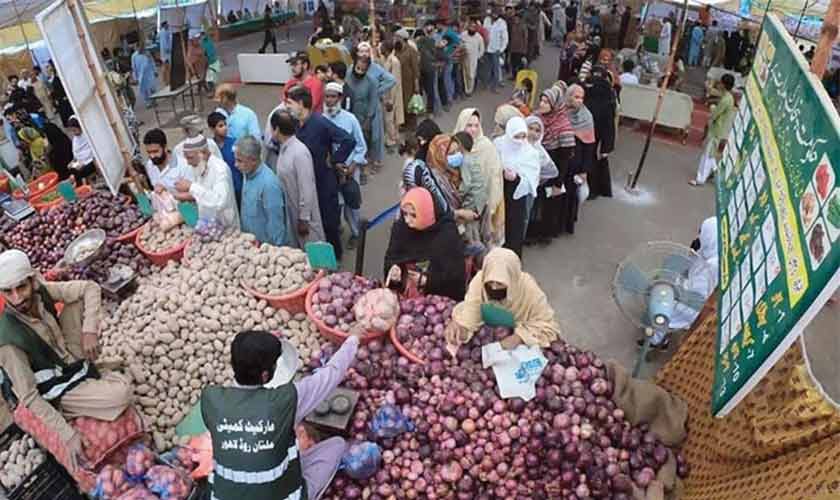
“In these bazaars, flour is available at Rs 850 per bag, sugar at Rs 140 per kg, and ghee/ cooking oil brands such as Dalda and Sufi are available at a Rs 16 per kg price reduction; other brands are providing relief up to Rs 10 per kg. Vegetables, fruits and grocery items are available at up to 10 percent lower the market prices.”
The Sahulat Bazaars operate from 9am to 5pm. In addition, Sahulat-On-The-Go facilities allow citizens to buy essential items conveniently, with extended timings up to 11pm in selected locations. The network now covers most Punjab districts and is being expanded to the tehsil level.
One such bazaar is located along the Shadman drain. Several shoppers were busy buying items for the first sehri on Wednesday evening.
Shopkeepers had a different view about the Ramazan relief drive.
“Look, we are supposed to sell fruits and vegetables for less than official prices,” says a vendor, reluctantly identifying himself as Fiaz.
“We get no cash subsidy to sell at subsidised rates,” he says.
“In Ramazan, as the demand and supply gap widens, wholesale markets also see a surge in prices. For example, we bought a crate of bananas at around Rs 800 last week, but today it was around Rs 1,000. Apple crates have moved from Rs 3,000 to Rs 3,300. However, the Sahulat Bazaar Authority is tough on vendors. It should work on the wholesale markets as well.”
Dr Rizwan Safdar, an assistant professor of sociology at the Punjab University, says that Ramazan Bazaars, seen by politicians as vote pullers, do provide “some relief to the public.”
“They hold practical benefit for low-income families and communities, making essential items accessible at subsidised rates,” he says. “There are concerns about the overall quality of products and how these markets reflect our social values.”
He says that bazaars often serve multiple purposes: “They help citizens during the holy month, but they are also politically and socially symbolic.”
Amir Ali is a member of the Lahore Chamber of Commerce and Industry. He says that during Ramazan, when every family turns to sharing and charity, Ramazan Bazaars carry symbolic significance.
“They are not just markets; they represent communal values of charity, solidarity and care for the less privileged.” He says that global examples, such as bazaars in Arab countries and the United States, show that these markets combine affordability with quality.”
“The lesson for us is that financial support alone is not enough; there must also be ethical and quality standards in place,” he adds.
With 75 Sahulat Bazaars operational and additional temporary Ramazan setups in districts that lack the permanent bazaars, Ahmad says that thousands of families are benefiting, directly and indirectly.
Naveed Rafaqat Ahmad says that the Sahulat Bazaars Authority takes great care of quality and price control.
“We have dedicated complaint cells at every bazaar, where customers can approach us and get any price or quality-related issues resolved in no time. We also have a monitoring and evaluation department overseeing these bazaars through surveillance cameras.”
Ramazan relief is a popular practice espoused by every government. Over the past seven years, the Punjab government has experimented with a variety of strategies to provide affordable food and essentials to citizens during Ramazan. One year there were traditional bazaars; the next, there were doorstep hampers.
In 2018, the province launched a subsidised Ramazan Package combining both market support and temporary bazaars. More than 300 bazaars were set up, including 32 model bazaars, alongside roughly 2,000 dastarkhwans providing free sehri and iftar meals. Subsidised staples like flour, sugar, ghee, fruits and vegetables were offered. The government said it had paid a Rs 11 billion subsidy for flour alone.
The 2019 Ramazan Package continued the focus on bazaars and item-level subsidies. Cabinet approval was granted for 309 bazaars and about 2,000 dastarkhwans. There were explicit per-item subsidies: for example, 10 kg of flour cost Rs 290 with an Rs 80 subsidy; sugar was Rs 55 per kg; ghee had a Rs 15 per kg subsidy; edible oil Rs 20 per kg; and chicken Rs 10 per kg.
In 2020, the Covid-19 pandemic forced a major shift. The government was advised to shun crowded bazaars and turned to cash-based relief. The provincial government approved Rs 3,000 per family for one million families. This marked a departure from market interventions to direct cash assistance to avoid crowding and ensure safety.
By 2021, however, the traditional bazaar approach was back. This time 313 bazaars and fair-price shops were set up under a Rs 7 billion package, including Rs 3.5 billion specifically for subsidised flour.
In 2022, the Punjab had at least 317 bazaars [some reports put the number at 319]. The Ramazan Package included subsidies on multiple items such as flour, pulses, sugar and vegetables. Of the Rs 8 billion allocated, Rs 1.25 billion was earmarked for fruits, pulses and vegetables. Monitoring systems and controlled pricing were emphasised to ensure transparency and curb profiteering.
In 2023, there was a departure from traditional bazaars. Under a caretaker chief minister, the focus shifted to free flour distribution, under which families received three 10 kg bags each. The Rs 53 billion programme utilised technology for verification but faced challenges, including stampede incidents and app glitches.
In 2024, the government launched the Nigehban Ramazan Package, combining doorstep delivery of ration hampers with model Ramazan Bazaars in select cities. Around 6.5 million packages were approved for distribution, and dashboards and apps were used for tracking and monitoring. However, reports indicated that the coverage of traditional bazaars remained inconsistent and verification issues persisted in some areas.
In 2025, direct cash transfers were made to deserving families. Only sugar and flour stalls were set up in selected model bazaars. These are now called Sahulat Bazaars.
“This shows evolution, not failure,” says Naveed Rafaqat Ahmad. “This year, cash is being distributed through the Ramazan Nigehban Card and Ration Card. The holders of these cards can also visit Sahulat Bazaars and benefit from these facilities. They can also order from home through the free home delivery service available at all Sahulat Bazaars and Sahulat-On-The-Go units. All transactions for Ramazan Nigehban Card and Ration Card customers are being facilitated through a cashless system for transparency and convenience.”
He says this model is not about short-term subsidy alone. Instead of simply distributing financial support, the government is investing in permanent infrastructure. “These bazaars are becoming public assets. They are also creating employment and entrepreneurship opportunities. Rather than just giving relief for a few days, the government is helping people build their own livelihoods.”
With 75 Sahulat Bazaars operational and additional temporary Ramazan setups in districts that lack permanent bazaars, Ahmad says that thousands of families are benefiting, directly and indirectly. “Our hope is that next year, every tehsil will have a Sahulat Bazaar.”
At the end of the day, the issue is not the name of the scheme but whether it effectively helps the poor. For many people, Ramazan relief is about putting food on the table. If the bazaars are too far away or prices still high, the promised relief loses its meaning.
The writer is the editor of Minute Mirror. He can be reached at [email protected].