Print Story
X




Economic independence can reshape public perception
| F |
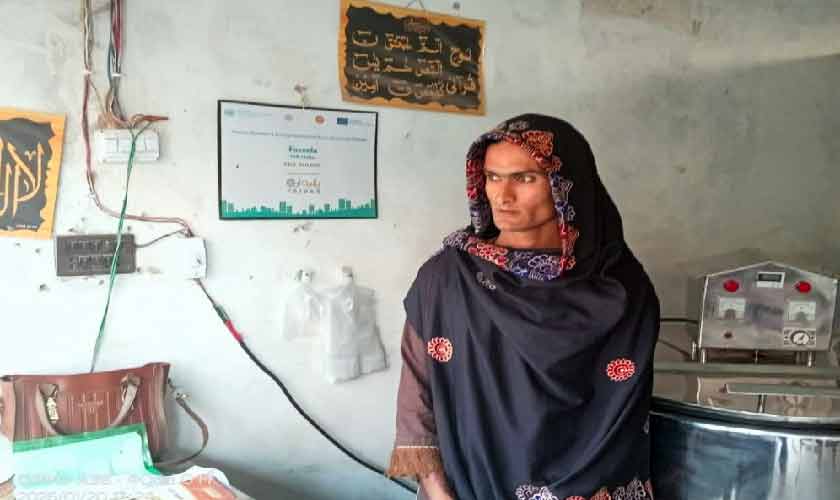
azila Laghari was born in Badin. It took years for her to recognise what others around her seemed to intuit early: she did not conform to the gendered expectations that governed her household and village.
By the time she was five, the difference had begun to weigh on her family. What could not be explained slowly became a source of discomfort. Only her mother remained constant. “A child does not change because of gender,” Zahila says. “Love does not ask such questions.”
Education, often imagined as a route to escape from judgment, became another site of exclusion. Fazila was first enrolled in a madrassa, where teachers struggled to categorise her within familiar norms. Formal schooling followed, but the classroom was no kinder. She recalls ridicule, isolation and a persistent, unspoken message: she did not belong there. Eventually, she stopped attending.
Across Pakistan, transgender children are systematically pushed out of educational spaces through bullying, institutional neglect and pressure from their own families. The Human Rights Commission of Pakistan has repeatedly warned that early educational disruption sets off a chain reaction—economic insecurity, social exclusion and lifelong vulnerability. “Once education is cut short,” says HRCP secretary-general Harris Khalique, “the damage is rarely contained.”
Adolescence brought clarity, but not relief. Realising she was transgender did not feel liberating; it felt dangerous. Her father responded with beatings. Humiliation became routine. Eventually, she left home for a while.
At fifteen, her precariousness deepened when a cousin harassed her late one night. She defended herself but blame was directed toward her. She was branded immoral—an accusation frequently deployed to silence transgender people and absolve others. The episode further isolated her within her family.
By eighteen, the accumulation of rejection had become overwhelming. Fazila attempted suicide. Her mother intervened, pulling her back from what Fazila describes as the edge. “She didn’t ask me for an explanation,” Fazila says. “She stayed with me. That was enough.”
Mental health professionals say such crises are far from rare. A 2022 South Asian study published in BMC Public Health documented significantly higher rates of depression and suicide attempts among transgender youth, closely linked to family rejection. “Family support is the most decisive protective factor,” says psychiatrist Dr Ayesha Mian. “Even one affirming relationship can dramatically alter outcomes.”
Survival required work. Work was scarce. Fazila took whatever labour she could find—mostly daily-wage agricultural jobs, poorly paid and insecure. She became known for supporting others, particularly women in the Laghari community. Fluent in Seraiki and embedded in the Baloch social fabric, she learned to navigate intersecting margins of gender, class and poverty.
In a society that often demands erasure before acceptance, Fazila Laghari chose persistence instead.
In 2017, a narrow opening appeared. The Sindh Rural Support Organisation launched a women’s empowerment programme aided by the Government of Sindh. Fazila was denied formal participation because she was transgender. Undeterred, she attended through her mother’s registration. The meetings were unwelcoming. Mockery was routine. However, she continued to show up.
“Development initiatives are often designed around rigid gender binaries,” observes Development Professional Naimatullah Sawand. “Even when inclusion is claimed, transgender people are excluded by default. Persistence, in such spaces, becomes political.”
Over time, her consistency began to shift perceptions. Fazila attended NGO trainings and district-level forums. Eventually, she was invited to sit on a district committee—an unprecedented step. Fear nearly silenced her, but she chose not to withdraw.
“I don’t want transgender people treated as a separate category,” she says. “There should be one measure—citizenship.” She briefly explored politics but found sustained participation impossible without financial backing or patronage. Instead, she turned to community organisation, quietly bringing women together and building influence beyond public view.
In 2025, a turning point arrived. Under the Paidar Project, SRSO introduced a small enterprise grant. Fazila applied for and received Rs 0.9 million. With the funds, she established a business in Matli city and later opened a modest tea dhaba. Despite stigma and economic risk, the venture proved viable.
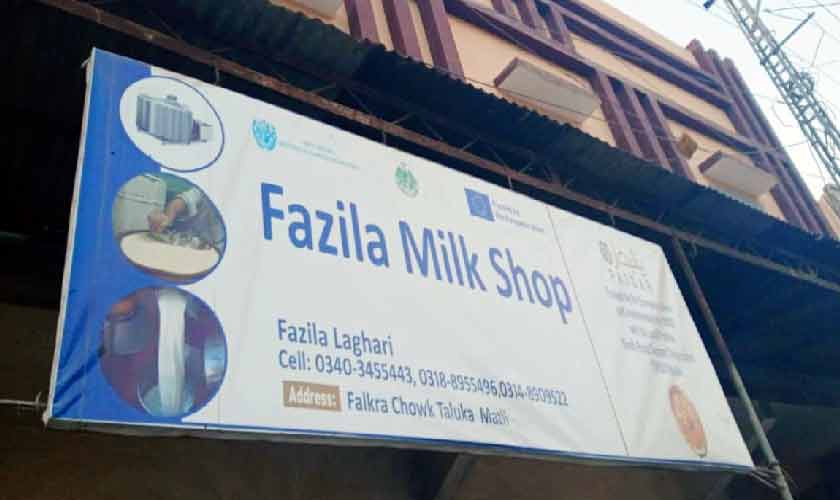
Economic independence reshaped her personal life. Her father apologized and made up. Her brothers returned. One of them says today, “We are proud of our sister. I regret how long it took us to understand her.” Fazila accepted them without bitterness and allowed them to work alongside her.
“When you start earning,” she says, “people revise their judgments.”
Asked to name the best moment of her life, she does not point to reconciliation. “It was when I became financially independent,” she says. “That is when people began to smile at me.”
Her demands remain pragmatic rather than symbolic: skills training, employment opportunities and community spaces. Pakistan’s Transgender Persons (Protection of Rights) Act of 2018 was widely welcomed, but a 2024 policy review by the Policy Research Institute of Market Economy noted that legal recognition has not translated into broad economic inclusion. “Without livelihoods,” the review concludes, “dignity remains theoretical.”
Fazila understands this gap intimately. Her future plans focus on supporting women and others living at the margins. “I have known hardship,” she says. “I don’t want it repeated.” In a society that often demands erasure before acceptance, Fazila Laghari chose persistence instead.
The writer is a researcher and development practitioner in Hyderabad, Sindh. He can be reached at [email protected]