Print Story
X

| E |
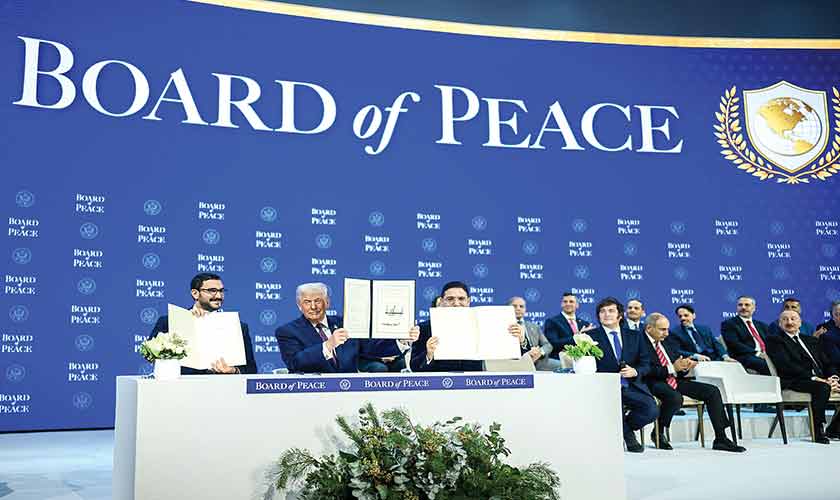
xaggeration is unnecessary. The official introduction of the Board of Peace by President Donald Trump on January 22, at the World Economic Forum in Davos, Switzerland, represents not a step toward stability but a significant and direct challenge to the principles of justice, fairness and collective human security. This programme demands united opposition before its mechanisms of monopolistic authority and commercialised influence become entrenched and irreversible.
Superficially, the board was presented as a supervisory body for the reconstruction of Gaza following the US-negotiated ceasefire under United Nations Security Council Resolution 2803, with a broad mandate to ensure stability, governance and peace in conflict regions worldwide. However, its structure raises profound concerns. President Trump has positioned himself as permanent chairman, with sweeping powers to appoint members and designate successors. Permanent seats are effectively commodified, reportedly requiring a $1 billion contribution in the first year. International peacemaking, therefore, risks being transformed into a transactional privilege—available only to those with sufficient resources and the willingness to conform.
More than 20 countries have agreed to join. These include Pakistan, Argentina, Hungary, Bahrain, Belarus, Bulgaria, Vietnam, Indonesia, Egypt, Jordan, Saudi Arabia, Qatar and the United Arab Emirates. Several prominent Western democracies such as France, Germany, the United Kingdom, Spain, Norway, Sweden, Denmark, Slovenia and Canada have declined participation, citing concerns over the board’s structure and its potential threat to the multilateral framework established after World War II.
Recent developments have only intensified these apprehensions. The inaugural high-level meeting of the board has been scheduled for February 19, in Washington, DC, at the United States Institute of Peace—reportedly renamed the Donald J Trump Institute of Peace. The meeting is designed not only as the board’s first formal session but also as a fundraising conference for Gaza’s reconstruction. Discussions are expected to cover governance structures, demilitarisation, security oversight and rebuilding costs estimated at up to $70 billion.
Stark authoritarianism is visible here. There is a remarkable concentration of executive power, the possibility of personal veto authority and the cultivation of alliances based more on regime preservation than on freedom. President Trump’s open disdain for the United Nations—which he has described as ineffective—constitutes a direct challenge to the collective security architecture designed to prevent global catastrophe. The prospect of incorporating crises such as Ukraine into the board’s jurisdiction raises deep concern. What is promised as pragmatic mediation may instead institutionalise bias, marginalise weaker states and cloak dominance in the language of efficiency.
The board was presented as a supervisory body for the reconstruction of Gaza following the US-negotiated ceasefire under United Nations Security Council Resolution 2803, with a broad mandate to ensure stability, governance and peace in conflict regions worldwide.
We confront this danger at a historical moment defined by stark realities, articulated forcefully by Canadian Prime Minister Mark Carney in his special address on January 20. Carney described the collapse of an era in which economic interdependence was mutually beneficial, replaced by great powers weaponising tariffs, financial leverage and supply chains. Institutions such as the United Nations, climate frameworks and the World Trade Organisation face existential erosion. Drawing on Vaclav Havel’s The Power of the Powerless, Carney urged middle powers to reject false conformity and pursue strategic autonomy in energy, food, critical minerals and defence, while building flexible coalitions rooted in shared values. Canada’s response has been decisive: tax reductions, removal of interprovincial trade barriers, a commitment to double defence spending by the end of the decade and expanded alliances across Europe, Asia, Latin America and the Middle East. Carney’s warning resonates sharply: if we are not at the table, we risk being on the menu. Inaction is surrender.
Hypocrisy threatens to intensify this crisis. For decades, Western powers have preached democracy and human rights to the Global South while selectively applying norms—intervening where convenient, imposing sanctions that devastate civilian populations and blocking institutional reforms they claim to defend. They now condemn the board’s pay-to-play structure and autocratic vision. Yet many leaders in the Global South have been quick to seek Trumpian patronage as insulation against accountability.
Pakistan’s participation demands introspection. Could we be compromising sovereignty and moral clarity for a temporary strategic cover?
History offers perspective. No system built on coercion is permanent. The Arab Spring dismantled entrenched dictatorships; apartheid collapsed; the Soviet Union disintegrated. Structures founded on force contain the seeds of their own undoing—internal dissent, economic fragility and relentless international scrutiny. The same fate awaits authoritarian tendencies that now emanate from Washington: executive aggrandisement, contempt for multilateral norms and the commodification of global power. Hubris is often the prelude to decline.
In this evolving landscape, the BRICS has emerged as a significant counterweight. Its expansion into BRICS+, incorporating members such as Egypt, Ethiopia, Iran, Indonesia, Saudi Arabia and the United Arab Emirates, along with partners including Belarus, Bolivia, Cuba, Kazakhstan, Malaysia, Nigeria, Thailand, Uganda and Uzbekistan, reflects a growing commitment to multipolarity, de-dollarisation and authentic South-South cooperation. Through initiatives such as the New Development Bank, joint exercises and collaboration in health, climate, artificial intelligence and peacekeeping, alternatives to US-dominated frameworks are materialising. China and Russia’s decision not to join the board underscores its structural fragility. It also signals broad geopolitical realignments that privilege consensus and non-interference over unilateral dominance.
The moment is critical. The Board of Peace is not a benign experiment but a challenge to the architecture of a just global order. As a Pakistani convinced of the structural weaknesses of coercive systems, I urge resistance—firm, collective and immediate—through diplomatic resolve, strengthened civil society and deeper engagement with alternative alliances such as the BRICS. History does not bend on its own; it must be shaped by those unwilling to surrender.
The writer is the central information secretary of the Awami National Party. He can be reached at [email protected].