Print Story
X




From Mohammed Hanif’s sharp satire to reflections on political regret, the three-day KLF dealt with some difficult questions
| F |
or a city that has many qualifiers, the good, the bad and the perpetually ugly, neglected, debilitated, fragmented and divisive, anything that allows people to come together to make sense of their collective predicament is a cause for celebration. Karachi has almost always lived in a fragile world of its own, an ecosystem of the possibility of opportunity challenged by a fractured history and constant uncertainty.
That reality, however, has now expanded into the wider world.
This year’s Karachi Literature Festival aimed to capture that sentiment in its 17th edition, with sessions encapsulating the challenges, hopes and fears within a broad theme exploring where literature fits in this mad, mad world. As Lahoris celebrated Basant after almost two decades, alongside their own editions of literary and cultural festivals over the past weekend, the three-day festival offered some respite to Karachiites who had been longing for the same and more.
In a session on how stories change the world, Sharmeen Obaid-Chinoy emphasised the importance, as a filmmaker, of addressing diverse issues. The session opened with a reel showcasing her work. The diversity was evident. From exploring climate change and hate speech to featuring the work of change-makers and heroes in society, various streams of films, documentaries and projects highlighted the stories of a country and its people.
“My role is twofold: highlight the work of heroes and people; and hold up a mirror to society and hold people accountable.”
Featuring well over 20 book launches, the festival brought together writers, thinkers, educators, journalists and policymakers to unpack the times we live in.
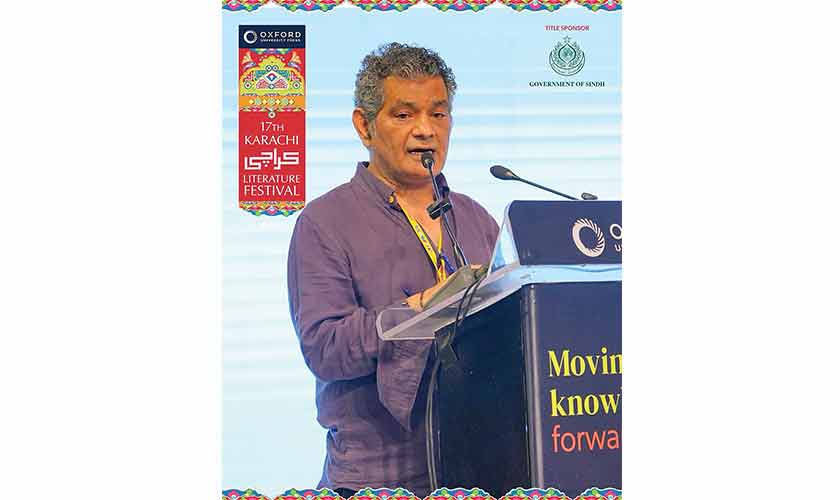
One of the festival’s main highlights was the much-anticipated launch of Rebel English Academy by Mohammed Hanif. The session began with Hanif reading an excerpt from his book, which opens in 1979. What followed was a cautious attempt to navigate the events and issues that have shaped the country, its people and everything in between over the past several decades. As if trained through years of practice, the audience picked up on the nuances, so that phrases like “the hanging” and “the institution” did not feel like hollow platitudes woven into a narrative but like lived and known realities.
“It took me seven years to write this book. After you’ve written it and it’s gone out into the world, you’re supposed to say intelligent, smart things about it,” Hanif said, prompting laughter. On the response to his latest book, which comes 18 years after A Case of Exploding Mangoes, and whether we remain as interested in critiques of power as before, Hanif responded simply: “Time will tell.” He added, “We can’t stop telling our stories; it’s our responsibility to tell their stories as well.”
Sipping water as he answered questions, Hanif could not resist blurting out at one point: “It’s a dirty job but somebody has to do it. I write novels.” That job has become increasingly difficult over the years. Hanif agreed. “If living people look like cartoons themselves, how do you make fun of them? How do you describe them? Things have become difficult to fictionalise.”
The conversation turned to harder questions as it progressed: thought and censorship. “Censoring thoughts is a higher form of censorship that I think is even more sinister.”
Censorship was also a broad theme in a session that examined media in the emerging world order. Journalist Ghazi Salahuddin picked up on Hanif’s remarks about fear and censorship. “In such an environment, truth can perhaps be better spoken in fiction than in the media.” Azhar Abbas, managing director at Geo News, said there were still many “brave people” who were writing and will continue to do so. “There’s still a lot being written and said in Pakistan… The editors have to guide their reporters and save the stories despite the censorship.” Abbas argued that the main challenge lay in the blurring of ‘red lines.’
From the much-contested and “flawed” financial model of journalism to censorship across various platforms and the credibility of mainstream media, the challenges facing journalism and journalists in Pakistan were examined in detail.
An observation by Ghazi Salahuddin regarding the lack of replacements for journalistic institutions like Newsline or Herald stood out. “Because the society never demanded or supported them,” he said. “This battle for freedoms isn’t only for the media or journalists to fight; this is a fight for the entire society. The media has not received the kind of support it requires from the society.”
For many in the audience, the importance of having a space to hold a dialogue, however constrained, was not lost amid the festivity of the event. Karachi Katcheri, for instance, saw Karachiites question power, authority and the city’s presumptively doomed fate. With the session focusing on the public and the police, discussions on the institution and corruption within the system allowed for a moment to appreciate why such events matter.
“Nasreen Jalil has been an integral part of the MQM’s story,” is how journalist Mazhar Abbas introduced the politician in a session that aimed to examine the “woman of substance.” What followed was a deep dive by Abbas into the politics of a party now on the margins, much to the annoyance of Nasreen Jalil, who would, every now and then, interject to remind the journalist of the unfairness of the questions put to her.
“What was it really that went wrong with the MQM?” asked Abbas.
“Things aren’t always the way they appear to be. When you have been subjected to so much injustice (extrajudicial killings, torture and forced disappearances), there will be a reaction. Violence breeds violence,” she replied.
“Look at the situation in Balochistan. We should learn from history,” she said.
A housewife who had previously worked at Behbud, Nasreen Jalil was imprisoned for three years. Recounting the ordeal that followed her political career and affected her family, Jalil spoke about Imran Farooq’s escape from the country, Altaf Hussain’s leadership and the party she had long been associated with. “There was a time one couldn’t hear a word against the MQM, just as the PTI isn’t willing to these days.”
“Did you win seats in the February 8 elections, or were you granted those seats?” Abbas asked. The small, intimate audience in the hall broke into a laughter. A bemused Jalil replied, “Here, there is always interference …”
“So who holds the remote control?” Abbas followed up. “Wrong question. I won’t answer it,” Jalil said, laughing at the audacity of it.
As for regrets about the MQM’s impact on politics, Karachi, urban Sindh and the party itself, Jalil said, “We wasted the last 30 years.”
So long as there remains hope in dialogue, connection and the coming together of people, such events will retain their value, even if they leave much to be desired.
T |
he venue had its trademark book section at the far end of the grounds. Booksellers and publishers, including Readings, Liberty Books, Oxford University Press, Paramount Books, Tawakal Academy, The Book Group, Gohar Publishers and Maktaba Daniyal, had set up their stalls under a large tent, as visitors made their way through to buy books by their favourite authors.
With the Gul Plaza fire tragedy still fresh in memory, the venue also provided stalls near the entrance for vendors affected by the inferno. They displayed their products in spaces named after their businesses, each suffixed with “Gul Plaza.”
The writer is a staff member.