Print Story
X




The recently concluded Lahore Literary Festival became a space to question what we are losing
| “W |
hy am I creating reality, why can’t I make my dreams and paint what I ought to see?” artist Tabinda Chinoy would likely say in a conversation with fellow intellectuals.
“Well, there is some truth to that. You don’t have to always figure everything out. Instead, one can choose to improve their surroundings and start somewhere,” would be a likely response from Geoff Dyer, author of Homework: A Memoir.
Joining this conversation, writer and curator Saima Zaidi would add, “For a long time I tried to find my style. It is a difficult journey to undertake. Shouldn’t we sometimes sponge in the environment around us? It affects us some way or the other,” turning to Deepa Mehta, the filmmaker.
“I am quite lost here. I believe this curiosity must drive one forward, to unravel the many different realities that ought to exist. Indeed, one such observation worries me upon hearing English being spoken around despite having an incredible native language,” she would respond.
This would intrigue cultural curator Kashif Shah to delve into the conversation, saying, “Maybe we should try and preserve this fabric of identity. Once a noble guy gave the clearest response to the question of not scraping away patches of history, of places that belonged to past inhabitants, who said, ‘What benefit does it give us? Relatives of these long-forgotten people travel here looking for their loved ones, grieving over what once was theirs.’ Let’s not rob ourselves of our roots and identity.”
“You’re right. Though the words begum and mem translated into English would be the same as ‘lady,’ we surely lose something in the process. We lose the essence of both words, which hold different levels of significance in the root language,” Daniel Majchrowicz, translator of A Journey to Mecca and London, would conclude.*
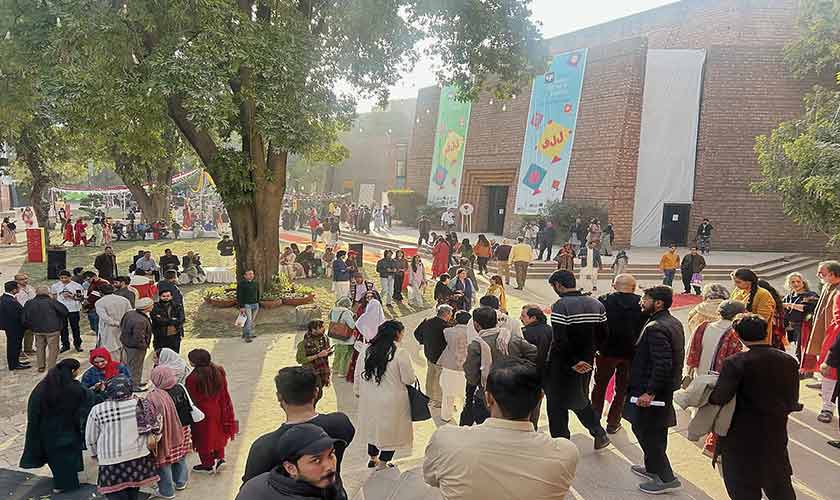
To bring together the different perspectives presented at the 14th edition of the Lahore Literary Festival, which took place - during Basant - at Alhamra, Lahore, I imagine this conversation to be the crux of all the ideas. Every session was stimulating. The questions posed by the audience further enriched the discussions. A widely discussed theme throughout the festival was Basant. Conversations centred on the reasons for its decline, from chemical-coated strings to deaths that turned the sport into a terrifying phenomenon. Farida Batool, dean of humanities at the National College of Arts, shared from her experience that while working on a project, even the silhouette of a kite had come to feel deadly. As Basant is reintroduced following years of suspension, the memory still lingers. After all, it is a cultural tradition to mark the arrival of spring, just as Sadeh is in Iran.
The discourse also introduced cross perspectives on intervention. Artist Risham Syed spoke of how, when power overtakes a festival, or when it takes over art, you lose its beauty. It gestures towards a wider understanding of how power shapes narrative, regardless of whether that authority lies in the hands of the government or private corporations and multinationals. Saima Zaidi, on the other hand, would not dismiss the government’s role entirely. She supported engagement between artists and governments, arguing that culturally sensitive individuals may be found everywhere and that collaboration between artists and officials could foster an understanding that surpasses individual efforts.
Several panels discussed themes of exploitation and the ways South Asian identity was overshadowed throughout history. Saiful Islam, the Dhaka-based author of Muslin, led an incredibly informative session on the history of muslin and its decline. In his work, he strove to restore to his nation what had been lost after reading a book published in England that made no mention of Bangladesh in the production of the cloth. The mulmul, as we call it here, was once the biggest cash cow for the East India Company. The Company nevertheless sought to introduce cloth produced in England to dominate in India, in other words to increase British imports, deprive locals of their muslin and have it transported to Britain for their own benefit. They went on to commit what Islam described as the “supreme act of corporate violence in world history.” Native weavers were reduced from artists to mere employees. The adverse effects of this exploitation continue to influence our lives. It is as if ideas of inferiority and superiority have become ingrained across generations.
Navigating similar themes, historian Jane Ohlmeyer introduced an Irish lens to the discussion. She noted how the Irish were depicted as barbarians, a label that racialised their community despite their being white. What private chartered companies such as the East India Company were determined to pursue was the exploitation of local populations by whatever means necessary.
Several sessions highlighted current developmental projects taking place in the city. A highly engaging session on Patras Bokhari, the renowned humourist and diplomat, traced his life and times through documentary clips, including memorable cameos by Zia Mohyeddin. Patras’s grandson, Ayaz Bokhari, revealed that he had created a website dedicated to his grandfather, primarily for students working on assignments in need of resources. Simple as it might seem, such efforts should be acknowledged, not only to support young scholars but also to preserve and present to the world the remarkable work of Pakistani literary pioneers.
Najam-us-Saqib, director general of the Walled City of Lahore Authority, spoke about the numerous tangible and intangible restoration projects undertaken by the authority, particularly the identification and restoration of havelis and the spice bazaar. He said the entire Walled City would be transformed over the next two years, without compromising its heritage or overly commercialising it. Some areas next to the Walled City, such as Neela Gumbad, will also be refurbished.
I’d like to conclude on a rather subtle theme that resonated strongly. Isolated, our society is perceptibly losing its spark. Not isolation in a strictly literal sense, but in the way architecture has evolved to limit the geniality of a shared neighbourhood. During her project on Basant, Farida Batool noted that whenever she climbed on to rooftops in Old Lahore, each homeowner would welcome her team, provide electricity for their use and contribute to a wholesome atmosphere that now feels increasingly distant. In some of the posh housing societies, the spirit was lacking.
Najam spoke about increasingly larger houses that nonetheless lack the connection of knowing the neighbour next door. It is worth noting this detail gradually permeating the society. It is equally worth exploring why such dividing walls were erected in the first place. Nothing, after all, emerges without necessity.
*The dialogues are not verbatim. They, however, convey the essence of what each panellist brought to the sessions.
The writer is a student at LUMS with an interest in foreign languages,particularly German. She may be reached at [email protected]