Print Story
X




At the 14th Lahore Literary Festival, Basant and conversation converged to revive the city’s cultural spirit
| L |
iterary festivals add to the beauty of a culture. They help resuscitate and revive the literary soul of a megalopolis. They serve readers who have long aspired to meet the authors whose books they have read and greatly admired. Such activities and events are now few and far between. Unfortunately, they are sometimes dismissed as a relic of the past.
The much-awaited 14th iteration of the Lahore Literary Festival coincided with the Basant Festival. Basant took place after a hiatus of 19 years. For a Lahori like me, it was difficult to decide between staying on the many chhats I was constantly on and attending the festival. I managed to be there on Saturday and attended some sessions. It was a great delight to be in the company of so many diverse intellects gathered from across the globe to discuss, listen and spark debates about the remarkable influence of the written word.
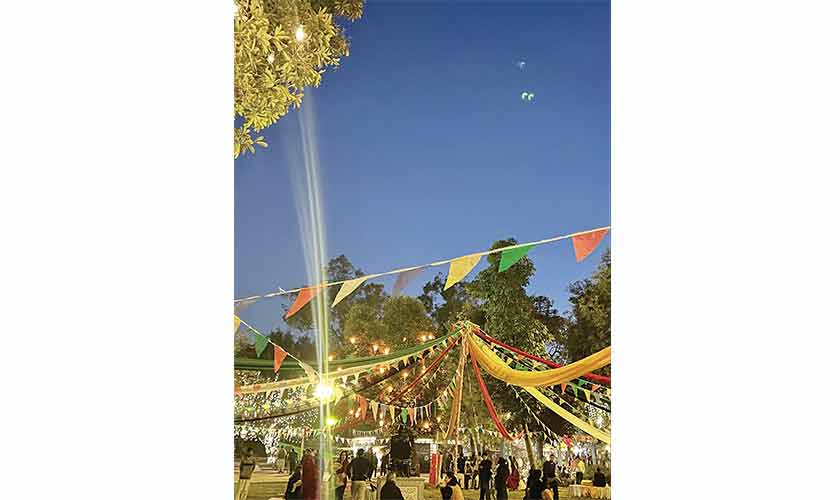
The festival, which took place at the Alhamra on The Mall from February 6 to February 8, reaffirmed and reinvigorated the identity of Lahore as a hub of literature. With colourful, rectangular buntings, a live kite-making stall and the sing-song tunes of the flute inspired by popular Punjabi scores the venue was bedecked to welcome the spring season and the audience.
The first session I had the pleasure of attending was on the non-fiction book But Beautiful by Geoff Dyer, an English author of numerous acclaimed books. He was in conversation with Saba Karim Khan, the filmmaker, author and educator. Dyer spoke as though quietly recounting the process by which his book came into being. He said his father had been very mean with money. However, he had agreed to buy his son a record player. The father then realised that he would also have to buy him a record every week, because records were being released weekly. Dyer said this caused him great anguish to his frugal father. The anecdote amused everyone.
About his book, Dyer remarked, “I did not know anything about music, particularly jazz.” He continued, “I was absorbing jazz without realising what it meant. It was so mysterious to me that I learned a lot about it and ended up writing a book on jazz,” he added.
My fledgling interest in mystery fiction led me to attend the launch of Maha Khan Phillips’s new novel, The Museum Detective. The session was quite intriguing. The novel turned out to be based on real-life events. One of the panellists, Asma Ibrahim, a director of the State Bank Museum, showed photographs of a mummy that had been falsely claimed to be that of a Persian princess. She said some people had attempted to sell it for a staggering sum.
Hassan Tahir, editor of the Aleph Review, moderated the session. He posed Phillips a question that caught her off guard. He asked how she had decided to move the narrative from 2000 to contemporary times. She paused for a moment and said, “I actually did not think of this question coming my way.”
Literary festivals help resuscitate and revive the literary soul of a megalopolis.
Phillips also spoke about the setting of the novel. She hoped the readers would come to know the raw Karachi - its odours, fragrances and the lives of its residents. “Even those who have not been to Karachi will get to know about the city and its culture,” she said.
The session concluded with remarks by Phillips. She said she was dejected that there whereas there had once been an international tug of war over the body, after some time, everyone had forgot about it. That was what prompted her to acquire the creative rights and write a novel about the episode.
The last session I attended was the launch of Three Begums: The Women Who Shaped My Life by Ziauddin Sardar. The session began with a heartwarming remark by the author. He said, “Literature is part of our soil.” He added, “Women in our home would read books and nudge us to follow suit. I was lucky because I was the eldest child in the house. I learnt a great deal in their company.”
Moderator Sadia Zulfiqar, an assistant professor at LUMS, asked how he had felt after losing all three women over a short span. “It made me think of my own death,” he said.
Commenting on the time when he underwent a surgery, he said, “The doctor entered the operating theatre and said to me, ‘Say your prayers.’ The word that came to my mind was ‘shit’.”
“Emotions were a way of knowing things for me,” Ziauddin revealed. “You have to be emotional to be creative,” he remarked. He said he would break down while writing the book. Then he would stop writing and try hard to gather his thoughts.
Towards the end of the session, someone asked him to describe his connection with the three languages he knew. He said, “I think in English, feel in Urdu and pray in Arabic.” He said he was profoundly influenced by Urdu poetry.
By the time I thought of leaving the venue, the night was still young. Reclining against a bolster on the lawn, I looked up at the sky and saw a kite tangled in a bough. At the same time, an aeroplane crossed the skyline right above the kite. I took it as a hint and made for home, where countless kites awaited me.
The writer is a literary critic and storyteller.