Print Story
X




At a moment when people are questioning what major cultural institutions stand for, the Grammys ’26 became a mirror for not just the Recording Academy but the world outside of it. It was messy, political, ambitious and unpredictable. In other words, it felt real.
| F |
or decades, the Grammys have wrestled with an identity problem. Are they music’s highest institutional honour or a televised pop culture spectacle built for viral relevance? The 2026 ceremony suggested that the Recor-ding Academy was no longer trying to choose. Instead, it leaned into both, producing a broadcast that was politically charged, visually elaborate and deeply reflective of the industry’s changing nature.
The night belonged, unquest-ionably, to Bad Bunny. His album Debí Tirar Más Fotos won Album of the Year, making history as the first Spanish language album to take the Grammys’ biggest award. It marked a turning point, showing that Latin music is no longer just crossing borders but being embraced at the highest level. More importantly, it signalled that the Recording Academy is finally paying attention to music beyond the traditional English-speaking mould.
What made the moment even more powerful was what Bad Bunny said when he reached the stage. Before thanking anyone, he declared “ICE out” and launched into one of the evening’s most politically charged speeches. “Before I say thanks to God, I’m going to say ICE out. We’re not savages, we’re not animals, we’re not aliens. We’re human and we are Americans. The only thing more powerful than hate is love so we need to be different. If we fight, we have to do it with love. We don’t hate them. We love our people, we love our families and that’s the way to do it. We love.”

This wasn’t mere performative activism signalled through an Insta-gram post. It set the tone for an evening where music and activism felt impossible to separate. Bad Bunny’s win was not just a personal victory but part of a broader reshaping of the Grammys.
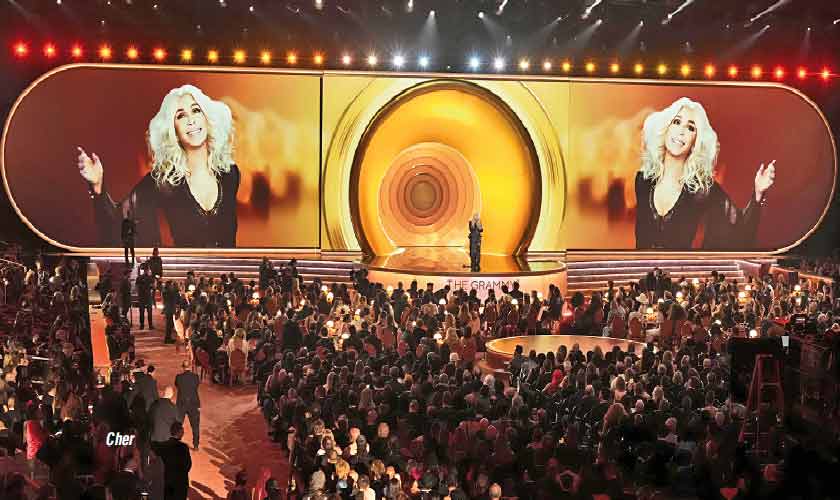
Kendrick Lamar made history again. His Record of the Year win with SZA for ‘Luther’ made him the most decorated rapper in Grammy history. The moment became even more unforgettable when presenter Cher accidentally announced “Luther Vandross” before correcting herself, creating a brief, cringe-worthy slip. Accepting the award alongside Lamar, SZA spoke about belonging. “Please don’t fall into despair. We can go on. We need each other. We’re not governed by the government. We’re governed by God.”
It echoed a sentiment that has long been a part of Lamar’s visual language through performance. Remember the crown of thorns he wore during Glastonbury in 2022 when the U.S. Supreme Court overturned Roe v. Wade and he closed the set with ‘Savior’ from his album, Mr. Morale & The Big Steppers. Blood dripped from his head through the crown as he chanted, “They judge you, they judge Christ. Godspeed for women’s rights.”

In other major categories, Billie Eilish and Finneas added another Song of the Year win to their growing collection, a moment that felt like a quiet correction after the Academy overlooked her last year for ‘Birds of a Feather’ which was a major snub. This year, it was Eilish’s speech that resonated most. “No one is illegal on stolen land. It’s really hard to know what to say or what to do right now but we need to keep figh-ting, speaking up and protesting.”
Immigration, identity and belonging surfaced throughout the night. British singer-songwriter Olivia Dean brought the theme back to her own story when she won Best New Artist. “I am up here as the grand-daughter of an immigrant. I’m a product of bravery and I think those people deserve to be celebrated.”
The ceremony increasingly felt less like a celebration and more like a conversation by artists who were not afraid to speak up. Perhaps the evening’s most unexpected win went to Lola Young for Best Pop Solo Performance for ‘Messy’, a raw and emotionally fractured track that beat the usual chart heavyweights. Her shocked reaction and unscripted speech became a truly human moment that cut through the noise, amplified by her recent public dis-cussions about sobriety and mental health. “I don’t have any speech prepared. Obviously, I don’t. It’s messy, do you know what I mean?” she continued, visibly emotional. “I don‘t know what to say. Thank you so much. You can tell by my face. I’m very, very grateful for this. Nick [Shymansky], we did it, Mum. I love you.”

Just months earlier, Young had collapsed onstage at the All Things Go festival and cancelled everything to step away. Her stripped-back piano performance earlier in the night had already earned a standing ovation. The win felt like the room collectively saying, “we see you.”
Not everyone went home happy. Sabrina Carpenter and Chappell Roan, two of the biggest names in streaming and touring right now, walked away empty-handed, a reminder that the Grammys still enjoy keeping audi-ences guessing. Carpenter did, however, deliver a performance that quickly became a talking point, transforming the stage into a retro airport baggage claim for ‘Manchild’, complete with camp humour and sharp choreography. Her vocals were not perfect but the performance was visually fun and a little weird.
Justin Bieber went in the opposite direction. For ‘Yukon’, he stripped everything back and delivered a raw, intimate performance. Bieber ditched back-up dancers, pyro and gimmicks and chose silk boxers, a guitar loop machine instead. In a night filled with colourful performances, Bieber pro-ved that sometimes the quietest performances are the ones people remember the most, even if the baring of skin felt quite unnecessary.
Tyler, the Creator went in a very different direction in terms of his performance. It was bold and wildly ambitious. His mash-up of ‘Thought I Was Dead’ and ‘Sugar On My Tongue’ played like a short film, beginning in black and white with a moody noir vibe before bursting into colour with elaborate sets, costume changes and a full narrative arc. Was it a bit much at times? Maybe. His vocals got a little lost in all the chaos, but the ambition was undeniable. Tyler has become an artist who treats every performance like a piece of art.
Lady Gaga reminded everyone why she is still the queen of theatrics. For ‘Abracadabra’, she appeared in a massive sculptural headpiece, surr-ounded by strobing lights and intense choreography. The performance fused rock energy with piano and guitars, echoing the chaotic glamour of her early career. Her vocals, however, remained strong and consistent throughout.
Bruno Mars delivered exactly what he does best. He opened the ceremony with Rosé, turning ‘APT’ into a high energy rock pop moment, then returned later with his solo single ‘I Just Might’, leaning into funky and nostalgic vibes.
Nothing groundbreaking, but entertaining nonetheless.
The Best New Artist medley has become a Grammy staple and this year’s lineup was packed. The Marías, Addison Rae, Katseye, Leon Thomas, Alex Warren, Lola Young, Olivia Dean and Sombr all took the stage. The performances were polished and tightly choreographed, perhaps too polished, lacking the raw electricity of past years. Still, it did what it was meant to do, placing newer artists front and centre instead of treating them as an afterthought. Olivia Dean’s disco groove and Sombr’s high energy crowd interaction were the clear highlights.
The tributes formed the emotional core of the broadcast. Lauryn Hill honoured both D’Angelo and Roberta Flack with a moving rendition of ‘The First Time Ever I Saw Your Face’, capturing the reverence of Flack’s legacy. Wyclef Jean, Leon Bridges and Chaka Khan followed with ‘Killing Me Softly’, creating one of the Gram-my’s most terrific in memoriam per-formances.
Post Malone surprised audiences with a tribute to Ozzy Osbourne, covering Black Sabbath’s ‘War Pigs’ in a way that felt unexpected but effective.
Pharrell Williams and Clipse closed the night with ‘So Far Ahead’, a gospel-inspired performance feat-uring a choir dressed in Louis Vuitton couture. It was flashy but also thoughtful and felt like a fitting finale for a duo that had been critically praised for years but slow to receive mainstream recognition.
Earlier in the night, Clipse won Best Rap Performance for ‘Chains & Whips’. Finally.
Not everything landed smoothly though. Country music fans were vocal about the lack of a dedicated performance slot, despite wins by Jelly Roll and Zach Top in newly split categories. Given how massive the genre is right now, the omission felt like a glaring oversight.
Beyond the music, the ceremony was shaped by its political atmos-phere. Trevor Noah, hosting for the final time, walked a careful line with jokes about Donald Trump and Jeffrey Epstein. He also made jokes about Nicki Minaj, who went from anti-MAGA (Make America Great Again) in 2020 to pro-MAGA in 2025, even calling Donald Trump America’s ‘Best President’ at a recent event. But Noah knew this was the perfect platform and it certainly was.
The backlash and threats of legal action that followed only reinforced what the Grammys have become, not just an awards show but a collision point for entertainment and politics.
Ultimately, the 2026 Grammys worked because they were messy. Spectacle and sincerity, activism and entertainment, legacy acts and emerging voices all existed side by side. The show did not attempt to resolve its contradictions. It emb-raced them. And perhaps that is the point now. The Grammys are no longer just about trophies. They are an unpredictable snapshot of where music and culture stand, for better or worse.