Print Story
X




Afghanistan’s growing role in precursor chemical supply chains has enhanced its influence in global narcotics markets
| T |
he 2025 Turkish Drug Report presents a sobering portrait of an illicit drug market undergoing rapid transformation in which Afghanistan remains central despite dramatic shifts in production methods, trafficking routes and market strategies. Far from diminishing the country’s role, recent developments indicate that Afghanistan has adapted to global pressures with calculated precision—reshaping its narcotics economy rather than abandoning it.
The report underscores a global trend: the gradual movement away from traditional plant-based narcotics toward synthetic drugs and new psycho-active substances (NPS). This evolution has fundamentally altered trafficking dynamics, criminal business models and law enforcement challenges. Türkiye, positioned at the crossroads of Europe and Asia, has emerged as a critical transit hub on the Balkan Route for heroin, simultaneously becoming a key corridor for cocaine and methamphetamine from Latin America.
This transformation, the report notes, is not accidental. It reflects a strategic recalibration by organised crime networks seeking to lower production costs, reduce risks and evade detection. In this new landscape, the fight against drugs has ceased to be a purely national concern and has become a matter of trans-national security.
Despite political upheaval and international isolation, Afghanistan remains one of the world’s primary sources of illicit narcotics. The 2025 report confirms that the country continues to dominate global opiate production, even after the Taliban’s 2022 decree banning poppy cultivation and narcotics trade.
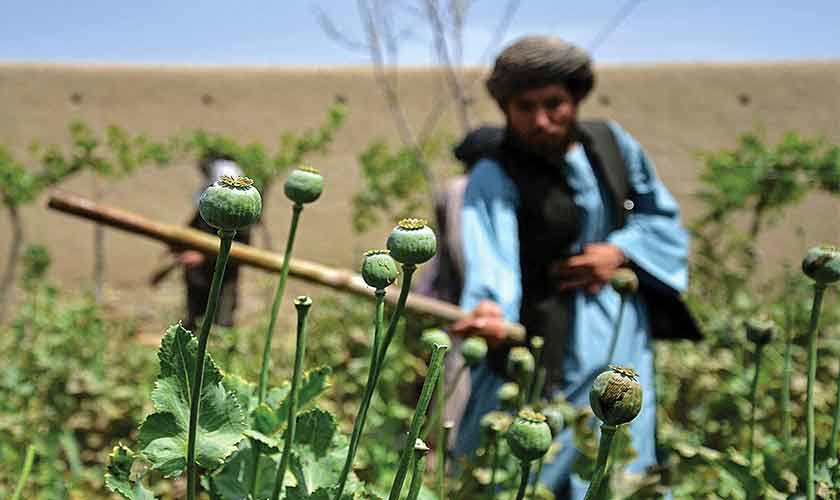
That ban, widely interpreted at the time as a potential turning point, has produced uneven outcomes. While opium production reportedly dropped by 95 percent in 2023—allowing Myanmar to temporarily surpass Afghanistan as the world’s largest producer—the decline was neither permanent nor comprehensive. By 2024, poppy cultivation had rebounded by 19 percent, rising from 10,800 to approximately 12,800 hectares.
This rebound, the report suggests, was not a failure of enforcement but part of a controlled recalibration.
For decades, Afghanistan supplied nearly 80 percent of the world’s illicit opium. This dominance created a vast and resilient infrastructure encompassing cultivation, processing, storage, trafficking routes and cross-border logistics extending across West Asia, Central Asia, Europe and Africa.
When the Taliban returned to power in 2021, this infrastructure did not vanish. Instead, it became the backbone of a more centrally managed narcotics economy. The April 2022 poppy ban was introduced not to dismantle drug production but to correct a glut in global opium markets caused by years of overproduction.
By imposing a cultivation ban while granting a 10-month grace period to sell existing stocks, the Taliban engineered an artificial scarcity. This move triggered a sharp rise in prices, transferring market power away from small-scale farmers and toward traffickers and stockpile holders. The result was a restructuring of profit flows.
The effects were immediate. Global heroin supplies contracted and prices surged. Afghan traffickers—buffered by years of accumulated reserves—remained insulated from the downturn. By 2024, dry opium prices had soared to $780 per kilogramme, up from $110 in 2022. Stockpiles accumulated during surplus years are believed to be sufficient to sustain trafficking operations until at least 2026.
The report claims that enforcement under Taliban has been selective. While poppy cultivation was publicly restricted, laboratories, storage facilities and trafficking corridors remained largely intact. The crackdown focused on visible cultivation and spared the deeper infrastructure of the drug trade.
This approach allowed drug flows to slow temporarily without collapsing altogether. In effect, the Taliban shifted from a volume-driven economy to one based on managed scarcity, market timing and strategic release of supply. The result has been greater leverage over international drug prices and trafficking dynamics.
Selective enforcement also enabled the controlled re-introduction of cultivation when market conditions demanded it. The 19 percent rise in poppy cultivation in 2024 reflects this flexibility rather than a loss of control.
Perhaps the most consequential development highlighted in the report is Afghanistan’s rapid expansion into synthetic drug production—particularly methamphetamine. Unlike opium, synthetic drugs do not depend on agricultural cycles, weather conditions or large farms. They are cheaper to produce, easier to transport and harder to detect.
Afghanistan’s abundant ephedra plant has provided traffickers with a readily available source of ephedrine, a key precursor in methamphetamine production. The report notes a sharp increase in seizures of Afghan-origin methamphetamine across neighboring countries and as far afield as Europe and East Africa.
This shift has strategic implications. Synthetic drugs offer higher profit margins, faster production cycles and greater resilience against law enforcement pressure. Laboratories can be relocated quickly, production scaled up or down with ease and shipments concealed more efficiently than bulk agricultural narcotics.
Crucially, the Taliban’s ban on poppy cultivation has not hindered this synthetic drug expansion. On the contrary, it appears to have accelerated diversification, allowing drug revenues to continue flowing while public attention focused on opium reductions.
Afghanistan’s growing role in precursor chemical supply chains enhances its influence in global narcotics markets. Control over these inputs allows actors to shape production not only domestically but across the wider region. This upstream position gives Afghan networks leverage far beyond their borders, strengthening their role in transnational criminal economies.
The result is a drug system that is more adaptive, more profitable and more resilient than before. Rather than diminishing Afghanistan’s role, recent developments have entrenched it as a central node in the global narcotics trade.
The 2025 Turkish Drug Report portrays Afghanistan as a country that has refined its drug economy.
The report suggests that trough managed scarcity, selective enforcement, stockpile control and diversification into synthetic drugs, Afghanistan has reshaped its position within international drug markets. It says the narcotics trade is less as an uncontrolled byproduct of instability and more a calculated system.
Such a transformation can have consequences far beyond Afghanistan’s borders. It can fuel addiction crises, strengthens organized crime, undermines regional security and complicate international counter-narcotics efforts. As synthetic drugs spread and trafficking routes diversify, the challenges facing law enforcement agencies from Europe to East Africa may grow more complex.
The report’s conclusion is unambiguous: Afghanistan remains at the heart of the global drug trade—not despite recent changes, but because of those. It says the country’s evolution from mass producer to market manager signals a new phase in the international narcotics economy.
The author works for The News. He can be contacted at [email protected].