Print Story
X




In between claims of development and chaos lie the realities of the people living in and around Quetta
| L |
ast month, 22-year-old Laiba was travelling back to Quetta with her family after attending the wedding ceremony of a cousin in Lahore. On reaching Sakhi Sarwar at around midnight, they learnt that they would have to wait there till morning. “We were stopped at Sakhi Sarwar for at least five hours because security clearance was not forthcoming.”
Chief Minister Mir Sarfraz Bugti has claimed on several occasions that there are no no-go areas in the province and that militants can do no worse then “come and make TikTok videos for a while and then leave.”
Balochistan, Pakistan’s southwest frontier province, borders with Afghanistan and Iran and has a 700-kilometre coastal belt along the Arabian Sea. Despite its fabled mineral wealth, it is the country’s least developed province.
For more than two decades now, it has faced separatist militancy, sectarian violence and a surge in religious extremism.
In Quetta, Grand Alliance, a coalition of 42 organisations of government employees, has been protesting for the last seven months for a disparity reduction allowance (DRA).
Rashida Sumalani, a core committee member of the Grand Alliance, says the protesting workers represent the backbone of the system. “There are more than two hundred thousand government employees in Balochistan.” She says that DRA is being paid in all provinces except Balochistan.
While a jail bharo movement by government workers continues, the government has initiated several development projects. Under the umbrella of the Chief Minister’s Development Programme, several road projects are under way in Quetta city. The capital’s beautification projects are an extension of the projects initiated by former chief minister Jam Kamal.
Trains and travel
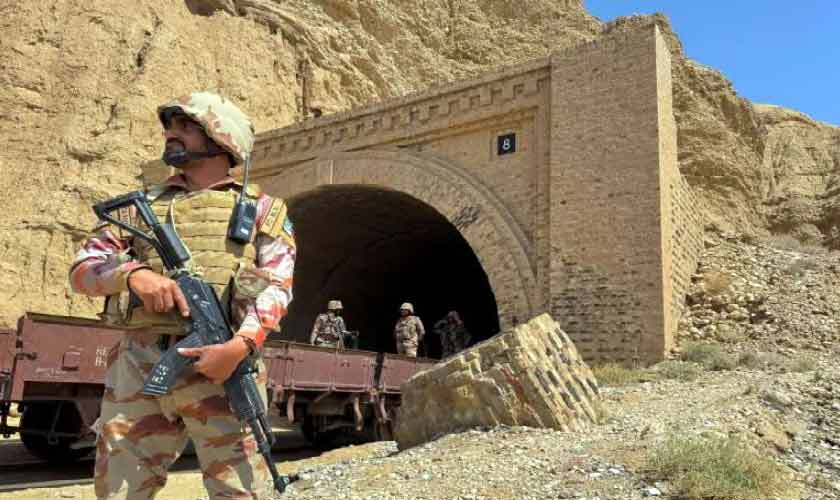
In August, Chief Minister Bugti had announced the initiation of a train service between Sariab and Kuchlak in order to provide safer and more efficient travel options to the residents of Quetta. This service has yet to begin.
Asked for his comment, Balochistan government spokesman Shahid Rind said he would require more time to get back with details on progress the development projects are making.
“Since the Jaffar Express incident, my family has been avoiding travelling by train,” says Laiba. The Railway Department has appointed security personnel to travel on board and added two bulletproof bogies. The train has resumed service for Sukkur, Lahore, Rawalpindi and Peshawar, but some of the travelling public have still to overcome the fear.
Border area livelihoods
Pakistan Peoples Party, best known for its Roti, kapra aur makaan slogan is a part of the ruling coalition at the Centre besides leading the provincial government. However, border trade with Afghanistan has remained suspended since May 2024. The more than two million people associated with this trade have been hit hard.
Waja Pullain Baloch, member of the National Assembly from Panjgur-Turbat, spoke to The News on Sunday over telephone: “Border closure has affected all of Balochistan,” he said. “The entire economy in the region has collapsed. Earlier, there used to be a mechanism for business and people engaged in various activities were registered by the government.”
“It may be inaccurate even to describe the various activities as business; some people used to work for daily wages. There were labourers, mechanics and menials,” Baloch added.
Abdul Nafi, the Chaman Chamber of Commerce and Industries president, says that the entire Pashtun belt in Balochistan, especially Chaman, has been affected, where most livelihoods had depended on cross-border trade. Many people are now struggling to meet basic needs as they lack alternative sources of income, he adds.
Clashes between Pakistani and Afghan border guards near Chaman and Spin Boldak have further complicated the situation.
Thousands of workers and traders are stranded. According to Abdul Nafi, “This has created serious financial stress for the affected traders and their families. The anxiety is worsening by the day.”
Border management is a federal subject. Meanwhile, nobody has come forward and accepted responsibility to ensure that the affected people have adequate opportunities and employment alternatives.
“Many more people have now become unemployed due to new restrictions on the Iranian border,” says Najib Saleem, head of the Border Bachao Tehreek, a movement for protection of labourers along the Iranian border.
Restrictions on informal trade with Iran have not only affected the livelihood of locals but also impacted the supply of food through these border crossings. “All bordering districts depend on Iranian edibles supplies. The authorities should let these items through,” says Saleem.
Rights and protections
The government has allegedly apprehended scores of people volunteering arrest under the Grand Alliance’s jail bharo movement.
In March last year, Baloch Yakjehti Committee’s central leaders were arrested during a protest in Quetta.
BYC leaders, Dr Mahrang Baloch, Sabghatullah Shah, Gulzadi, Bebo Baloch and Bebarg Baloch are behind bars under various charges including incitement to riots.
Laiba remains an optimist. “I am hopeful that the security situation will improve and the fear and restrictions will soon come to an end.”
The writer is a journalist based in Quetta. He covers conflict, politics, climate, migration and environment, and human rights. His X handle: @khaliqkhn. He can be reached at [email protected].