Print Story
X




Pakistan’s artists have re-worked shared histories into new visual languages
| T |
wo independent states, after their split from what was historically known as India, formed their separate cultural identities. This manifested in multiple ways. For example, dance flourished in India but faced a considerable decline in the Islamic Republic. Qawwali from Pakistan emerged globally as a strong genre of music in comparison with its counterpart in India. Bollywood conquered continents across the planet, whereas Pakistan’s film industry never enjoyed success on such a scale.
Another factor behind these disparities, in addition to the migration of maestros, inequality of resources, shifts in public taste and the diversity of languages, regions, faiths and customs, was monetary support, whether from patrons, the state or the market. This could be one reason for the divergent histories of traditional miniature painting in the two nations. In India, there have been numerous makers of miniatures, especially in Rajasthan, but their products are mainly sold to tourists, in hotel lobbies, at craft shops and, surprisingly, on pavements. Some can be found in state emporiums too, though their prices are rarely higher than those of other artefacts and are, in some cases, even rated low.
In Pakistan, due to its shrinking tourist industry, many traditional streaks of creative expression found unexpected outlets. One brilliant example is the revival of miniature painting as a means of formal and conceptual inquiry, led by artists such as Zahoor-ul Akhlaq, Jamil Naqsh and Bashir Mirza; initiated in the studios of the National College of Arts, where it was originally taught by Ustad Haji Sharif, Sheikh Shujaullah and Bashir Ahmed; and producing a generation of neo-miniaturists. Similarly, the minimal official encouragement for textiles, pottery and experimental jewellery not only expanded prestigious and established venues for these practices. Its absence also stimulated practitioners of art and design to explore threads of history in order to weave the narratives of their times.
Salahuddin Mian was one such figure. He contemporised conventional pottery by adhering to its historic motifs and materials, while simultaneously presenting a personal and unique view of age-old forms. Iram Zia Raja has been pursuing the same path for some years. With a number of solo exhibitions to her credit, she combines traditional patterns in a new order to represent, or, more accurately, to emphasise, the significance of tradition. In doing so, she follows the American art critic and curator Henry Geldzahler, who describes art as “making it new,” elaborating it as the transformation of an already existing material, image or idea, through a range of methods, techniques or technologies into a completely new, unseen and extraordinary entity.
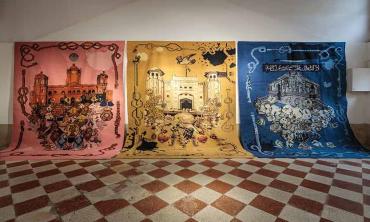
At her solo exhibition Narratives of Form, Past and Present (January 18-27, Numaish Gah, Lahore), Iram Zia Raja presented work in two formats: tapestries and jewellery pieces. These are, at first glance, distinct objects serving different functions, yet they are connected by Raja’s excavation of the pictorial history of South Asia, an engagement shaped by her training as a scholar of art history and her effort to re-interpret it through a complex and creative lens.
More than motifs, materials or colours, it was the artist’s sense of freedom that travelled from one surface to another; from one scale to the next; from two-dimensional to three-dimensional form; and from thread to metal and stone.
As a result, it was impossible to segregate the woven work on the walls from the wearable objects displayed on the blackened takhties. More than motifs, materials or colours, it was the artist’s sense of freedom that travelled from one surface to another; from one scale to the next; from two-dimensional to three-dimensional form; and from thread to metal and stone. Central to this practice was an attempt to claim what emerges from a shared history, not only of the subcontinent but also of Muslim image-making, made evident through the incorporation of calligraphic elements and spatial relationships associated with miniature painting.
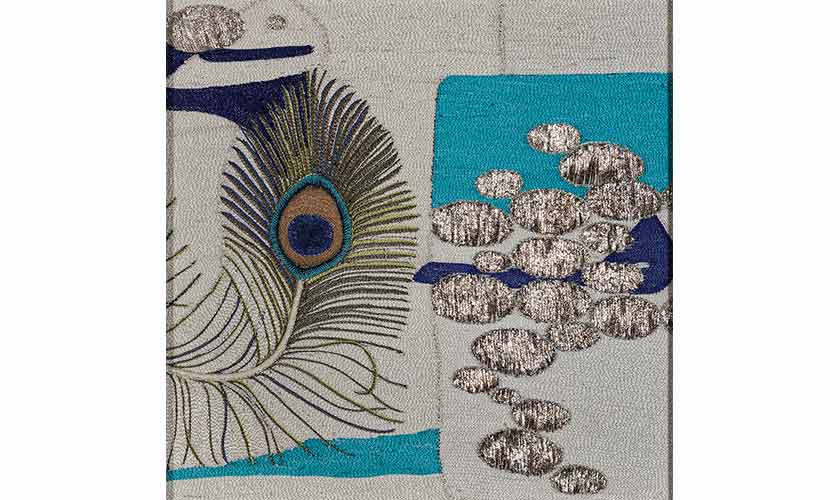
This tendency was evident in the series of her small works (A Thread in Time, 2025). The artist fabricates illusions of location, intuitive, intriguing and unreachable — using varying silk threads woven with tilla. In one image, silvery outlines of space appear to engulf a coppery field, all set beneath an expanse of rich blue, further punctuated by a slender stream cutting through a horizontal plane. In another, a dominant traditional motif made in silver tilla is suspended against a dark blue ground. A possible rationale for the presence of this element lies in its repeated appearance in religious manuscripts, either as a gap between two lines or along the margins of the written page. If the entire visual language of the tapestry were translated into the idiom of miniature painting, it could easily be transformed into a nocturnal court scene, complete with a low marble fence, earthy rugs and a night sky illuminated by a full moon.
Another feature that binds Iram Zia Raja’s textiles to miniature painting is her use of motifs. In her case, however, the pattern does not remain confined to the margins but occupies a central role in the composition. In one work from the same series, the ocelli of a peacock’s tail, almost like a blooming flower, enter one half of the composition alongside unidentifiable oblong forms rendered in silver tilla. By concentrating on a sparse palette, mainly cotton white, ultramarine blue and cerulean blue, the artist heightens a sense of abstraction in the image, one that is rooted in tradition yet executed through conventional handwork.
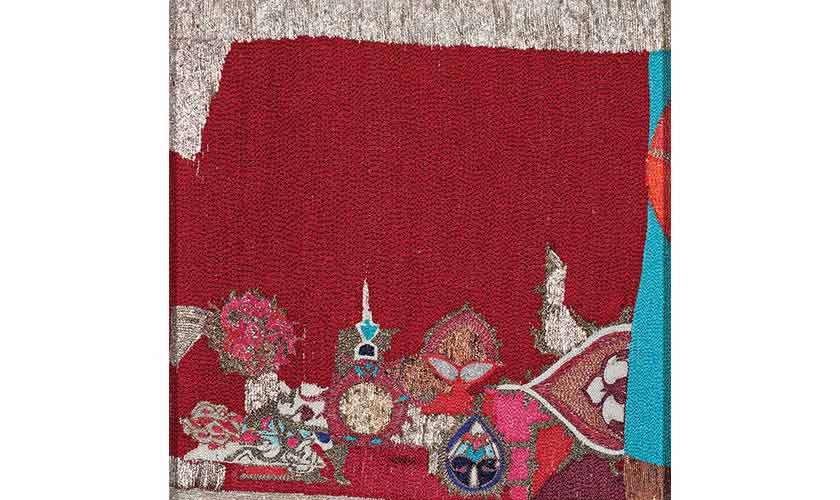
In two other works of the same scale (12x12 inches), a similar approach to visual heritage is evident. A striking quality of the series, however, is the artist’s subtle judgment and deliberate decisions in placing one tone next to another, one hue alongside the next and one detail bordering a vast field of colour. Areas of crimson touch vermilion, edged with a band of cerulean blue, all firmly positioned atop an array of small patterns, patches, spots and marks, making each work a world unto itself, inviting the viewer to concentrate on and contemplate its microcosm.
Raja’s larger tapestries, titled Patterns of Desire, reveal another, more structured set of layouts. Seemingly based on symmetry, repetition and chromatic harmony, these vertical works nevertheless deviate from conventional boundaries, suggesting how a visual artist may carve out freedom while working within a system. In these pieces, the soft and gradual shifts of shade, along with the careful coordination of pattern, contribute to the artist’s larger aim: reinterpreting history rather than representing or replicating it.
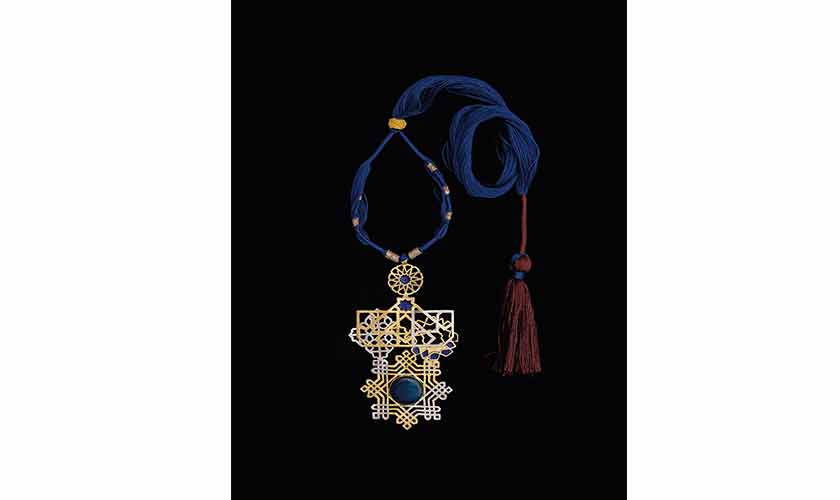
A similar flair of mind is visible in Raja’s jewellery as well. The wearable pendants, including Geometries of Time I, in their construction and colour, act as companions to the work hanging on the walls. Iram Zia Raja has been refining the language of jewellery for many years, as seen regularly in her solo exhibitions at Canvas Gallery, Karachi. In the recent show, however, the dichotomy between tapestry as textile and jewellery as product appeared to diminish. In her new creations, the passage of techniques, motifs, colours and sources of inspiration from wall to pedestal, or from brick to neck, was swift, sensible and soothing.
The writer is a visual artist, an art critic, a curator and a professor at the School of Visual Arts and Design, Beaconhouse National University, Lahore. He can be contacted on [email protected]