Print Story
X




Why a BBC correspondent’s unsparing view of India resonated so powerfully in Pakistan
| M |
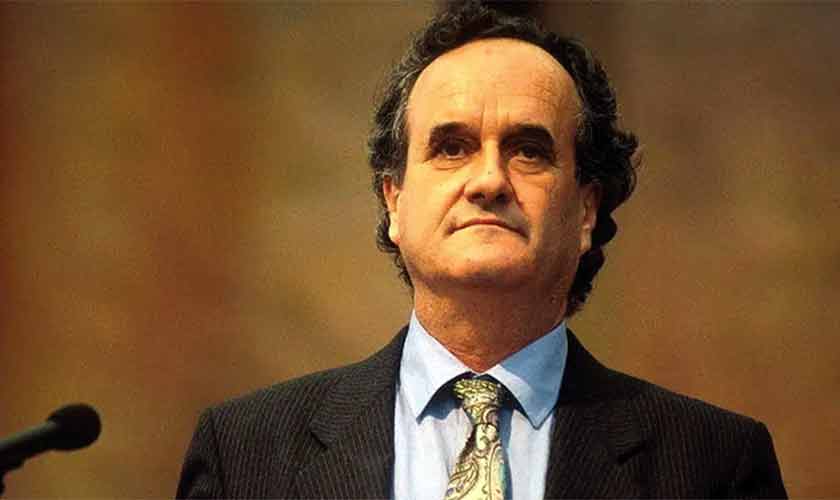
ark Tully was never just a foreign correspondent filing from across the border. For several decades, he occupied a rare and complicated place in Pakistan’s public imagination: a British journalist reporting from India whose words were listened to, trusted and, at times, quietly revered.
He died last week, closing a chapter on a style of journalism that now feels almost anachronistic. In Pakistan, particularly during the 1970s, ’80s and ’90s, Tully became a household name not because he confirmed prejudices, but because he unsettled certainties.
At the time, India’s global image was still largely intact. It was widely presented as a democratic success story, a plural society with a free press and functioning institutions. For Pakistanis watching from across a fraught border, India was often held up internationally as the example to follow. What made Tully distinctive was that he did not repeat that story uncritically. His reporting offered a meticulous, almost forensic account of how power actually functioned on the ground.
He was not hostile, nor was he polemical. Instead, he described the perils embedded within the system: political opportunism, social inequality, communal tensions and the everyday compromises that shaped democratic life. This kind of scrutiny was rare in international coverage of India at the time. In Pakistan, where criticism of India was usually dismissed as partisan or reactive, Tully’s measured analysis carried unusual weight.
Part of that authority came from where he worked. The BBC, during those decades, was regarded in Pakistan as the gold standard of credibility. Domestic media was heavily controlled, with both print and electronic outlets widely seen as extensions of the state. In that environment, the BBC’s broadcasts were treated almost as a parallel public sphere — a source of information that felt untainted by local propaganda.
Tully’s voice, calm and unembellished, became synonymous with that trust. His reports were not sensational. He avoided grandstanding. He did not speak down to his audience. For many Pakistanis, particularly within the urban middle classes, he represented the possibility of truth-telling in a region saturated with rhetoric. His criticism of India, precisely because it came from an outsider and was delivered without malice, was embraced rather than resisted.
Over time, however, it became clear that Tully’s interests extended far beyond politics. He was deeply curious about the cultural, social and environmental textures of the subcontinent. His fascination with the railway network is one example. He explored not just its economic role, but also its social impact — how trains shaped migration, memory, class and the rhythms of everyday life. These were not marginal subjects for him; they were central to understanding how societies held together.
That curiosity inevitably drew him to Pakistan as well. He did not treat the country as a footnote to India’s story, but as part of a shared civilisational and historical landscape. His work reflected a sense that political borders, however consequential, did not fully explain how people lived, believed or imagined their futures.
After leaving the BBC, Tully chose to remain in India — a decision that itself spoke to his commitment to the region. Freed from the demands of the daily news cycle, he widened his scope. He travelled extensively across the subcontinent, trying to understand what united people and what divided them, often discovering that these forces were not where policymakers assumed they were.
What interested him most were people’s choices: what they valued, what they feared, what they were willing to tolerate and what they were not. He paid close attention to the gap between officially endorsed ideals and lived priorities. In doing so, he often revealed how deeply local values could diverge from what was presented as universally desirable or progressive.
When Tully visited Pakistan, his presence itself became news. He moved easily among politicians, journalists and intellectuals, not as a distant observer but as someone engaged in conversation. He symbolised a form of journalism rooted in honesty rather than access, scepticism rather than cynicism. For many in the media, he represented a standard that felt increasingly difficult to uphold.
His storytelling was not confined to words. His documentaries, if that term even fully captures them, were visually attentive and quietly immersive. They explored landscapes, faces and rituals with the same restraint that characterised his writing. The result was work that appealed not only intellectually but also aesthetically, drawing connections between environment, culture and power without forcing conclusions.
Tully was knighted and later decorated by the Indian government, honours that acknowledged his contribution to public understanding. Yet his legacy is more complicated than official recognition suggests. He belonged to a generation of correspondents who believed that journalism’s primary obligation was to explain rather than to provoke, to illuminate rather than to perform.
In today’s media climate, dominated by speed, spectacle and outrage, that approach can seem quaint. But in Pakistan, where Tully’s voice once cut through censorship and noise alike, his work remains a reminder of what rigorous, patient reporting can achieve. He showed that it was possible to be critical without being adversarial; authoritative without being arrogant; and deeply engaged without losing perspective.
For many Pakistanis, Mark Tully did more than report on India. He modelled a way of seeing the subcontinent: complex, interconnected and resistant to easy narratives. That, perhaps, is why his death has been felt not just as the loss of a journalist, but as the passing of a certain moral clarity in public life.
The writer is a Lahore-based culture critic.