Print Story
X




On the International Day of Education, it is time to rebuild what teachers can no longer carry alone
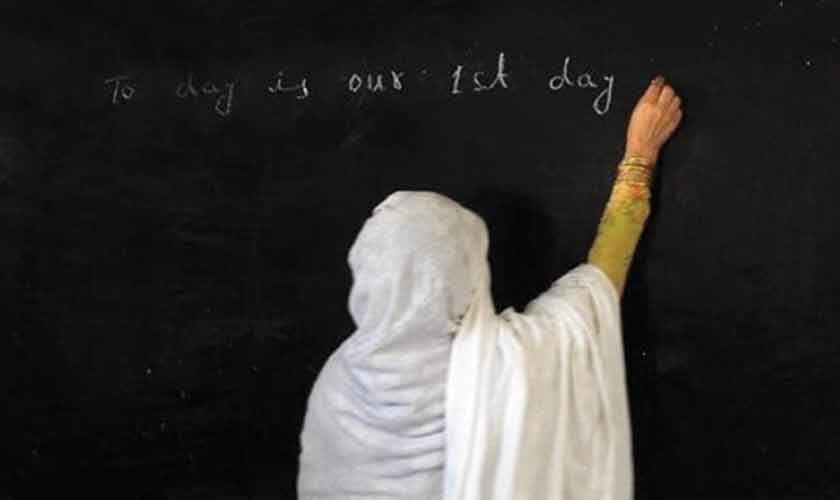
| A |
classroom in Lahore is already alive before the lesson begins. A teacher asks students to put away their phones. Some comply. Others angle their screens downward, thumbs still scrolling. Before the first page opens, students have absorbed hours of content, curated by algorithms optimised for attention.
Later that evening, at the dinner table: father scrolls through the news; mother tracks WhatsApp updates; and children are lost in screens. Even grandparents, once storytellers, are now absorbed in forwarded reels. The table is full, the room is empty.
Today, we must confront an uncomfortable truth: teachers are being asked to shoulder responsibilities that cannot rest on them alone.
Collapse of three monopolies
For generations, teachers held three monopolies in education: over knowledge, attention, and moral guidance. These were not formal powers but a social arrangement, sustained by families, communities and public institutions. Each has weakened. With those has thinned the infrastructure that once made schooling coherent.
The knowledge monopoly
In the analogue classroom, teachers curated and sequenced knowledge. Schools governed what was learned, when and how. That monopoly has collapsed. A child with a smartphone now accesses more information than any curriculum can contain.
Globally, children aged 8 to 18 spend more than seven hours a day on screens. In Pakistan, children aged 7 to 10 report several hours of daily screen exposure. Access, however, does not produce understanding. Platforms reward speed, novelty and outrage. Teachers increasingly spend time correcting misinformation rather than deepening insight.
What remains is the harder pedagogical task: helping students interpret, distinguish fact from manipulation and understand consequence.
The attention monopoly
If knowledge has become abundant, attention has become scarce.
Classrooms once structured time and focus. That rhythm has fractured. Notifications interrupt lessons. Phones compete relentlessly for attention. This is not misbehaviour but the logic of a new attention economy that is fragmented, commercialised and operating beyond the reach of teachers and schools.
Pedagogy shifted quietly; teachers were encouraged to facilitate rather than direct, to prioritise activity over explanation. These approaches assumed stable attention. They arrived just as attention collapsed.
The moral monopoly
The most consequential loss is in moral guidance.
Teachers once reinforced shared understanding of right and wrong, boundaries and consequence. Today, they respond after exposure has already occurred.
A Grade 8 teacher in Islamabad describes what this looks like in practice. A student casually shared a video during break showing public humiliation of a woman accused of theft, filmed and circulated as entertainment. By the time the teacher intervened, half the class had seen it.
“I had to explain not just that violence was wrong,” the teacher said, “but why filming, sharing and laughing were wrong.” Children absorb cues from reaction videos and reels. What elders once corrected now circulates unchecked online.
As Durkheim warned, normlessness emerges not through disorder, but through a quiet erosion of shared meaning. Ibn-i-Khaldun observed that when moral transmission between generations weakens, social cohesion begins to unravel.
A quiet withdrawal
Education was never meant to be carried out by schools and parents alone.
Moral formation once flowed through families, playgrounds and shared life. Children learned restraint and judgment through observation and correction in common spaces.
That ecosystem has eroded. Urbanisation and security concerns have narrowed public childhood. Pandemic closures have accelerated the shift. Elders now exist at a digital distance—present online but absent in care.
The teachers are then asked to fill the gaps, stabilising learning, behaviour and meaning in classrooms without the scaffolding they once relied on.
It is not that the teachers are failing; the support systems are withdrawing.
The education debate in Pakistan often focuses on teacher quality: licensing, training and metrics. However, this is not where the heart of the crisis lies.
Recent reforms have raised standards and expanded professional development. Yet, these measures assume that the classrooms still function the way they have done before. Only, they do not. Teachers navigate this loss without acknowledgement; hesitant to name the shift.
This is a call for strategic reinvestment in the ecosystems around teachers.
Schools cannot enforce norms that society no longer upholds. Teachers need families and communities as their partners. This requires deliberate engagement: parent education workshops on digital literacy; community forums on shared expectations; and restored roles for elders in moral guidance.
Reclaiming what is owed
We owe teachers more than training. We owe them legitimacy.
Pakistan has taken some steps forward, but unless we rebuild the trust, coherence and shared responsibility that once surrounded teachers, these efforts may falter.
The crisis is ontological, not merely methodological. Learning, as Mulla Sadra conceived it, is substantial motion, transformation of being itself, not accumulation of information. What Biesta calls subject formation cannot happen through knowledge transfer alone. Formation requires relationships, time and stability: environments where attention is sustained, judgment develops through practice and moral reasoning is reinforced, not contradicted.
Current policy assumes that the traditional monopolies still function. Professional development emphasises compliance and digital tool adoption as if knowledge transfer were still central. It is not. What teachers increasingly need are pedagogical skills for disrupted classrooms: how to rebuild attention; teach judgment amid misinformation; and guide moral reasoning when authority is contested. Technology must reduce their load, not increase it. When pedagogy becomes compliance tracking, formation becomes impossible.
Most critically, teachers need active partners in formation: digitally literate parents who model discernment, not just monitor screens; communities that restore elder participation through structured intergenerational programmes. Schools cannot uphold norms that families undermine at dinner tables and communities abandon in public spaces.
In an age of algorithms and instant answers, what remains irreplaceable is the teacher standing at the threshold, restoring focus when attention fractures, offering context when information overwhelms, modelling integrity when authority disperses.
Teachers no longer control knowledge, command attention or hold moral authority. They walk into classrooms each morning knowing the algorithm arrived first. They teach anyway.
On this International Day of Education, the question is not whether teachers can carry this weight, but whether the rest of us will show up.
The writer is affiliated with the Institute of Social and Policy Sciences. He can be reached at [email protected]