Print Story
X




In The Enterprise, Aamir Habib turns memory into unsettling sculptural forms
| M |
ore than its title, The Enterprise, the recently concluded exhibition by Aamir Habib came as a surprise. Before even entering the gallery, visitors were confronted by two large glass window panes completely covered in burgundy-coloured fabric. This act of concealment heightened curiosity about the new work of an artist who, since earning his BFA in sculpture from the Indus Valley School of Art and Architecture in 2003, has worked across multiple techniques and materials.
Originally from Kohat, Habib remained in Karachi after completing his studies. He explored themes such as religious extremism, political violence, state repression and societal pressure within a changing cultural landscape. In his solo exhibition (January 6 through 15, Canvas Gallery, Karachi), an atmosphere of fear permeated the space, spreading to unsettling proportions. It was a dread familiar to those of us who grew up under the dark, disastrous and enduring shadow of Gen Zia-ul Haq’s Islamisation, a grim period in the country’s history that gave rise to sectarian conflict and militant clericalism.
Another aspect of that spectre was the widespread culture of ignorance. A population seeking solace in religion ceded authority to religious leaders to interpret sacred texts. The leaders, in turn, mobilised crowds for political gain. Religious rallies, pamphlets invoking blasphemy and hate speech proliferated in the name of a faith whose very meaning is peace, and which instructs its followers to recognise the rights of others. Faith-based friction spread so sharply that even mosques, symbolic houses of God, were named after mortals said to represent the two main branches of Islam.
Aamir Habib recalls a childhood shaped by the aftermath of those years, marked by a severe lack of reading material at home. There were just four books: one on the importance of prayer, Namaz Ki Fazilat; Bahishti Zewar by Ashraf Ali Thanwi, a comprehensive guide to the education and conduct of Muslim women and girls; and two others, Maut Ka Manzar and Dozakh Ka Manzar by Khawaja Muhammad Islam, then a bestselling author known for graphic depictions of the afterlife.
One can imagine a young boy growing up in a strict environment, shaped by memories of a state and religious clerics who framed scripture as a system of punishment, of lashings and eternal fire. In this arrangement, the military dictatorship sought religious justification for its rule and religious leaders extended their influence beyond conventional boundaries.
Beginning at home, it was customary to send children to mosque schools or seminaries to learn the Holy Quran. The methods of instruction were often punitive, relying on sticks, slaps, fists and kicks. As a result, a young mind was rarely able to separate faith from fear. A failure to pronounce words correctly, or in the proper sequence, often invited physical punishment. Aamir Habib recalls this conditioning in his work: the bearded portraits placed on plinths, objects and walls serve as manifestations of a shared and enduring trauma.
Scale, colour, facial features and accompanying objects complete the narrative, one that speaks both to an individual experience of a young, defenceless and frightened boy, and to a society held hostage by its most hostile elements, extending far beyond religious seminaries alone. A recurring motif in Aamir Habib’s sculptures is the human head, recognisably rooted in this region, though not confined to it. In the artist’s own view, these caricatured forms emerge from his physical, psychological and social environment.
One example is the piece Birth of Munna; the head of a young pupil with a budding beard, delicately balanced on a metal dish. It suggests an early stage in the making of a hardened extremist, or, in a more extreme reading, the portrait of a suicide bomber prepared to sacrifice himself in obedience to a religious authority.
In its execution and restraint, the work recalls the enduring theme of Salome in European art history, where John the Baptist is executed at her request and his severed head presented to Herod after her dance at his birthday feast. Habib’s work moves between art history, media imagery, inherited belief systems and collective imagination, all underscored by a persistent tremor of terror.
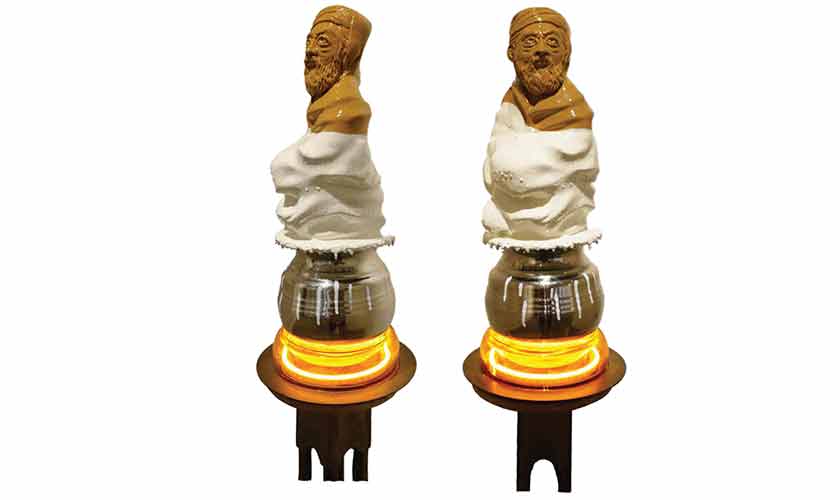
Another sculpture, Curdled Milk, features a torso attached to a fierce, turbaned and bearded head. The body transitions from a protruding human stomach into thickened, curdled milk spilling over the edges of a metal pan. Through the use of glass and LED lighting, Habib creates a convincing illusion of fire that appears to have caused the overflow. He recalls how his mother would instruct him to keep watch over milk simmering on the stove, instilling a constant fear of punishment should it boil over, a domestic memory that quietly mirrors the larger anxieties explored throughout his work.
The frightening fire of the home expanded into a larger vision of an intense, inescapable and eternal blaze awaiting in the inferno, should the rules of religion, as taught by clerics, be disobeyed. This idea is communicated directly in Fire of Hell, where the stern, blackened face of a man is suspended above flames rising from the mouth of a cauldron, a vessel commonly used for cooking large quantities of food at weddings or funerals.
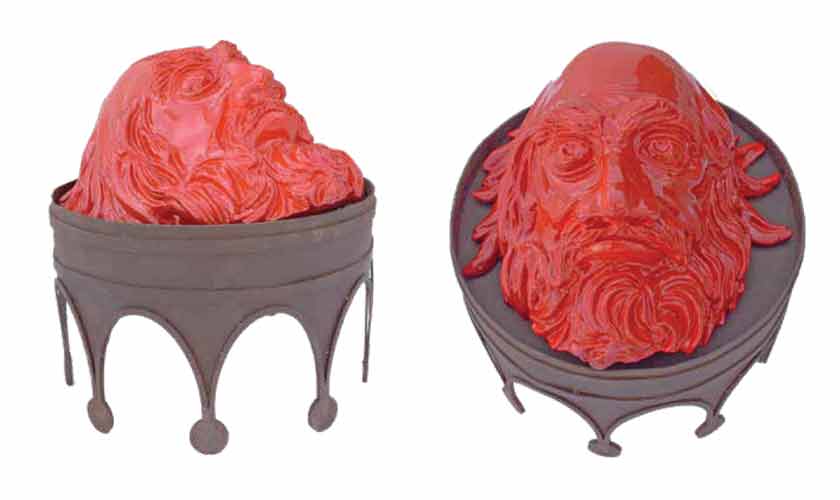
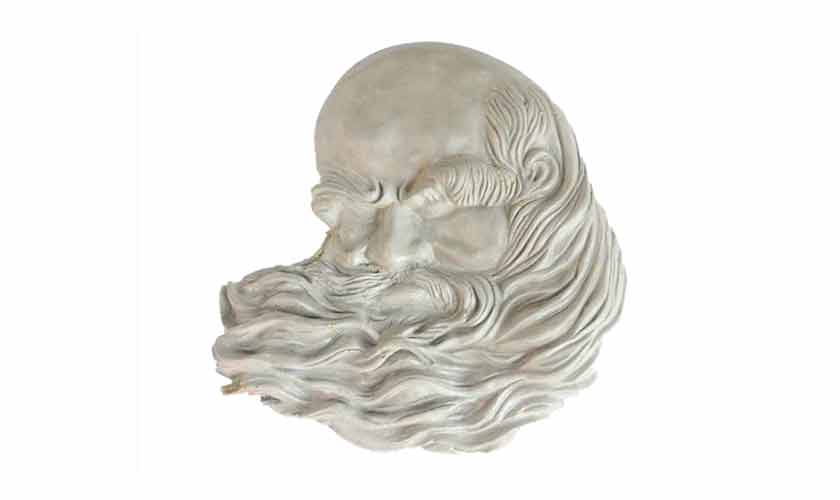
Fire itself is not literal in another work, King of Nothing, but its associated colour dominates. Red becomes the defining feature of the piece, in which an entire face, including eyes and hair, is mounted on a circular stool supported by arch-shaped legs. The expression of force, anger and threat continues in Habib’s wall reliefs. Bald, elderly men with long flowing beards, titled Spiritual Enterprise I, II and III, resemble patriarchs wielding supposed wisdom: delivering sermons, asserting authority or dividing faith into rival factions. At the same time, these figures verge on the fantastical, embodying fanaticism as much as imagination, the two existing side by side in this landscape.
After graduating, Aamir Habib spent several years working with David Alesworth, his teacher and mentor, during which he developed a deeper understanding of materials and refined his technical skills. These qualities are evident in his recent exhibition. More significantly, however, the show demonstrates how an artist draws on personal experience, observation and background to construct broader narratives.
One such work is Taalib, which emerged from Habib’s observation of seminary students in his hometown collecting food door to door and combining different meals into a single pan. This practice recalls an ancient South Asian monastic tradition, followed by Buddhist monks among others, in which all collected food was placed in one container, resulting in a bland, undifferentiated dish. The word taalib, meaning ‘student,’ has since acquired darker connotations, commonly associated with Afghan militant groups that control their country and have been involved in cross-border violence in Pakistan and parts of Central Asia.
In Habib’s Taalib, a small handled pot with two ladles attached to its sides is positioned on a ring of glowing fire. From this emerges a blue, serpent-like form that culminates in the life-sized head of a young man with a thick mane and curly beard, wearing a madrassa student’s straw cap. The colour blue, associated in local iconography with venom (such as neela thotha, a traditional poison), as well as with Krishna, who is said to have turned blue after consuming poisoned milk in childhood, combines with the serpent form to suggest lethality. Together, these elements evoke the dangerous rise of religious militancy: a force witnessed, endured and, thus far, survived.
The writer is a visual artist, an art critic, a curator and a professor at the School of Visual Arts and Design, Beaconhouse National University, Lahore. He can be contacted at [email protected].