Print Story
X




Poetry, nostalgia and conversations; Jashn-i-Jaun Elia will be remembered for breathing life into the city’s social scene
| A |
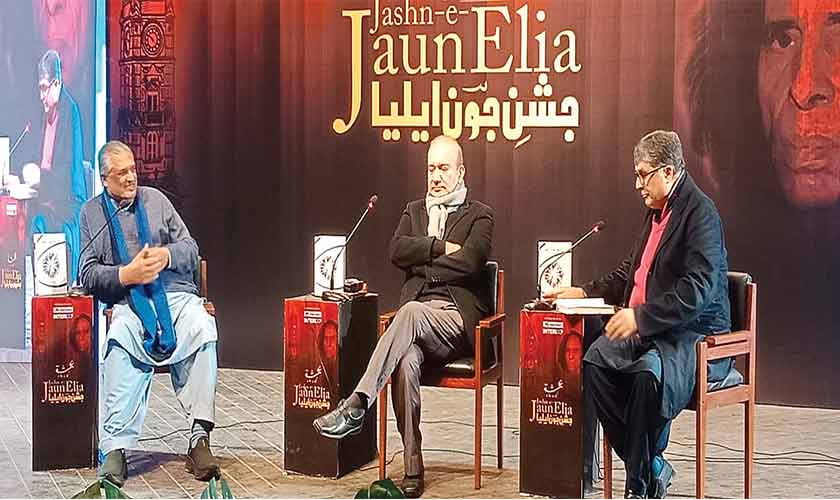
three-day literary festival titled Jashn-i-Jaun Elia was organised in Faisalabad to pay tribute to the renowned poet. The festival was held at the Nusrat Fateh Ali Khan Auditorium of the Faisalabad Arts Council. It was sponsored by Interloop and Allied Bank.
The festival opened with a session titled Main Jo Hoon, Jaun Elia Hoon Janab. It was presided over by Iftikhar Arif. Commissioner Raja Jahangir Anwar was the chief guest. Humayun Javed of Interloop was the guest of honour.
In their keynote addresses, Asghar Nadeem Syed and Hammad Ghaznavi described Jaun Elia as one of the most significant poets of his time, whose popularity continues to grow with the passage of time.
A session titled Jaun Ki Baatain featured Iftikhar Arif, Munawar Saeed, Hammad Ghaznavi and Adnan Rizvi, who shared personal memories of Jaun Elia. They recalled that he often described himself as a scholar of the Urdu language rather than a mere poet.
Another session was titled Hamaray Baad Jo Aayen Unhein Mubarak Ho. Its participants - Kazim Saeed, Nasira Zuberi, Nasir Abbas Nayyar, Shamoon Hashmi and Shakeel Jazib - noted that, like many great poets, Jaun Elia achieved recognition and popularity relatively late in life. They observed that his rebellious temperament and straightforward expression have made him particularly appealing to the younger generation. Several students later recited and sang Jaun Elia’s poetry. Faisal Durrani, a graduate of NAPA, Karachi, presented a monologue.
One of the most significant sessions of the festival was a discussion with Jaun Elia’s son, Zaryun Elia. He spoke candidly about his father’s personal life, its emotional complexity and the memories associated with him. Zaryun Elia said that for him, Jaun Elia was first and foremost a father.
Zaryun said that his parents’ separation had affected his relationship with his father. He said he still holds Jaun Elia responsible for certain aspects of his behaviour. He said that his mother, Zahida Hina, had never prevented him from meeting his father.
This was followed by a session titled Mukalma with Munawar Saeed. It was moderated by Shamoon Hashmi. Munawar Saeed recalled Jaun Elia’s diverse interests beyond poetry, including wrestling and acting. He said that Jaun Elia also wrote and produced several plays. Singers Amjad Niazi, Khurram Latif and Zebi Shah presented qawwalis based on Jaun Elia’s ghazals, followed by a poetry recital in which prominent poets and writers from across the country recited their work.
Hammad Ghaznavi noted that many great poets and writers, in the past, had been associated with journalism and began their careers as reporters. Fawad Hassan Fawad said that writing a column was more challenging than writing a news report or headline. He said it required a high level of skill and neutrality. Sohail Warraich remarked that contemporary columns serve as an important medium for the promotion of literature, while incorporating elements of history and poetry.
A separate session was held to pay tribute to Dr Arifa Syeda. Dr Shehzad described her as a person committed to dialogue who listened to differing opinions with grace. He warned that intolerance was increasing in the society, so that more people now prefer confrontation over meaningful dialogue.
A media-focused session titled Boltay Kyun Nahin Meray Haq Mein featured Sohail Warraich, Hammad Ghaznavi and Ajmal Jami. The speakers observed that journalism had always faced restrictions and that technological developments had raised the risk of fake news. They stressed that journalists should act as the voice of the people rather than as representatives of political parties. They emphasised the need for governments, political parties and other powerful institutions to develop the capacity to listen to dissenting views. They also noted that the decline of the editor’s role had damaged the credibility of journalism.
The festival concluded with a mushaira, followed by a performance by folk singer Ramazan Jani. Citizens of Faisalabad welcomed Jashn-i-Jaun Elia as the beginning of a new chapter in the city’s literary life and expressed hope that such events would continue in the future.
Interloop, one of the sponsors of the event, has previously supported major literary and cultural events in the city, including the Faisalabad Literary Festival, the Lyallpur Punjabi Saanjh Mela and the Lyallpur International History Conference.
The contributor is the bureau chief of dailies Jang and The News