Print Story
X




Promising that help is on the way, President Trump has pronounced a red line over Tehran’s crackdown on anti-government protesters
| A |
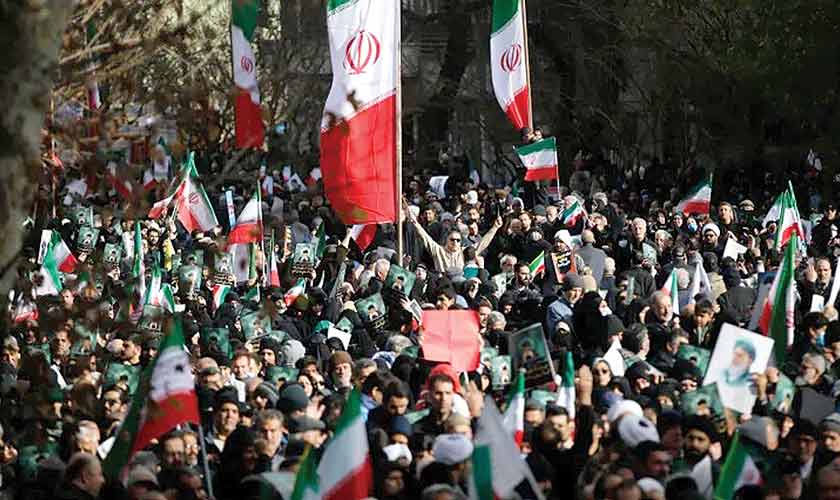
s street agitation continues in Iran, the United States is weighing its military options against Tehran. The White House, seeing an opportunity to pile up pressure on its long-standing adversary, is pondering a range of kinetic measures, creating a precarious standoff where the threat of American attack is being used as a tool to curb Tehran’s violent crackdown on its own citizens.
At the heart of this crisis lies a critical question: will Washington move beyond sanctions and rhetoric to launch military strikes, or is the threat of force a strategic bluff to keep the regime off-balance?
Fuelled by a sharp surge in the cost of living—hyperinflation, a collapsing currency and a severe water crisis—Iran is experiencing unrest that has spread across 111 cities. The unrest quickly spread to smaller cities and has reached even some traditionally pro-government centres such as Mashhad and Qom.
Western trade sanctions have crippled the economy. It has been suggested that the Iranian government’s mismanagement of the situation has allowed a bad situation to turn into a catastrophe: inflation is rampant, youth unemployment is sky-high, poverty is spreading and the middle class is getting squeezed. Instead of directing scarce resources toward job creation, health services, infrastructure and essential subsidies, it has been suggested, Tehran has continued to pour money into defence, nuclear programmes and regional resistance. The spending choices have deepened the hardship for ordinary Iranians.
The unrest has been aggravated by a worsening drinking water crisis. Ground water over-extraction since the mid-20th Century has severely depleted reserves, causing widespread land subsidence, especially in earthquake-prone urban areas—heightening the risk of mass casualties during seismic events. As surface water resources have dwindled, reliance on groundwater has grown, exacerbating shortages. Many communities now depend on water tankers and face rationing. Some of the scarce supplies also have to be diverted to industrial and nuclear sites. Energy Minister Abbas Aliabadi has said that the government “may be forced to reduce water pressure to almost zero at night.” President Pezeshkian has warned, “If it doesn’t rain, we will have no water and will have to evacuate Tehran.
Most of Iran’s population is youthful and educated. The median age is ~34 (half under 35). Over 73 percent of the people live in urban areas. Female youth literacy is ~99 percent. The educated urban youth increasingly perceive ‘rigid ideological elements’ as obstacles to personal freedoms, gender equality and merit-based opportunities. Curbs on free expression and internet censorship have stoked recent unrest, turning protests over economic grievances into outright challenge to the Islamic Republic’s legitimacy. The protests have been met with violent crackdowns, locking Iran into a relentless cycle of dissent and repression leading to “over 2000 deaths” over the last three weeks, although the numbers remain unverified.
Talking to The News on Sunday, former ambassador to Iran Asif Durrani says: “Both economic distress and interventions by the United States and Israel are at play. Economic issues, such as the falling value of the rial, are genuine concerns for Iranians. At the same time, the US and Israel have sought to undermine the Iranian Revolution. Besides students and the youth, the traders have joined the protests this time.”
Traders’ associations were instrumental in the street campaign of 1979 that led to the removal of the Shah. They have traditionally remained supportive of the regime and did not back the protests of 2009, 2019 or 2022. The economic distress, however, has turned acute, forcing the ‘merchants’ to actively take part in the demonstrations. In fact, the protest movement began in one of the major markets when traders shuttered their shops. “The protesters are not calling for the destruction of their nation, but for the return of their means of living and an end to the collective punishment that has eroded their future prospects.”
The external picture is being shaped by a US campaign that can fairly be called psychological warfare—designed to keep the Iranian regime on the back foot, erode its internal cohesion and nurture sustained domestic dissent that could force concessions on both the nuclear enrichment and ballistic missile programmes.
Former ambassador Mushtaq Shah says, “Since last year, Israeli ‘assets’ have made notable inroads into Iran.” He says the protest movement, while driven by economic hardship and concerns over personal freedoms, is also being steered by Israel and the United States. Tehran has presented video evidence to foreign diplomats, showing infiltrators opening fire on security forces—a point it has repeatedly highlighted in recent briefings. The growing unrest and ensuing chaos could weaken the Iranian government and deepen the suffering of ordinary citizens.”
Commenting on the situation in Iran, Durrani says it as not an ideal one for the ruling clergy. “They are under tremendous pressure. However,we should not underestimate the government’s resilience. It has survived numerous challenges. Over the years, Iranian governments have shown signs of evolving subtly. Social freedoms have increased over time. The clergy has made significant concessions on issues like the hijab enforcement so that as many as 60-70 percent of women no longer wear the hijab.”
Shah says Tehran should step back from the brink and see the crucial difference between genuine, hardship-driven protests and those providing the perilous opening to foreign meddling.
Meanwhile, the external picture is being shaped by a US campaign that can fairly be called psychological warfare. It is designed to keep the Iranian regime on the back foot, erode its internal cohesion and nurture sustained domestic dissent to force concessions on both nuclear enrichment and ballistic missile programmes. The recent attacks on Iran were framed around the nuclear programme, but the broad, unstated goal is the abrogation of the 1979 revolution.
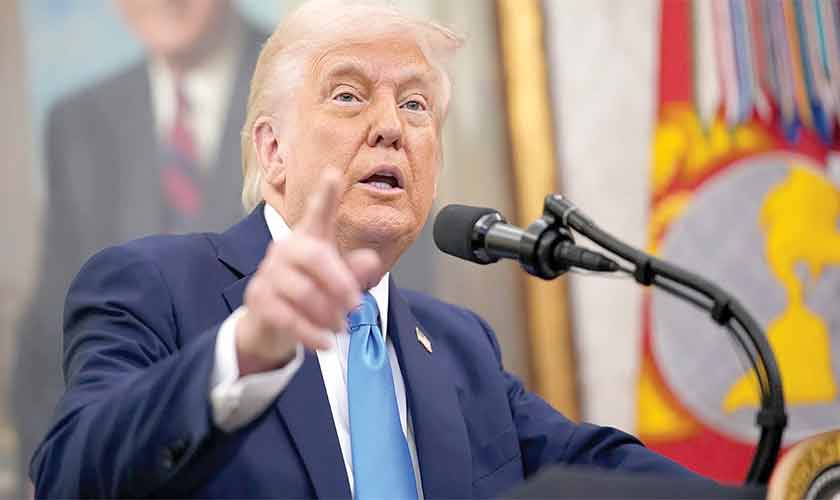
President Trump has announced a “red line” over Tehran’s crackdown on protesters. He has also urged the demonstrators to keep the pressure on and promised that “help is on its way.” Trump’s warning to Tehran that the execution of detained protesters will trigger a “very strong” US response has set off a chain. Iran has apparently stopped the executions. This has prompted the US president to tell reporters that he’s been told that the crackdown is easing and that there’s no plan currently for mass executions. However, this did not cause him to let go of the pressure. Instead he has refused to rule out military action, saying the US will “watch what the process is” while noting that Tehran had given a “very good statement.” The threat of force appears to have produced a temporary lull, but the door remains open for further US action.
Durrani says if there is US military action, “there will be no boots on the ground; instead, they will conduct air strikes.” Any US kinetic strategy must reckon with the fact that the Iranian society is deeply nationalist. Faced with external threats it is likely to rally around the government. Last year when the US and Israel attacked Iran, the nation stood united, he recalls.
A more likely US strategy would be to sustain pressure through sanctions, support internal dissent and wait for the regime to fracture from within. “This strategy ratchets up the pressure on Tehran. The heaviest burden will fall, once again, on the ordinary citizens. For over 40 years, economic siege has deepened public suffering without toppling the government. Escalation isn’t a strategy; it’s repeating a failed and cruel experiment. The greatest risk of escalation comes from Israel. Israel views Iran as the primary and singular obstacle to its vision of regional hegemony,” Durrani says.
Ambassador Shah says Netanyahu may see another strike on Iran as a political lifeline in his election year. Mirroring its Venezuela playbook, the Trump administration seems to be eyeing a pragmatic, insider-focused approach toward Iran—aiming to encourage regime fragmentation—but it remains unclear how that strategy will actually play out in Tehran.
Iran’s ideological indoctrination is foundational, not merely political. As a theological state, the Islamic Republic’s identity and legitimacy are built on opposition to the US and Israel, making this stance inseparable from its existence, says Shah. “The security apparatus includes the Iranian Revolutionary Guard Corps and the Basij militia, which have sworn to protect the revolution while suppressing dissent. Against this backdrop a defection from the ranks is unlikely.”
Regarding Pahlavi as an alternative candidate for leadership, Durrani says that he is not a “political animal.” Having left Iran at the age of 19, he has never returned and has not established a strong political organisation. A majority of protesters the protesters do not want a return to the monarchy. Even though a fringe of Iranians supports a restoration under Reza Pahlavi, his call to topple the government amid the June Israel-US strikes fell largely on deaf ears.
The opposition remains fragmented and weak. External media often focuses solely on criticism, but internal dynamics are more complex, he says.
The protests have challenged Iran’s leadership, testing their willingness to address popular grievances and maintain control. The role of traders, the youth and new social groups suggests that frustration with the government is broad-based. Continued repression without dialogue may prolong unrest, affecting domestic stability and foreign relations.
Shah says the only way to curb inflation is to loosen state control over energy, finance and manufacturing. “The clergy must calm a restless populace that is demanding jobs and higher living standards. They should roll out market reforms that will ease some of the economic pain. They don’t have to entirely dismantle the sanctions-driven isolation that props up their political survival.”
The writer is a senior The News staffer in Karachi.