Print Story
X




The question is not only why violence fascinates art, but what position the artist takes when representing it
| I |
magine the unimaginable: a world where peace has prevailed. There are no wars, arms races, violence, explosions, terrorist attacks, military operations, aerial bombing, famines, forced migration, mass murder, genocide or ethnic cleansing. What will happen to our print, digital and social media? What will be the topic(s) of our daily discussions? What will constitute the 24-hours news? How relevant will the opinions of foreign policy analysts and security experts be? What will people watch, except sentimental soaps, sports channels, cartoon networks, religious sermons, quiz shows, stock market updates, musical charts, reports on art exhibitions, cooking programmes, travel broadcasts and footage about forests and animals?
Most importantly, what will the creative individuals do? A planet at peace is an ideal scenario, but not a favourite subject. It is almost a dish lacking spices: a healthy but tasteless serving, a kosher drink, both for producers and consumers. No wonder, the history of visual and other arts is packed with all kinds of clashes, aggression, atrocities, devastation and destruction, whether unfolding in the present at home or in faraway lands; whether they happened long ago; or are connected to state power, colonial invasions, trade politics, tribal feuds and individual animosities.
Representing a battle between two groups is a routine task; more significant is the position of the presenter (actually the constructor) and the commentator: whether neutral or supporting one side; whether sympathising with the loss of humanity or fascinated by the spectacle; or using the situation to enhance the credibility, substance and attraction of an artwork.
Take the example of cinema: a reality fabricated through script, dialogue, action, lighting, backdrops and a diverse cast, including romantic heroes, vicious villains, untainted beauty, haunting vamps and hilarious comedians. It is often noticed that, out of this variety, negative characters emerge as the most convincing, lasting and admired. In Punjabi films of the 1980s and 1990s, the murderous roles performed by Sultan Rahi, Mustafa Qureshi and Shafqat Cheema were more popular, remembered and cited than those of other actors, particularly those playing police officers and judges. This fondness was also reflected in film titles and posters that were filled with guns, hatchets, pools of blood and scenes of physical combat. The films did huge business during the brief peak of the Pakistani entertainment industry.
Likewise, in the history of visual art across many periods and regions, violence has been a frequent motif. Early Sumerian art, Assyrian relief sculptures, ancient Egyptian wall paintings, Greek marbles, Roman statues, Renaissance art, as well as Turkish, Persian and Mughal miniatures depict battlefields, hunting scenes and dying people. These images are often derived from observation, history, myth, literature, faith, folk tales and imagination.
If one compares, for instance, a particular Assyrian relief of a lioness dragging her hind legs while several arrows draw blood from her almost lifeless body, its force, honesty and artistic accomplishment appear more compelling than many other sculptures portraying kings, generals and courtiers.
Similarly, in the Sistine Chapel frescoes, Michelangelo’s mythological figures twisting adversaries’ bodies, annihilating demons, trampling serpents and challenging the forces of the netherworld appear, in their power, posture and presence, more vibrant than even his iconic composition, The Creation of Adam.
The convention has continued in numerous versions of the Crucifixion: Christ nailed to the wood with bleeding wounds. The imagery has captivated Christians for two millennia, yet viewed from another perspective, it is also the depiction of a torturous act displayed inside churches and the homes of ordinary believers. Likewise, the subject of Karbala, represented in literature and to some extent in pictorial arts and documentaries, commemorates a scene of bloodshed with sacred connotations. The worship of Kali in Hindu homes and temples is another example of reverence for blood, death and savagery within a system of belief.
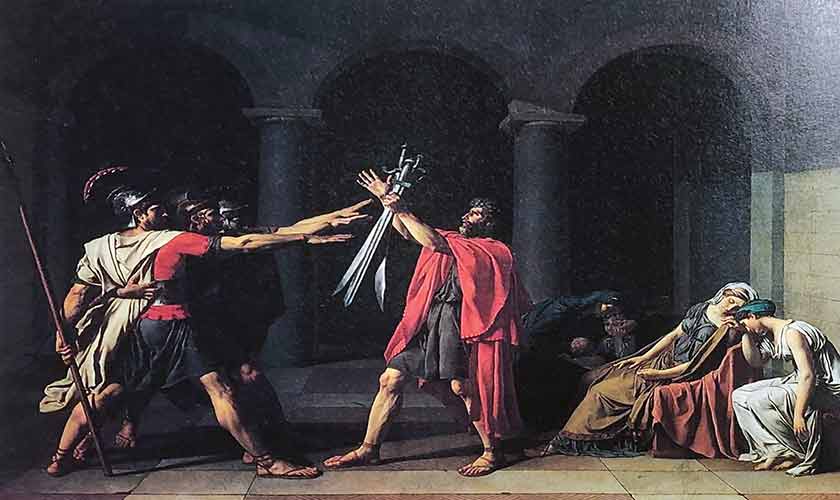
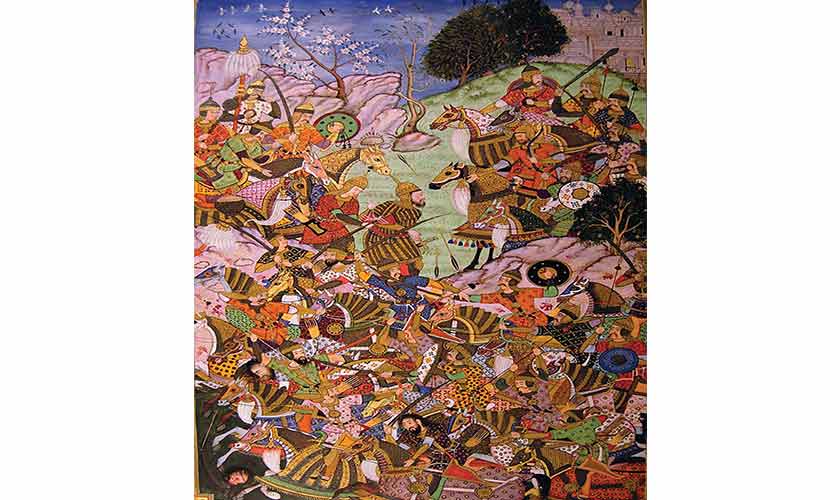
The list extends further with imagery based on religion, history, myth and epic: the canvases of Caravaggio, Jacques-Louis David, Francisco Goya and Édouard Manet, as well as Mughal-era miniatures such as the Hamzanama and the Badshahnama. With decapitated heads, dismembered limbs and dripping blood, these works convey a hint of celebration alongside their grief-stricken atmosphere. One wonders about the artist’s shifting choices while creating such images. A mournful narrative may turn into a demonstration of the maker’s skill and perhaps a temptation, if not a pleasure, in attempting such gruesome imagery.
Artists of the 20th Century confronted the cruelties of their age not only in their work but also in their political commitment.
The sculpture Laocoön and His Sons, produced in 25 BCE in the workshop of Hagesandros, Athenodoros and Polydoros of Rhodes, embodies this internal divide and dilemma. This Hellenic piece “represents the terrible scene also described in Virgil’s Aeneid… The gods who see their plans of destroying Troy thwarted send two gigantic snakes from the sea which catch the priest and his two unfortunate sons in their coils and suffocate them.” EH Gombrich asks whether “the Greek artist who conceived this impressive group… wanted us to feel the horror of a scene in which an innocent victim is made to suffer… Or did he mainly want to show off his own power of representing a terrifying and somewhat sensational fight between man and beast?”
The experiences of two world wars, territorial conflicts and the Vietnam War shattered much of humanity’s earlier optimism. The imagery that emerged from these painful chapters of our collective memory often reflects the divide between the powerful and the powerless, the oppressor and the abused, the occupier and the displaced. Such themes appear not only in pictorial art but also in fiction, poetry and other forms of literature.
Wars have not ended in our time; rather, they have accelerated in scale and dimension. Two planes striking the Twin Towers, the War on Terror, carpet bombing, suicide attacks, military coups, civil wars and the eviction of peoples from their homelands have marked the first quarter of the present century. Added to this are two years of the Israeli Defence Forces’ deliberate annihilation of Gaza that reduced a once-thriving urban space to a heap of rubble, charred vehicles and stains of dried blood.
Protesters across the globe have demonstrated against these atrocities. The issue has surfaced repeatedly on social and popular media, and in graffiti, including work attributed to the most famous, yet still invisible, Banksy. It is also visible in artworks, though there remain differences in artists’ intentions, positions and approaches.
Art that has emerged from Gaza refers directly to crimes against humanity, the killing of innocent children and the expulsion of families from their rightful homes, a scenario that, in some ways, seems to be repeating in the Middle East. Visual artists have responded to what has happened in Gaza and may respond to what is unfolding in our own neighbourhood. Yet one also reflects on the motives behind these conscious efforts: actions largely confined to studios, materials and galleries rather than participation in demonstrations, protest marches or resistance movements.
Artists of the 20th Century confronted the cruelties of their age not only in their work but also in their political commitment. The Mexican muralists Diego Rivera, José Clemente Orozco and David Alfaro Siqueiros, as well as Pablo Picasso, were engaged in revolutionary politics. In a 1944 interview with L’Humanité, Picasso stated: “I must fight not only through my art, but with all of myself. So I came to the Communist Party without the least hesitation.”
Ijaz-ul Hassan, the veteran Pakistani artist, has also dealt with the brutalities of the Vietnam War, the deaths during the Bangladesh Liberation War and the use of pellet guns against the population of Indian-Held Kashmir. His engagement with these subjects stems from his own role as a social activist; he was jailed for his ideology and political struggle. This direct exposure and insight lend credibility to his work, no matter how symbolic or distant it may appear from its point of reference.
A parallel can be drawn with the verses of the great Urdu poet Faiz Ahmed Faiz, a leading member of the Communist Party of Pakistan who was imprisoned because of his political affiliation and beliefs. That experience immortalised the poet’s lines. His voice carried neither a self-congratulatory tone nor a politically correct undercurrent; rather, it was the honest expression of a creative individual’s ideas, and, crucially, his practice.
The writer is a visual artist, an art critic, a curator and a professor at the School of Visual Arts and Design, Beaconhouse National University, Lahore. He can be contacted at [email protected].