Print Story
X

| “W |
ar is peace. Freedom is slavery. Ignorance is strength.” George Orwell, 1984.
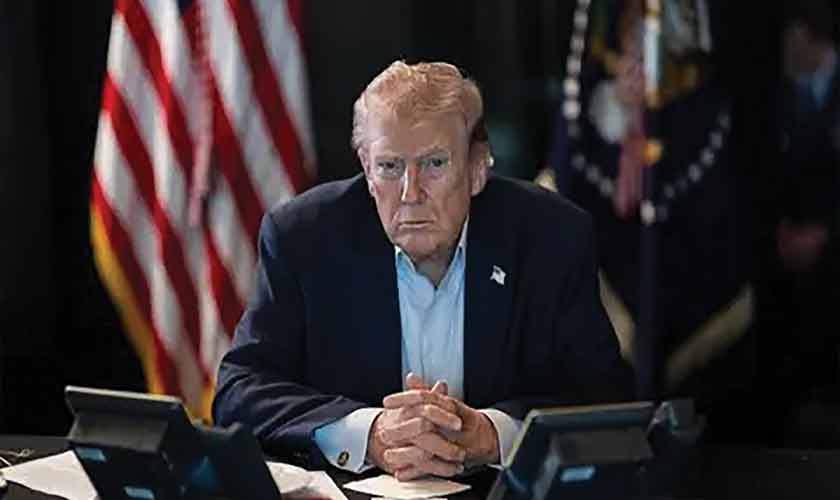
In his second inaugural address, President Donald Trump had said that his proudest legacy would be that of a peacemaker and unifier. In nearly a year since then the same US president has authorised military action against seven nations.
President Trump has apparently taken George Orwell’s words too close to heart. His close ally from Israel, Prime Minister Benjamin Netanyahu, also sees the ongoing war between the US-Israel and Iran as an opportunity for building lasting peace in the Middle East.
These self-styled peacemakers first start wars and then triumphantly announce ceasefires that are mere pauses before the next round of fighting.
A US watchdog has reported that US troops have been told the war is intended to “induce the biblical end of time.”
Earlier, progress was reported in talks mediated by Oman in Geneva. Oman’s Foreign Minister Badr bin Hamad Al-Busaidi said, “A peace deal is within our reach… Now we are talking about zero stockpiling. That is very important because if you cannot stockpile fissile material that is enriched, then there is no way you can actually make a bomb… There will also be full and comprehensive verification by the IAEA.”
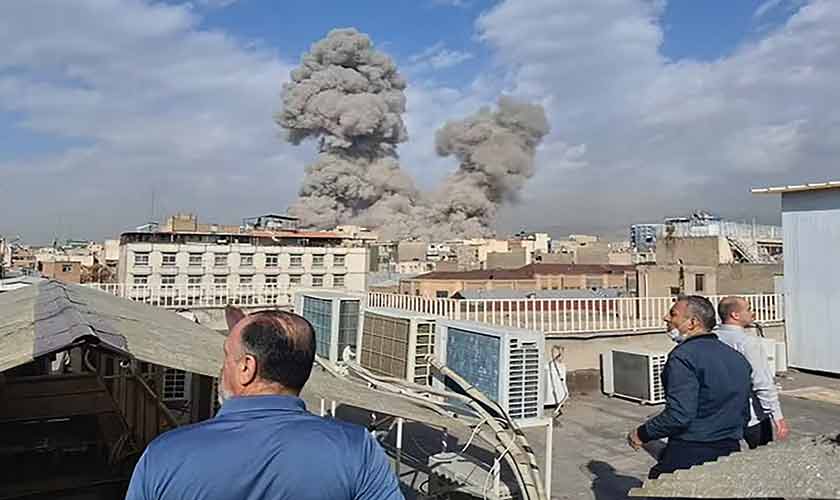
Only a day later, Israel bombed Iran in a pre-emptive strike. US Secretary of State Marco Rubio later said, “We knew that there was going to be an Israeli action… We knew that that would precipitate an attack against American forces. We knew that if we didn’t pre-emptively go after them, before they launched those attacks, we would suffer higher casualties.” The so-called pre-emptive strikes, carried out after negotiations had made significant progress, included assassination of Iran’s supreme leader, Ayatollah Ali Khamenei, and the targeting of a primary school in Southern Iran, killing 165 children and staff members.
The News on Sunday has spoken to several experts to discuss the kinetic situation, the potential for escalation, a possible timeline for the war and where Pakistan stands in the conflict.
Dr Kenneth Holland, an adjunct professor of political science at the University of Utah, said, “Iran usually prefers proportional responses that impose a cost while limiting a spiral. However, this conflict has signals consistent with an existential framing (especially in view of the leadership targeting).” Speaking of likely escalation triggers, said the most plausible near-term trajectory was “a managed but dangerous cycle of strike-retaliation rather than an immediate full regional war.”
Dr James W Davis, a professor of political science and director of the Institute of Political Science at the University of St Gallen, said a sort of horizontal escalation—an increase in the number of actors involved—was always possible. “Will this have an important strategic effect? I don’t think so. As for vertical escalation—by which I mean moving up the ladder of weaponry—it is unclear to me that Iran really has any options there.”
Speaking of various scenarios and their potential implications in the mid-term, Dr Davis said that if the regime in Tehran collapsed and there was a vacuum, one could imagine a civil war that might tempt other regional actors to intervene by supporting one side or the other. “This could lead to a deterioration of the situation that eventually leads to a wider conflict, an escalation of another sort,” he said.
If Tehran continues a sustained, managed confrontation, it can consolidate domestic support via rally-around-the-flag dynamics that will justify intensified internal security measures, strengthening bargaining leverage by demonstrating that Iran can raise the regional and economic costs for Washington and its partners, “without crossing thresholds that invites overwhelming retaliation.”
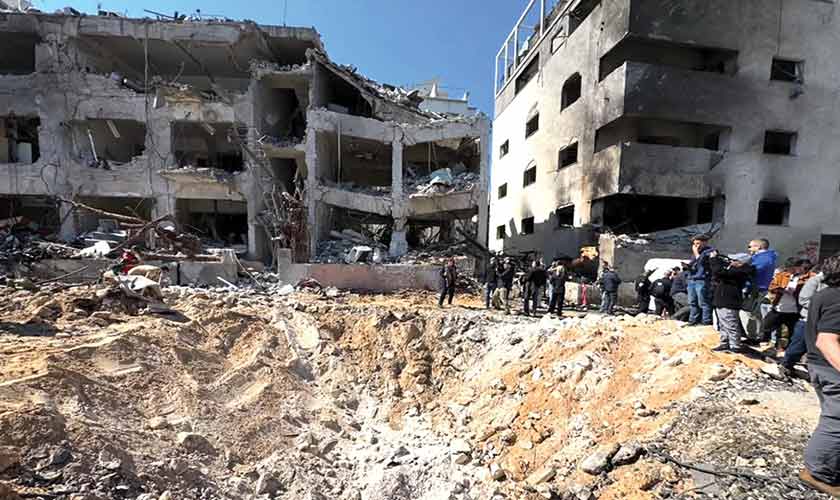
The so-called preemptive strikes have included assassination of Iran’s supreme leader, Ayatollah Ali Khamenei and killed 165 children and staff at a primary school in in Southern Iran.
“Historically, external military pressure alone is a poor instrument for producing stable, favourable political change—especially against a resilient, coercively capable state,” Dr Holland said. “Even when it succeeds in removing leadership, it often yields state fragmentation/ civil conflict or nationalist backlash and hardliner consolidation, or long, costly stabilisation requirements that interveners are politically unwilling to sustain.”
As for alliance commitment, particularly US-Israel security coordination, Dr Davis said, “The question is whether the dog is wagging the tail or the tail is wagging the dog. Did the US decision to go to war reflect an independent assessment of the risks of not doing so? Or did the US’s regional allies—Israel is only one of them—push the US to act hastily?… Allies can be both a benefit and a burden. They are a burden when they drag you into conflicts you would have wanted to avoid.”
How long is the war likely to last? “Predicting the military outcome of war is far easier than predicting the political outcome,” said Dr Davis. “That the Iranian military will suffer greatly in this war is easy to predict… predicting how the war will end is a much more difficult challenge.” He said there was no appetite in the US for a ground operation.
“If the regime can hold out—by which I mean retain domestic control of the country despite the bombardment—then I can imagine a negotiated ceasefire that will include some commitment to inspection of weapons facilities to make sure Iran doesn’t reconstitute its nuclear or ballistic missile programmes in the future… The US could then walk away claiming, ‘mission accomplished.’
“In this scenario,” Dr Davis noted, “the Iranian opposition would be betrayed and a weakened Iran left in a volatile region with other powers—Turkey, Saudi Arabia, Qatar, a weakened Iraq and, of course, Israel—competing for influence. The regional implications are an open question.”
Dr Holland said, a ‘mission accomplished’ moment for Washington and its allies was achievable without widening the conflict if “Washington keeps the goals limited and measurable, avoids actions that signal regime change as strategy and pairs military moves with credible off-ramps (explicit conditions for pause, third-party facilitated talks and de-confliction mechanisms)… A realistic ‘mission accomplished’ would look like achievable, observable effects, not maximal political transformation.”
For Dr Holland, examples consistent with public US messaging included, “reduced ability to launch near-term missile/ drone salvos at US forces and partners (measured by tempo, accuracy and stockpile depletion); restored deterrence and protection of key maritime routes (reduced successful attacks on shipping and Gulf infrastructure; sustained freedom of navigation); and re-established crisis communications and a return to structured diplomacy (even if indirect), with some monitored constraints on the most destabilising capabilities.”
As for Pakistan
Given Pakistan’s geographic proximity to Iran and its ongoing “open war” against the Taliban regime in Afghanistan, how could Islamabad realistically maintain strategic neutrality? “For Pakistan, it’s a very complicated situation. On one hand, it enjoys good relations with the United States; on the other, it shares a border with Iran. Although Pakistan supports Iran diplomatically and morally, in view of the American pressure, it will be very difficult for Pakistan to maintain neutrality,” Dr Naeem Ahmed, the University of Karachi Department of International Relations chairperson, said.
Dr Ahmed said, “the defence pact between Pakistan and Saudi Arabia says that an attack on one of the countries will be considered an attack on both. If Iran has targeted American bases in Gulf countries, including Saudi Arabia, and if this situation escalates, then Pakistan will have to respond in favour of Saudi Arabia.
“There will be double pressure on Pakistan: from Saudi Arabia under the military pact and from the United States, with which it has friendly relations… It will be a test of Pakistan’s foreign policy… So far, Pakistan has managed the situation in a skilful way.“
Should Pakistan prioritise Afghan border management or broader regional alignment? Dr Ahmed said, “So far, Pakistan can argue that given the activity on its western border, it cannot provide logistic support to the United States against Iran… In the case of Afghanistan, of course, there is a probability of spillover into Pakistan because the Afghan Taliban, which support the TTP, may carry out terrorist attacks inside Pakistan and make it more vulnerable.”
Dr Ahmed said that while Pakistan could not ignore the emerging situation along its border with Iran, it has to be very, very cautious. “We should not rule out the Indian factor, keeping in view what happened last year in May. If India opens up a front, then it will be very difficult for Pakistan to maintain its posture or counter India. It will be a very difficult situation.”
The writer, a communications professional, is currently the manager at the Centre for Excellence in Journalism, IBA Karachi. She can be reached on X: @mariaamkahn.