Print Story
X




The art of writing by hand resists becoming a relic of the machine age
| J |
ust as the month of Muharram is associated with marsiya recitals, Ramazan brings a range of exhibitions dedicated to Islamic calligraphy. Both are facets of Indo-Islamic culture; yet while the former has remained a devotional service in sacred spaces, the latter has, by and large, evolved into a commercial activity managed through private galleries. As the verses of great bards such as Meer Anis, Mirza Dabir and others transform a person through their imaginative power, composition and lyricism, the Quranic text – inscribed on paper, carved in stone or incised in metal from the medieval to later periods – has enlightened numerous readers and viewers.
In both cases, access to the formal aspects of devotional poetry or religious phrases does not require one to be a worshipper; nor even schooled in the relevant language, background or history. Many Hindu poets penned highly effective marsiyas; and, extending this to the present, qawwali remains a popular genre even among those who cannot comprehend a single word of Urdu. Likewise, the flow of line, the delicacy of mark and the spatial relationships in Islamic calligraphy have been appreciated by non-believers too, including rulers, merchants and collectors across Christian Europe.
Traditionally, different surfaces have been employed for inscribing the holy words of God: leather, vellum, fabric, ceramic, stone and paper, which eventually replaced other materials because of its practicality, portability and affordability. These are qualities the computer offers to an even greater degree; hence almost everyone has turned to writing on a machine, if not prompting the machine to write for them. In this day and age, the habit of writing letters on paper, sealing them in envelopes and dispatching them by post seems archaic, largely consigned to memory.
Nevertheless, many students, professors, journalists, politicians, fashion designers and physicians still take notes by hand, scribble in diaries, jot comments in the margins of books and write prescriptions on letterheads. Small shopkeepers also fall in this category, as handwritten receipts remain commonplace.
Apart from situations where it is required, such as opening a bank account or obtaining a national identity card or passport, it is difficult to recall how often, and on what occasions, one writes by hand on paper. I remember being with friends and searching for a pen or pencil, only to discover that none of us was carrying one. It is an example of how training turns into technique and then transmigrates into technology.
In several disciplines, all stages, strategies and versions of accomplishing a task survive simultaneously. Take image-making: beginning with prehistoric paintings and carvings, it evolved through a range of techniques, media and surfaces, wall, wood, canvas, paper, board; fresco, tempera, oil, watercolour, gouache, acrylic, collage and more. A few have faded, but most remain in use. The greatest challenge to conventional methods of capturing reality came from photography, an accurate, quick and inexpensive process compared with painting. Yet today the two coexist and, in many cases, are intensely interdependent.
One reason painting was not abandoned lies in the role of artists who accepted, adapted and extended their practices, claiming to offer what the camera could not. John Berger, in his essay The Changing View of Man in the Portrait, reminds us that “painters and their patrons invented” the myth that “Only a man, not a machine (the camera), could interpret the soul of a sitter.” This idea later evolved into abstract expressionism, encouraging spectators to focus on shapes, expanses and layers of colour that transcend representation and enabling critics to expound on these objectless spans of painted canvas.
Using pen or pencil on paper not only reveals an individual’s personality; it also compels the writer to formulate a sentence mentally before committing it to the page.
In the history of Islamic calligraphy, parallel to that of Western art, there have been various styles and schools, some linked to particular periods, regions or local languages. Yet regardless of these variations, a defining feature of Islamic calligraphy is its association with the sacred. Not long ago, conventional scribes, even those copying non-religious Urdu and Persian texts, were immaculately dressed, heads covered, seated on neat mats as they worked, as though engaged in prayer. For them, writing, even when not transcribing scripture, retained a sense of sanctity, since they had been trained to write The Book, the mother of all books.
That practice required not only attention to dress, cleanliness and posture, but also mastery of form: shaping letters with precision, concentrating on delicate curves, joining characters, adding dots, measuring the distance between lines and seeking ideal proportions on the page when following a specific style. Such professionals, one assumes, have largely disappeared with the introduction and spread of Urdu software, from publishing and communication design to personal correspondence.
Where once a single scribe or a group of scribes composed an entire text by hand to be reproduced in print, now multiple individuals type on computers and send digital files to clients. The stark difference between writing by hand and pressing keys on a keyboard is that, in the finished product, one can no longer identify an individual’s style, or discern their thought, understanding and, most importantly, their aesthetic sensibility.
Using pen or pencil on paper not only reveals an individual’s personality; it also compels the writer to formulate a sentence mentally before committing it to the page. It is, in a sense, a form of everyday art-making, akin to the process by which visual artists pause, reflect and decide before materialising an image or idea on a surface.
Hans Ulrich Obrist, artistic director of the Serpentine Galleries in London, notes in his book Life in Progress that he makes a habit of visiting creative individuals and asking them to write a line, message or verse on a sheet of paper. On his Instagram account, he explains: “I have posted phrases from poets, artists, architects. Sometimes sketches too, but often just phrases written by hand as a direct protest against the disappearance of manuscript writing. It has become a daily ritual, a sort of celebration.”
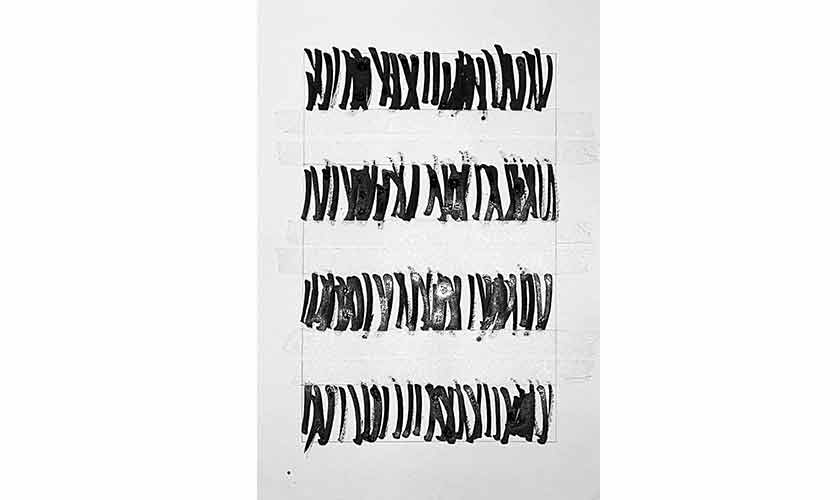
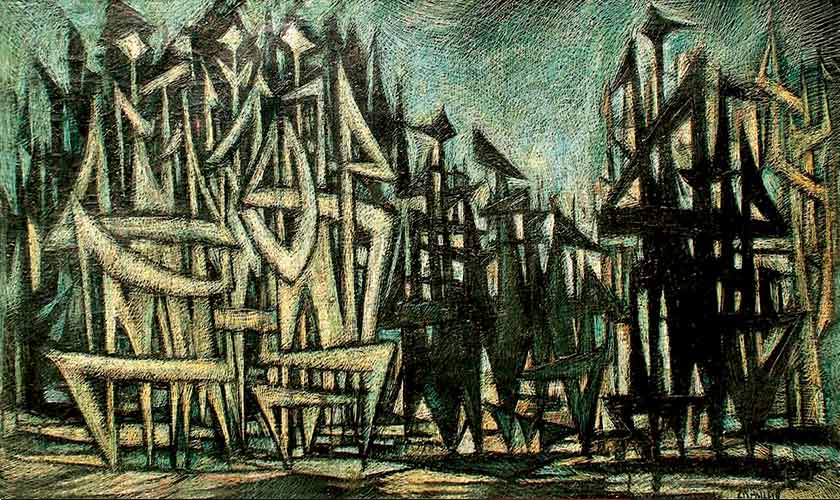
In South Asian culture, writing and art-making were never separate. Writing was not merely writing but khushkhati - pleasant writing - akin to the English term calligraphy, derived from the Greek kalligraphia, meaning beautiful writing. Fortunately, many artists from this region were taught to write with a reed pen on a wooden tablet coated with dried clay. Traces of this training can be found in the work of earlier generations, including AJ Shemza, Ahmed Parvez, Hanif Ramey, Sadequain, Zahoor-ul Akhlaq, Jamil Naqsh and Ismail Gulgee, even though their imagery was not always directly concerned with, or solely based on, calligraphy.
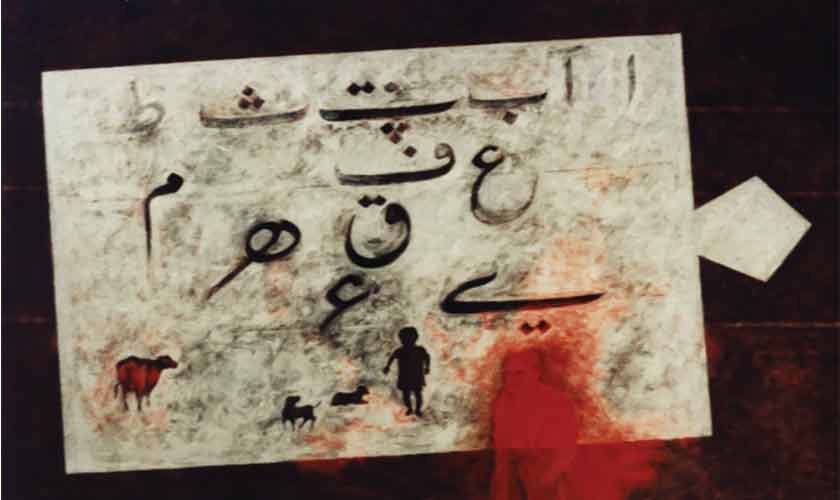
A custom that continues, for instance, in the art of Rashid Arshed, who on his sensitive surfaces absorbs lines, occasionally legible, partially obscure, to create the texture of a language or the sound of a spoken tongue. Writing in his art, and in his hand, is not merely a formal device but a means of articulating ideas and sharing symbols related to socio-religious and geopolitical conflicts.
Muhammad Ali Talpur, a contemporary artist, studied conventional calligraphy after completing his MA in visual arts at the National College of Arts. With ease, control and contemplation, he produces manuscripts of a language that is unreadable yet not unfamiliar, as it does not rely on a fixed script but on recognisable elements such as rhythm, flow, repetition and digression of the mark.
Perhaps one reason their works do not appear in the calligraphy exhibitions that proliferate during Ramazan is that both artists stand apart from what is often termed calligraphic painting. Arshed and Talpur approach calligraphy as a personal passion, a field of experimentation and a form of intellectual inquiry, rather than as a sensational deployment of the sacred, frequently displayed year after year during the holy month.
The writer is a visual artist, an art critic, a curator and a professor at the School of Visual Arts and Design, Beaconhouse National University, Lahore. He can be contacted at [email protected]