Print Story
X

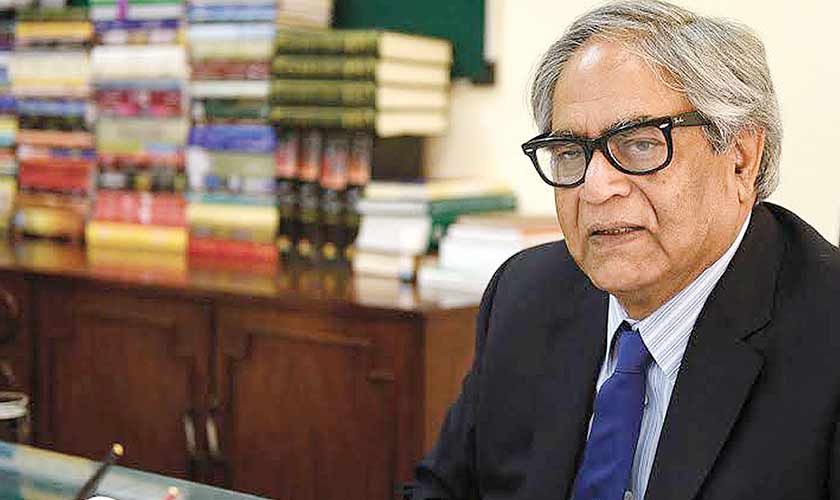
Iftikhar Arif is one of the most widely read and respected Urdu poets of his generation. Few Urdu poets enjoy as much admiration among both critics and general readers. His poetry gives voice to a thoughtful observer’s unease with the degradation he sees around him, combining urgency with lyric grace.
In December, Arif travelled from Islamabad to Karachi to attend the International Urdu Conference. There, The News on Sunday spoke with him about the decline in reading habits, literary criticism and influence, faith in poetry and the state of contemporary Urdu writing. Excerpts:
| B |
ilal Ahmed: A few years ago, you remarked somewhere that literature was a lost bet (Haari Hui Baazi) in the contemporary world. Do you still believe that? What exactly resulted in this despair?
Iftikhar Arif: First of all, let me make it clear that one should not expect a writer or a poet to have the same feelings all the time. Being extra-sensitive and highly imaginative, writers remain in a constant flux of emotions. There may be moments when I have great hope about the world, and there may be other moments when I experience extreme despair.
As for my remark about a “lost bet,” I do not disown it. The reason I feel despair about the role of literature in shaping the future is the general decline in reading and a growing disinterest in keeping books. When we were young, the proportion of literate people was lower than it is today, yet there were more households where books were kept and read. A child would often listen to his elders citing poets like Ghalib and Anis in their daily conversations. Even people who were not highly literate knew about Saadi and would tell tales from Gulestan and Bostan to children.
Now, there are more literate people and more university graduates, yet there are fewer books in their homes. This, to me, is an indication of a declining taste for literature among the masses.
BA: Muhammad Hasan Askari apparently felt a similar despair in the 1950s. He announced the death of literature even though very high-quality literature was being produced and poets like Faiz, Noon Meem Rashid and Nasir Kazmi were composing verses. Do you think the declaration was an attention-seeking move by Askari?
IA: I don’t think Askari said this to seek attention. We can say that it was an exaggerated response to certain trends of that era but it was not something said in a jovial manner.
BA: This is not the only surprising statement attributed to him. It is said that when you invited him to participate in a PTV programme on Ghalib, he responded, “Ghalib kaun?” Don’t you think he deserves a trivialising reference in return, something like “Askari kaun?”
IA: Despite the controversies he generated, Askari had a great influence on Urdu literature. He played a major role in the revival of the ghazal after the creation of Pakistan, when many young poets began composing ghazals in an altogether new style. The most prominent poet among them was Nasir Kazmi. Nasir and several other poets in that group were clearly influenced by Askari, who, in turn, was inspired by Firaq Gorakhpuri. There are some people today who find fault with Firaq. Despite the unevenness in his poetry, I consider Firaq an important poet.
BA: Saheefa, a periodical of the Majlis-i-Taraqqi-i-Adab, dedicated its 2024 issue to you. In it, in a piece on Mehr-i-Do Neem, Mushtaq Ahmed Yousufi pokes fun at: “Hum Mir toe kia hotay keh Ghalib bhi nahin thay.” This line is not to be found in your recently published Kulliyat.
IA: I omitted that. It was the second misra of the matla of the ghazal that now begins with, Haamee bhi na thay, munkir-i-Ghalib bhi nahin thay / hum Ahl-e-tazabzub kisi jaanib bhi nahin thay. I changed it because Faiz Ahmed Faiz said that it be replaced. Faiz sahib was not the sort of person to tell people to omit something they had written, but he did give me this advice regarding the original matla of that ghazal. When I recited the ghazal in his presence, he said the matla would be better replaced. I had to comply.
That was one of the two changes I made to my published work on Faiz sahib’s advice. The other was the inclusion of something I had previously discarded. When ‘Mehr-e-do Neem’ was published, Faiz sahib asked me about the ghazal beginning with, “Tujh say bichar kar zinda hain/ jaan bohat sharminda hain.” I told him that I thought that ghazal was not up to the mark and had decided to leave it out of the book. Faiz sahib said that I ought to have retained it because it was among the pieces that made me popular. I then included just the matla of that ghazal in the collection.
BA: Curious readers can find some more verses from that ghazal on the internet, as it was rendered by Muhammad Ali Shehki for PTV.
IA: (Laughing) I really did not like that. My ghazals had earlier been sung by Malika-i-Mausiqi Roshan Ara Begum and Noor Jahan and become very popular. I was taken aback when I heard a pop singer rendering my poetry. Some of my friends at the time also fuelled my anger, and I lodged a protest with the PTV authorities.
BA: A significant part of each of the collections of your poetry consists of what is now termed taqdeesi adab: hamd, naat, salaam, manqabat, marsiya and other poems with religious themes. A surprising aspect of this corpus is the inclusion of the holy city of Makkah as a subject of poetry. There has been a rich tradition in Urdu poetry of expressing love for the city of Madinah. Has there been a similar tradition for Makkah or was that a first when you wrote you’re the famous poem that begins with the verse: “Manzil-i-zikr mein har shehr peh chhaye huay shehr / kia sana ho teri Quran mein aaye huay shehr?”
IA: God has blessed me beyond limits. I have to be grateful to Him. Some friends do not like so much religious content in my books. I tell them that I have to express my gratitude to God. As far as my poems about Makkah are concerned, I do not think that those were inspired by some earlier poems. I consciously tried to praise God and His chosen people in a style that had not been attempted before. Thankfully, my poems with religious themes have been appreciated by many readers and critics. Saleem Ahmed once said that my poem titled Mukalma was the greatest hamd ever written in Urdu.
BA: Did other writers and poets appreciate your inclination towards religion?
IA: I can certainly name some. Mukhtar Masood, whom I consider one of my benefactors, once told me to keep offering namaz. I was working at PTV when his book Aawaz-i-Dost was published. I was so mesmerised by the beauty of his prose that I wrote to him, expressing my desire to meet him. When he came to Karachi, he was kind enough to accommodate my request.
We met at a restaurant near the PTV Karachi station, where I told him that I sometimes felt insecure. He remarked that insecurity found its way into one’s soul when one began to consider one’s boss or rulers as masters who provided one with a job and sustenance. He advised me to be regular in saying my prayers and to always remember that no one but God provided for me.
BA: Besides poetry, you also follow fiction. What is your opinion of the contemporary Urdu novel?
IA: The contemporary Urdu novel scene is quite rich. It is much better than what we had soon after the creation of Pakistan, when one could count major novelists on one’s fingers. There were Qurratulain Hyder, Shaukat Siddiqui, Khadija Mastoor, Abdullah Hussain and only a few others. Now, we have many more good novelists. Some of them, like Hasan Manzar, deserve more appreciation for their work. Two other contemporary Urdu novelists who, in my opinion, should be read and discussed are Zaif Syed and Akhtar Raza Saleemi.
BA: Do you keep track of new trends in Western poetry?
IA: I try to read the work of major poets writing in English as well as other Western languages. I have also tried to maintain correspondence with some of them. I feel that, in general, Urdu poets have not read much beyond TS Eliot in the 20th-Century English poetry. There were many other major poets — such as Auden, Frost and Ted Hughes but they were largely ignored by Urdu poets.
The interviewer may be reached at [email protected].