Print Story
X




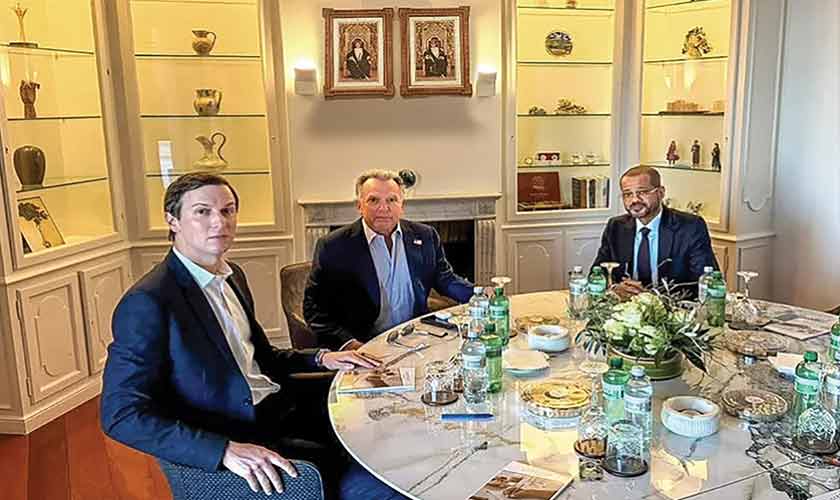
US and Iranian negotiators met for another round of talks just as US continued to threaten more violence
| T |
he United States and Iran have appeared in recent weeks to be gearing up to engage militarily, putting the entire region at risk of a conflagration. Diplomats on all sides have been working hard to avert another unnecessary war.
The United States continued its military buildup in the Middle East reinforcing the impression since mid-January that it was planning once again to strike Iran.
How imminent is the risk of a direct US military strike? What are the red lines that may trigger such an action? The News on Sunday spoke to Dr Kenneth Holland, an adjunct professor of political science at the University of Utah, to discuss the evolving situation.
Dr Holland said the risk of war was “elevated but conditional.”
“President Donald Trump is clearly postured for action, but posture is not the same as decision,” he said. He said a visible military buildup could provide coercive leverage and strengthen his hand diplomatically but it was not as an automatic pathway to war.
Dr Holland also identified three probable triggers. “First, credible intelligence that Iran is approaching a nuclear breakout; second, a major Iranian or proxy attack that kills a significant number of US personnel; and third, a dramatic escalation involving Israel that President Trump believes it must help contain.” In the absence of all these, Dr Holland said, he believed that President Trump’s motive would remain to “combine deterrence with negotiation.”
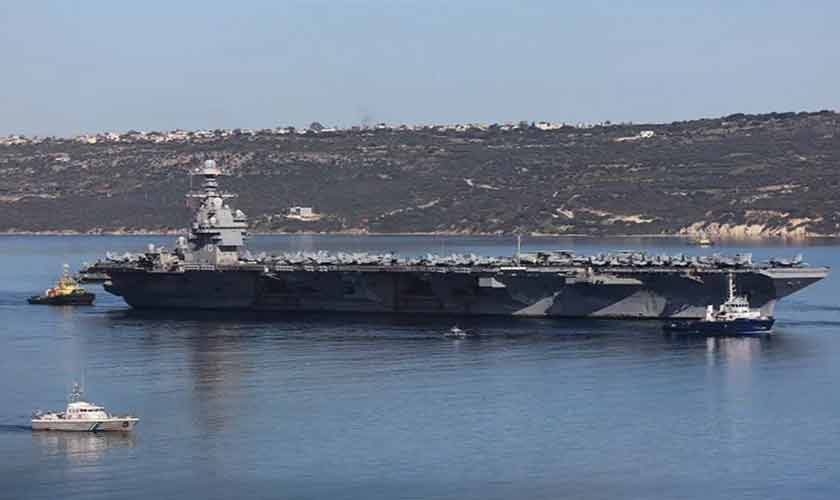
Potential strikes against Iran won’t be without consequences, as the Iranian regime has made clear after The Wall Street Journal reported last week that President Trump was considering limited military strikes against Iran. The consequences could be far-reaching and can include a war that might engulf the entire region.
“The greatest danger is that a ‘limited strike’ may not remain limited. Iran’s strategy is built around layered retaliation — missiles, drones, cyber operations and proxy networks,” said Dr Holland. Iran’s response could be “distributed retaliation across multiple theaters over days or weeks.”
Dr Holland said that policymakers should worry most about US casualties in retaliatory strikes on regional bases, maritime disruption in the Persian Gulf and escalation cycles that become politically difficult to stop once American lives are lost. Another major concern is “strategic miscalculation, if either side interprets signaling as regime-change intent, escalation becomes more likely.”
For Professor Holland, “Spirals happen less because leaders want them and more because decision time compresses and domestic political pressures intensify after casualties.”
The Wall Street Journal reported last week that President Trump was considering more military strikes against Iran. The consequences of such action could be far-reaching.
Regime change
Regime change in Iran as the “goal” of the US admin, was mentioned in an interview on The Spectator US news and opinion by Professor John J Mearsheimer, an R Wendell Harrison distinguished service professor of political science at the University of Chicago. “Regime change was the goal. What we were doing in 2025 to strangle the economy and cause these protests was working toward a way or a strategy for regime change,” Professor Mearsheimer said in the interview. He also noted that “to get regime change, you needed boots on the ground. The boots on the ground were the Iranian protesters.”
Does the media framing of an inevitable a military confrontation affect the diplomatic or strategic calculus? Dr Holland believes so. “When confrontation is framed as inevitable or existential, policymakers feel pressure to demonstrate resolve rather than explore strategic tradeoffs. That reduces perceived policy space.” He says existential framing encourages maximalism. “Permanent elimination of capabilities and regime transformation are much harder to achieve and much more escalatory… When leaders publicly define an issue as existential, compromise becomes politically toxic, even if it is strategically wiser. That dynamic can narrow off-ramps precisely when they are most needed,” says Dr Holland.
Is there a credible scenario in which a US-Iran conflict contributes to wider strategic instability? “There is a credible pathway,” says Dr Holland. “Not because Washington and Tehran would suddenly become superpowers in direct confrontation, but because the international system is already strained by great-power competition and overlapping crises.”
Dr Holland says that “a [US-Iran] conflict could accelerate nuclear proliferation incentives, strain US military resources, disrupt global energy markets and reduce crisis-management bandwidth elsewhere. The result would be a more brittle system — one in which separate crises begin interacting with one another. That is how Cold War-era instability often developed: not from a single flashpoint, but from overlapping pressures that narrowed room for error.”
CNN recently reported on a Situation Room meeting last week. As per CNN, the meeting “went three times longer than scheduled. [Chairman of the Joint Chiefs General Dan] Caine was unable to predict the result of a an operation targeting regime change.” The general had been confident about the mission in Venezuela.
General Caine would have his reasons to caution President Trump on striking Iran. As Professor Mearsheimer has said, “[if there is a war] Israel is really going to be pounded and American assets in the Middle East are going to be targeted… Furthermore, Iranians have committed themselves to shutting down the Strait of Hormuz. So this is why (General) Caine is telling Trump that we don’t have a good military option.”
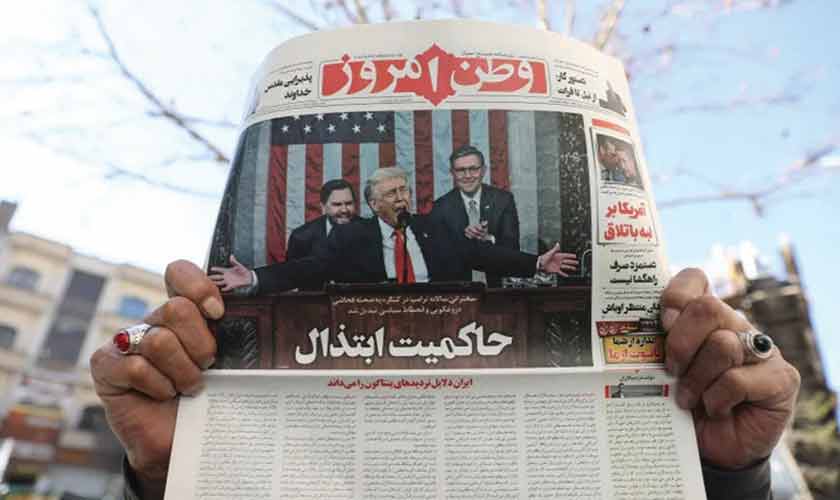
Will President Trump be decisively influenced by his top general’s advice or pressure from Israel? Professor Mearsheimer says the president has “two bad alternatives: if he attacks Iran, he loses because he can’t win a meaningful victory and he runs the risk of a protracted war. But if he doesn’t attack, he’ll be castigated by Israel and by the lobby, and that will cause significant political problems for him… So, President Trump is in one of these situations where no matter what he does, he loses.”
The writer, a communications professional, is currently the manager at the Centre for Excellence in Journalism, IBA Karachi. She can be reached on X: @mariaamkahn.