Print Story
X




In Salima Hashmi’s Open Studio, art becomes a way of holding on to the fragile work of remembering
| L |
ate is a short work of fiction from the recently published book The Eleventh Hour. In it, the author imagines a man who wakes one morning to find that he has left his body behind. It takes him some time to comprehend that he is dead, yet he is able to observe other people gathered around his corpse, attend his own funeral, revisit his home in Oxford and strike up a conversation with a student at a university eatery. What the mind experiences, once freed from the body, is a kind of enveloping fog that remains imperceptible to others.
Memories, to an extent, resemble souls: once attached to a body, an event, a dream or a physical object, they later survive in a continuous haze. As one advances in years, it becomes increasingly difficult to distinguish between reality and imagination, as the two begin to dissolve into fleeting fragments. Art, by contrast, is an attempt to resist this physical and chemical erasure, not only of the personal, but also of the shared, the cultural and the societal.
Salima Hashmi’s exhibition Open Studio, which opened on her 83rd birthday on December 14 and runs until January 15 at Rohtas 2 in Lahore, is steeped in the shadow of the past. The works unfold against a backdrop that includes her late husband, her family and some of the defining, unsettling events of our time. Emerging as intimate chronicles, many of the new works focus on the world immediately surrounding her, becoming points of connection with loss, disappearance and grief.
To explore themes closest to her life and practice, Hashmi turns to collage, mixed media, digital print, pencil and water-based paint, working on both archival paper and handmade rag paper. Central to her aesthetic is assemblage, of visual elements, concepts and historical references, alongside material traces such as fragments of old photographs and scraps of printed paper. These components are brought together to form images whose structure appears provisional, as though still in the process of becoming, or already on the verge of disintegration.
A significant part of the exhibition consists of three sketchbooks that the artist has been working on over several years. The first, received in 2012 as “a gift… to tempt me to use it as frequently as possible,” was followed by two others purchased in 2019 and 2021. These small, handheld volumes, made up of coarse pages, function not only as surfaces for observation but, more importantly, as spaces for contemplation and quiet pleasure.
Within their pages, one encounters a dotted line here, a hilly landscape there; the irregular details of a tree glimpsed during the artist’s travels; fleeting impressions rendered without insistence. Collectively, they evoke moments of pause and reflection, resisting the speed and restlessness usually associated with travel. In their restraint, they offer a gentle counterpoint to the larger works, reinforcing the exhibition’s meditative engagement with memory, time and the persistence of looking.
There is a quiet joy evident in these views, in which the artist’s preference for an intimate narrative, expressed through a localised visual language, is unmistakable. Early in her career, Salima Hashmi worked primarily in oil paint, but she later abandoned the medium, introduced and institutionalised through colonial art education in the subcontinent, in favour of water-based pigments on paper. This was a deliberate and considered shift.
Her decision invites comparison with Ng g wa Thiong’o, who, after writing his early novels in English, chose to return to his mother tongue, Gikuyu. Such a change of language is not merely a matter of vocabulary; it signals an embrace of indigenous structures of thought and expression. Crucially, it does so without slipping into provincialism. On the contrary, it enables an artist or writer to speak in their own voice to a wider world.
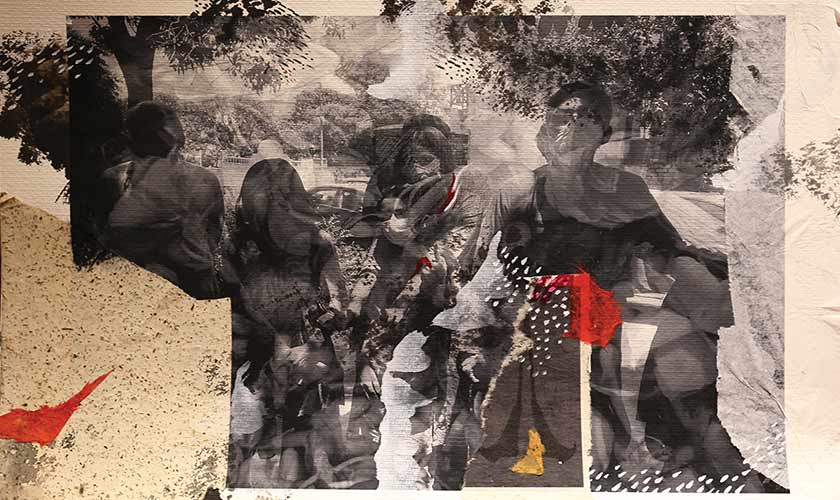
This merging of the private and the public is clearly visible in Hashmi’s work. A series of four pieces, collectively titled Family, depicts groups of adults accompanied by children, standing in open spaces against the presence of vehicles. The most striking detail, however, is their face masks, those small but potent symbols that became synonymous with safety and survival during the three years of the Covid-19 pandemic, and have since been so readily forgotten.
Memory, in the art of Salima Hashmi, functions as a thread that holds together multiple divergences.
Hashmi recalls that period by juxtaposing these images with footage from the war in Gaza, creating an enveloping narrative of collective suffering. The figures’ features are rubbed out; layers of paint obscure identity; the backgrounds remain indistinct. These families could belong to any place, any moment, any people. In dissolving specificity, the works extend beyond personal memory, speaking instead to a shared and ongoing human vulnerability.
A family, in Hashmi’s work, is not composed solely of human figures. It also includes pets, ancestral houses, trees and other forms of vegetation. In another group of works, the artist draws on her long association with the jasmine plant (Jasminum sambac), a local species found in countless homes and cherished for its unmistakable fragrance. The flower recurs in two mixed-media paintings titled A River Dies of Thirst and, as Hashmi reveals, comes from her own family garden. The plant is nearly as old as the house itself, built almost 80 years ago. Each season, it blooms and withers, only to be renewed in the next cycle, a quiet metaphor for continuity and return.
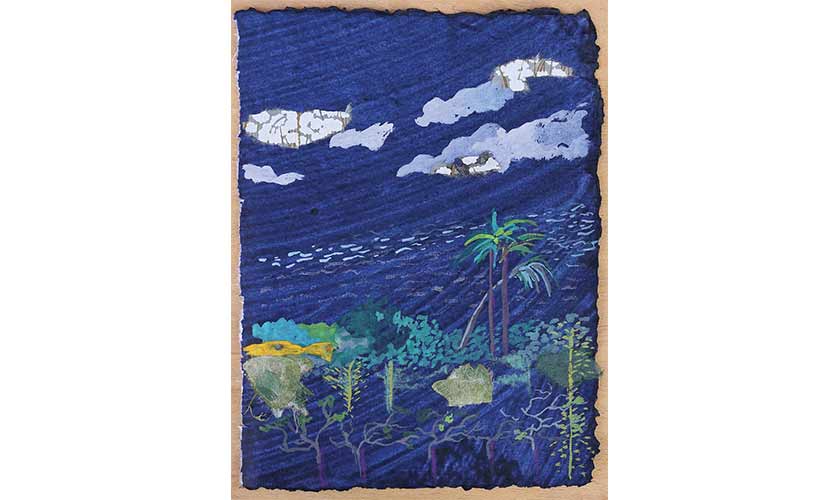
The power, purity and resilience of nature are explored further in a set of 15 small works on handmade rag paper dyed in indigo. Titled Sunless Light and produced during Hashmi’s stay in Sri Lanka, these works mark a subtle but significant shift in the idiom of an artist whose practice spans more than six decades. They may appear casual or unstructured, yet they hover delicately between the realm of reality and the arena of imagination.
These miniature works resemble pages from a book, but instead of words, they carry a different kind of script. Sensations, emotions and fleeting states of feeling move through the richly dyed surfaces of raw paper. Within them, one glimpses tall trees, palm fronds, sea foam, waves, mounds of earth, droplets of rain, solitary clouds, fish and dense stretches of greenery. Together, they evoke an idealised refuge: a tropical landscape imagined as a site of solitude and repose.
Sri Lanka, which Hashmi visits frequently, is the geographical source of these works. Yet the reference to place remains deliberately diffuse. What emerges instead is something closer to an earthly paradise, a zone of peace and quietude. The residue of mark-making, of scribbling with material, is central here. Hashmi has long believed and taught her students that the artist must listen to the medium, recognise and respect its sound and enter into dialogue with it rather than force it to comply with the maker’s will. In these works, that philosophy feels fully realised: the surfaces remain open, suggestive and generous in their capacity for interpretation.
Creating these paintings appears to be an act of remembering, perhaps even of preservation. Through them, Hashmi seems to hold on to an extraordinary lived experience, translating it into a visual language that resists closure. Instead, it invites contemplation, return and quiet immersion.
Memory, in the art of Salima Hashmi, functions as a thread that holds together multiple divergences. This is particularly evident in two works titled The Letters of Your Name, which depict Shoaib Hashmi, her late husband, alongside his grandson. In each sensitively rendered mixed-media piece, the image is divided into three parallel sequences. The figures shift from being sharply defined and fully coloured to gradually blurred, either through the spread of grey tones or through layered textures.
Both works are built around the same image. The variations chart the fragile processes through which memory fades and amnesia makes an encroachment. At the same time, they insist on memory as an act of resistance, a way of holding on. The gesture extends beyond private remembrance of a life partner to encompass broader, shared histories: moments of rupture, loss and crisis witnessed on a global scale. In this way, Hashmi’s work situates personal grief within a larger, collective struggle against forgetting.
The writer is a visual artist, an art critic, a curator and a professor at the School of Visual Arts and Design, Beaconhouse National University, Lahore. He can be contacted at [email protected]