Print Story
X




Poverty in the country has been rising consistently since 2018
| A |
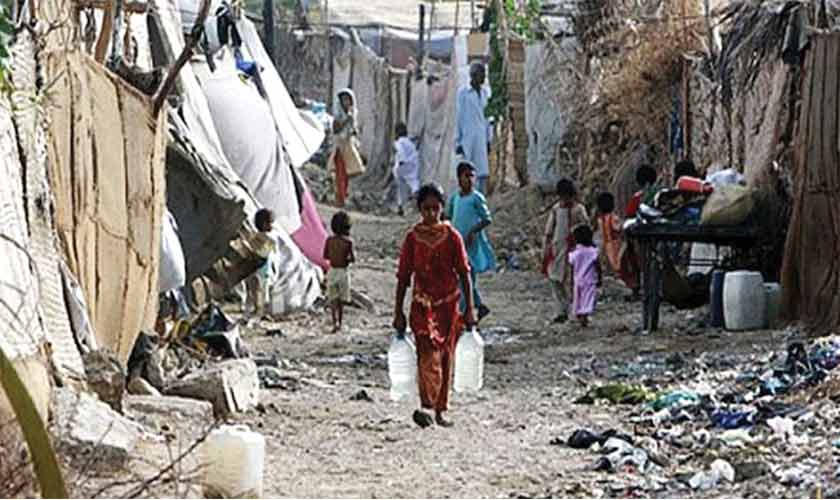
recent report, launched by the Ministry of Planning and Development, has highlighted an alarming increase in the incidence of poverty in the country over the past five-six years.
“Pakistan’s poverty rate has increased in the 2024-25 estimates, with national poverty rising from 21.9 percent to 28.9 percent. Rural poverty has increased from 28.2 percent to 36.2 percent and urban poverty from 11 percent to 17.4 percent,” Federal Mminister for Planning Ahsan Iqbal announced at the launch of this report.
Government leaders and some experts have blamed the inconsistent economic policies, resulting from political instability, for the rise. The poverty index is now at an 11-year high and income inequality has reached its highest level in 27 years. Official survey findings have been released by Pakistan Bureau of Statistics in the report The Poverty and Inequality Estimates 2024-25.
Following the completion of the Household Integrated Economic Survey 2024-25, the federal government had constituted a 17-member Poverty Estimation Committee to compute the latest poverty and inequality figures for the country.
Poverty measurement is a standard exercise undertaken by governments worldwide.The practice serves as a fundamental tool for designing and targeting effective policies and programmes aimed at poverty eradication. Beyond its statistical signi cance, poverty estimation is essential for assessing the distributional implications of macroeconomic policies. It provides an evidence-based framework to analyse how scal consolidation, stabilisation measures, structural reforms and external shocks have affected household welfare.
Last year, a World Bank report had highlighted that poverty had worsened significantly in Pakistan. It said 44.7 percent of the population now lived below the poverty line. The World Bank itself has revised its poverty benchmark for lower-middle-income countries to $4.20 per person per day, up from the previous $3.65. According to the new standard, an estimated 90 to 95 million Pakistanis are living in poverty. The report also said 16.5 percent of the population earned less than $3 per day, placing them in the extreme poverty category. According to the report, Pakistan’s middle-income class is also shrinking as 88.4 percent of the population now earns less than $8.50 per day. Economic hardships such as high inflation, low wages, currency devaluation and rising unemployment are pushing more people below the poverty line.
The PBS, however, has its own methodology. According to the PBS official report 70 million people in the country are now living in extreme poverty, based on the monthly poverty line of Rs 8,484 — the minimum expenditure threshold for basic needs. A preliminary report on poverty estimation for the fiscal year 2024-25 showed that there had been a 32 percent increase in poverty since 2018-19 when the country had its last poverty survey.
Following the completion of the Household Integrated Economic Survey 2024-25, the federal government had constituted a 17-member Poverty Estimation Committee to compute the latest poverty and inequality figures for the country.
In 2019 the poverty ratio was 21.9 percent. It is now at its highest level since 2014, when the poverty rate was recorded at 29.5. Province wise, the Punjab has seen poverty ratio increase from 28.4 to 32 percent; Sindh from 29.7 to 35.9 percent; Khyber Pakhtunkhwa from 24.8 to 29.4 percent; and Balochistanfrom 21 percent to 26.5 percent.
The report says poverty dynamics were strongly in uenced by in ation, notably sharp increases in food and utility prices. These dynamics disproportionately affected lower-income households, for whom food constitutes the largest share of expenditure. Even as headline in ation moderated, relative prices of essential goods remained elevated, keeping the consumption baskets under pressure. Energy tariff adjustments under scal and sectoral reforms further raised electricity and and fuel costs. These inelastic expenditures reduced disposable income for other essentials, sustaining welfare stress and contributing to rising poverty.
The planning minister said there was a pressing need to increase the country’s exports. He urged the provincial governments to devolve resources to the district and grassroots levels to reduce the poverty ratio.
The report also highlighted several social factors that have contributed to the persistence and rise of poverty across Pakistan. These included security challenges; human capital constraints; and regional and structural disparities.
Most experts agree that security challenges are a major factor in disrupting livelihoods. These also limit access to markets and essential services and increase household vulnerability, resulting in increased poverty ratios, particularly in conflict-hit regions.
“There is a strong correlation between poverty and militancy. It’s not a coincidence that the economically backward regions of the KP and Balochistan are most affected by the ongoing insurgency. Deprived of basic economic and democratic rights, people there are becoming increasingly alienated from the state,” says columnist ZahidHussain.
GM Arif, a former director at the Pakistan Institute of Development Economics, who headed the poverty committee, has said this is a worrying situation. “This rise in the number of the poor is concerning for both the government and the society,” he says, adding, “the focus on social protection alone is not sufficient.” He said the poverty surge has taken Pakistan to some 12 years back in terms of social and economic conditions.
The WB has recommended investment in people, places and opportunities with stronger local governance, better public services and targeted support for the poorest families.
The author is a staff reporter. He can be reached at [email protected]. He tweets at @waqargillani.