Print Story
X




Indian media waged an anti-Pakistan campaign in the aftermath of Sydney attack
| T |
he tragic attack in Sydney should have united the world in grief, empathy and a collective commitment to truth. Instead, it became the latest episode in a troubling pattern where suffering is rapidly transformed into a propaganda opportunity. Within hours of the incident, Pakistan found itself targeted by a coordinated misinformation campaign originating largely from sections of Indian media and affiliated social media networks. The facts of the case were secondary; the narrative was predetermined.
Two gunmen had opened fire on Sunday at a Hanukkah gathering in Sydney’s Bondi Beach, killing 15 people.
Rather than waiting for verified statements from Australian authorities or credible international sources, certain Indian television channels, digital platforms and online influencers rushed to implicate Pakistan. Unverified claims, doctored visuals and recycled videos were circulated widely, often presented as “breaking” evidence. This rush to judgment was driven by a long-standing hostility that seeks to frame Pakistan as a perpetual source of instability.
A Pakistan-origin man living in Sydney said he had received death threats and was “terrified” to leave his home after his photo was widely shared online as the gunman.
What makes this episode particularly disturbing is the apparent organisation behind the misinformation. The spread of identical talking points, similar visuals and synchronised hashtags suggested more than spontaneous outrage. It reflected a systematic attempt to construct and globalise an anti-Pakistan narrative. This approach aligns with a broad pattern in which tragedies—whether in Europe, Australia or elsewhere—are opportunistically linked to Pakistan without substantiation, reinforcing stereotypes rather than informing audiences.
Indian media’s role in this process merits scrutiny. Journalism demands verification, restraint and ethical responsibility, especially in the aftermath of violence. In this case, those principles were sidelined. Unrelated images were presented as current; anonymous social media claims were attributed to “sources;” and speculative commentary was broadcast as analysis. No credible international news agency, investigative body or Australian law enforcement authority supported the claims against Pakistan. The absence of evidence did not slow the narrative; it merely exposed its political motivation.
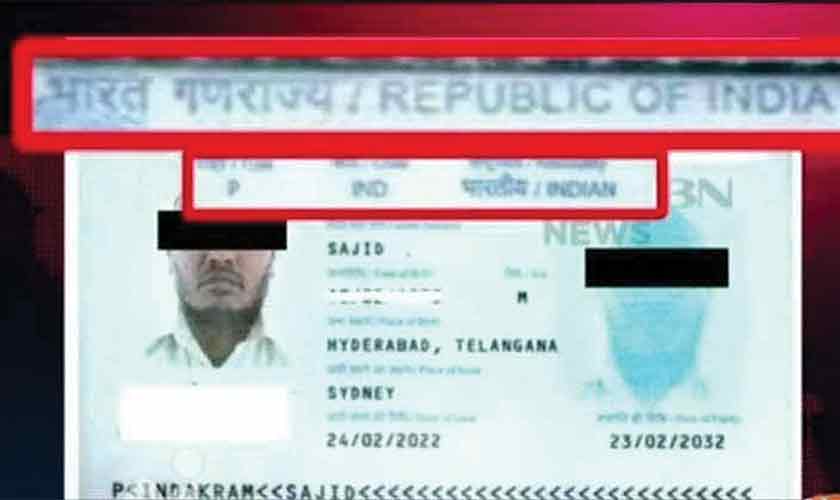
Indian police later admitted that one of the gunmen in the shooting, Sajid Akram, was originally from the southern Indian city of Hyderabad.
The damage caused by such misinformation extends beyond diplomatic relations. It distorts public understanding, fuels prejudice and diverts attention from the human cost of the incident. While Pakistani-bashing dominated certain media cycles, the victims and their families were pushed into the background. Acts of courage and humanity received little attention because they did not serve the agenda of blame.
The Indian media’s role in this process deserves scrutiny. Journalism demands verification, restraint and ethical responsibility, especially in the aftermath of violence. In this case, those principles were sidelined. Old and unrelated images were presented as current; anonymous social media claims were attributed to “sources;” and speculative commentary was broadcast as analysis.
One such overlooked story was that of Ahmed Al-Ahmad, a Muslim hero whose bravery during the crisis exemplified selflessness and courage. His actions demonstrated a simple truth often ignored in propaganda-driven narratives: humanity has no religion and bravery no nationality. Yet, this story struggled to compete with the noise of accusations and conspiracy theories. The deliberate marginalisation of such positive narratives reveals how propaganda thrives on division rather than truth.
Linking terrorism to Pakistan—or to Islam—is not only inaccurate but deeply irresponsible. Terrorism is committed by individuals, not nations or faiths. Pakistan has suffered immensely at the hands of terrorists. For decades, the country has endured attacks on schools, mosques, markets and security forces, losing tens of thousands of lives. To accuse Pakistan of sponsoring violence abroad while ignoring its sacrifices against extremism reflects selective memory and political bias.
In an era where digital platforms shape global perceptions, misinformation has become a low-cost, high-impact weapon. By framing Pakistan as a default culprit, certain Indian narratives seek to normalise hostility, distract from domestic challenges and maintain an external adversary for political consumption. The Sydney incident was not an isolated case but part of a larger pattern of narrative construction.
This approach has serious consequences for global discourse. When influential media outlets promote unverified claims, they undermine trust in journalism. Audiences become cynical, facts become negotiable and truth is replaced by ideology. Such practices do not strengthen democracy or security; they weaken them. They also risk inflaming communal tensions.
Pakistan’s response was consistent and grounded in principle. Islamabad condemned terrorism in all its forms and has called for evidence-based assessments rather than emotional accusations. Pakistan’s counterterrorism efforts have been recognised internationally, including its compliance with global financial and security frameworks. These facts stand in sharp contrast to the narratives pushed by sections of Indian media, which prefer insinuation over investigation.
Global institutions and reputable international media did not echo the allegations against Pakistan. Their restraint highlighted the gap between propaganda and information. While misinformation circulated loudly on social media, it failed to gain legitimacy at serious global forums. This effectively exposed the claims as baseless.
Another aspect of the campaign was its impact on humanitarian values. By turning a tragedy into a political contest, the focus was shifted away from support for the victims, mental health discussions and preventive measures. Instead of asking how such violence can be prevented or how communities can heal, the discourse revolved around assigning blame to an unrelated country.
The broad implication is clear: when states or media ecosystems normalise disinformation, they erode the moral foundations of international engagement. Pakistan’s experience demonstrates how easily facts can be overshadowed by prejudice when narratives are driven by hostility rather than evidence. It also underscores the importance of media literacy, fact-checking and ethical reporting in an interconnected world.
The Sydney attack revealed more than the brutality of an isolated act. It also exposed the mechanics of modern propaganda.
The author works for The News. He can be contacted at [email protected]