Print Story
X




Without stronger implementation of protective frameworks, impunity will continue silencing those tasked with holding power to account
| T |
he last year saw an alarming escalation in attacks and legal pressures against journalists and media professionals in Pakistan. The period from November 2024 to September 2025 marked an unprecedented contraction of space for free expression, with journalists facing not only physical threats but also increasingly aggressive legal harassment. The Prevention of Electronic Crimes Act, first enacted in 2016, became a central instrument of this crackdown after sweeping amendments in January 2025 broadened its scope and penalties. Vague language, poorly defined provisions and enhanced administrative powers allowed authorities to use PECA and the Pakistan Penal Code to intimidate, detain and silence many media practitioners.
Legal cases surged during this period. At least 36 formal cases were filed against 30 journalists and media workers. Besides, dozens received notices for alleged infractions under PECA. The Punjab emerged as the epicentre of these legal actions, but the chilling effect reached across Islamabad, Khyber Pakhtunkhwa, Sindh and Balochistan. Amendments in January 2025 criminalised the dissemination of “fake or false” information, established the Digital Rights Protection Authority and expanded the definition of blockable content to include broadcast media.
Despite opposition from journalists’ unions, human rights organisations and international observers, further restrictions followed in September 2025, reinforcing the government’s grip over digital spaces.
The impact was immediate and stark. Arrests, FIRs, channel blockings and threats of fines and imprisonment became common. Journalists faced legal ambiguity that encouraged self-censorship. The International Federation of Journalists noted that anonymous complaints could trigger serious consequences. Local unions reported that hundreds of journalists were facing charges, often for allegedly spreading false narratives against state institutions. Human rights defenders called for repeal or reform of PECA amendments to align them with international standards. Journalists, especially in merged districts of Khyber Pakhtunkhwa, were caught between state and non-state actors, receiving direct and indirect threats and harassment from various groups and political parties.
Physical attacks and threats also rose sharply. Between November 2024 and September 2025, at least 142 cases of violations were documented against media professionals, a nearly 60 per cent increase over the previous year. Islamabad the and Punjab were the most dangerous regions, each accounting for 28 per cent of violations. They were followed by Khyber Pakhtunkhwa, Sindh, Balochistan and Azad Jammu and Kashmir. Television journalists were most frequently targeted, followed by print and digital media. Radio journalists also affected. The violations included one verified murder of a journalist, four assassination attempts, 39 physical assaults, 15 arrests, 30 legal threats, three kidnappings, three disappearances and ten digital threats. Governments were responsible for 71 per cent of the documented cases. Other actors included political parties.
Together, the legal environment and physical threats have created a chilling effect across the country. Journalists and media workers have had to navigate a landscape where investigative reporting carries high personal risk, livelihood disruption and the constant threat of digital censorship. The PECA, combined with the PPC, has become a tool for stifling dissent, suppressing critical reporting and blurring the line between legitimate journalism and criminalised expression. Even in cases where journalists were not convicted, the frequent threat of FIRs, summons and prosecution caused self-censorship and hindered independent reporting.
Several high-profile cases illustrate this grim reality. Matiullah Jan, arrested under terrorism and PECA charges in December 2024, was eventually released on bail. Harmeet Singh faced PECA charges while covering political protests. Waheed Murad and Farhan Mallick were arrested. Later, they were granted post-arrest bail. A dozen YouTube channels were also targeted, reflecting the government’s drive to control online media spaces. These cases highlight not just individual harassment but a systematic strategy to intimidate journalists and media organizations into silence.
In this climate, Pakistan’s legal frameworks for journalist protection remain uneven. Sindh and the federal government have made strides with legislation and the establishment of safety commissions but operational gaps persist. Chairpersons were appointed for both commissions in 2025—Kamal Uddin Tipu at the federal level and Aijaz Memon in Sindh. However, the federal commission remained incomplete, with members awaiting security clearance. Azad Jammu and Kashmir, Balochistan, Gilgit-Baltistan, Khyber Pakhtunkhwa and the Punjab lagged far behind in policy, legislation and operational measures, scoring between 1 and 2 out of 10 on the Pakistan Media Impunity Index.
The index, developed by Freedom Network and International Media Support, evaluates policy, legislation and operational actions across federal and provincial levels. It paints a stark picture while the federal and Sindh governments have scored 9 out of 10, most other regions have failed to enact protective laws or implement operational mechanisms. In the Punjab, Balochistan and the AJK, even advisory committees have struggled to act effectively, leaving journalists vulnerable to threats and violence.
The human cost of this impunity is evident in the cases of journalists who were killed, attacked or harassed. Imtiaz Mir, a Metro 1 TV anchor, succumbed to gunshot injuries in Karachi after being attacked in September 2025. Other cases including those of Zafar Naich, AD Shar, Latif Baloch and Khawar Hussain and Khalil Jibran Afridi remain unverified as work-related killings, underscoring the difficulty of documenting journalist-targeting violence in a climate of secrecy and fear. Across provinces, journalists continue to face the threat of physical harm, legal harassment and digital suppression.
Efforts to improve safety and combat impunity have been partially successful, thanks to advocacy and coalition-building. The Pakistan Journalists Safety Coalition, facilitated by Freedom Network and supported by international partners, played a pivotal role in enacting provincial and federal laws. Yet, uneven implementation across regions and incomplete operationalisation of safety commissions highlight the fragility of these legal protections. In the Punjab, for instance, administrative committees established to address threats remain largely ineffective, with repeated threats and attacks on journalists going unaddressed.
Kamal Uddin Tipu, the newly appointed chair of the federal commission, brings years of experience in law enforcement and media regulation, having served as deputy inspector general of Islamabad Police and with PEMRA. His proactive engagement with media organisations and civil society demonstrates potential for meaningful intervention. However, the commission’s incomplete structure, limited resources and ongoing political inertia present substantial challenges to addressing impunity effectively.
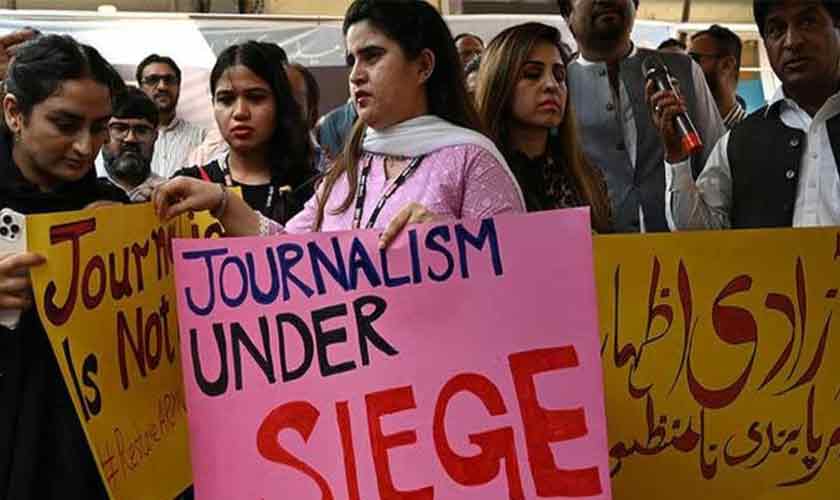
The story of Pakistan’s journalists over this past year is one of courage under siege. Despite a legal and operational environment increasingly stacked against them, journalists continue to report, investigate and speak truth to power. Yet the landscape remains perilous: legal ambiguity, threats to life, digital suppression and economic vulnerability shape every decision, every story and every broadcast. Without stronger implementation of protective frameworks, robust accountability mechanisms and consistent monitoring, impunity will continue to embolden perpetrators and silence those tasked with holding power to account.
Pakistan’s experience highlights a global challenge. Legislation alone does not guarantee safety. Laws must be enforced, commissions must be operationalised and violations must be systematically addressed. The absence of these elements allows threats, attacks and killings to persist with near-total impunity. For journalists, media professionals and citizen reporters, the message is clear: speak out at your own risk, navigate threats at every turn and rely on advocacy networks to survive.
As Pakistan commemorates the international day to end impunity of crimes against journalists, the grim statistics and chilling stories from the past year demand urgent reflection. Legal reforms, operational oversight and political will are critical, but so too is the recognition that journalists’ work is essential for democracy, transparency and public accountability. The combined weight of legal threats, physical violence and impunity challenges the very foundation of press freedom in Pakistan and the coming years will test whether reforms can translate into genuine safety and protection for those who dare to report the truth.
The writer is a freelance journalist and activist