Print Story
X




Putin visits India as Modi slashes Russian oil imports under US pressure
| I |
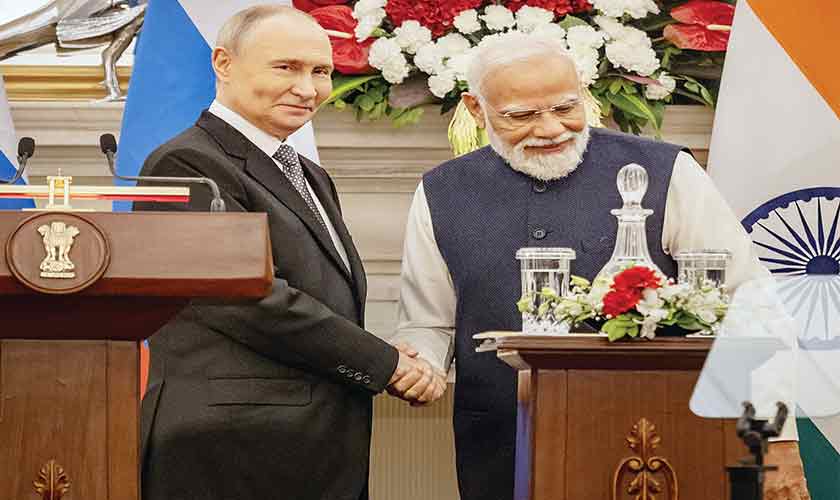
Indian Prime Minister Narendra Modi’s warm reception of President Putin of Russia, complete with a bear hug and a shared car ride, unmistakably signalled that New Delhi and Moscow continue to view each other as long-term strategic partners. India is employing strategic autonomy to keep Moscow close while attempting to minimise the fallout from Washington over its stance on Ukraine and Russian oil imports.
President Putin’s visit reinforced historical bonds rather than marking a major shift on the geostrategic landscape. The 23rd India-Russia summit that concluded a week ago was part of a decades-long dialogue aimed at fostering a strategic partnership. It had earlier been delayed due to Covid-19 restrictions and scheduling issues. For Russia, the presidential visit was a pragmatic move to break its isolation, showcasing engagement with Global South leaders like Modi. It also highlighted Russia’s strategic pivot to Asia, underscoring its ongoing relevance.
Naghmana Hashmi, a former Pakistani ambassador, say the visit has come at a time when US-India ties are under unprecedented strain. The Trump administration has slapped cumulative 50 percent tariffs on Indian exports, linking half of those to India’s refusal to stop buying Russian oil. These have been reinforced with threats of secondary sanctions, besides blunt NATO warnings of “hitting India very hard” if it continues to defy the West on Ukraine. Delhi views these moves as coercive overreach, stalling Quad cooperation, trade talks and broad strategic initiatives.
Bilateral trade between India and Russia has grown from about $10 billion pre-2022 to $69 billion now, largely driven by discounted Russian oil. Since the Ukraine war, India has significantly increased the share of Russian crude oil to 40 percent of its total oil imports, making it Russia’s top buyer after China. “The discounted Russian oil has become a major economic lifeline, saving India billions of dollars and helping manage inflation. This creates strong incentives to keep energy ties intact despite Western pressure,” says Ambassador Hashmi. In response to secondary US sanctions on Russia’s Lukoil and Rosneft, Indian companies are adapting: Adani has banned sanctioned oil vessels from its ports; and Reliance has reduced Russian crude purchases. Besides, India is now buying more crude oil from other sources, including the United States and the Middle East, to reduce its exposure to sanctions and address US trade concerns.
Against this backdrop, President Putin announced that Russia was prepared to guarantee steady oil supplies to India. However, no specific agreements were revealed. This leaves the next move largely up to New Delhi.
Ambassador Hahsmi says that Prime Minister Modi is signalling to the United States that India will not be coerced on its Russia policy even as it wants to stabilise a badly frayed US-India relationship. The partnership has been badly bruised and is, for now, drifting toward a colder, more transactional phase. “This pressure has pushed India to hedge harder, deepening non-Western forums like BRICS even as it insists it still values US technology and market access.” New Delhi also wants “Russian help to blunt or work around US secondary sanctions and tariffs linked to Russian crude.”
“The visit allowed India to push Putin—at least symbolically—towards a peace process, while allowing India to reduce its exposure to sanctions and tariffs tied explicitly to the continuation of the war.” Under intense Western pressure, Modi carefully framed the Putin summit around “peace” in Ukraine, reiterating India’s longstanding call for dialogue and an early ceasefire while pointedly avoiding any condemnation of Russia or endorsement of sanctions. By sticking to the mantra “this is not an era of war,” Ambassador Hashmi says, for Moscow, “India’s neutral but business-driven approach helps counter Western isolation.”
Pakistan’s former ambassador to India Abdul Basit says the striking absence of Ukraine from the Russia-India joint statement is a notable omission. With oil trade under threat, both nations want to diversify their economic relationship. The two leaders also discussed expanding trade with Russia aiming to increase import of Indian goods to achieve $100 billion in bilateral trade by 2030. The balance of trade favours Russia. India is pushing for diversification in agriculture, pharmaceuticals and fertilisers. Basit says Russia-India trade remains modest, but initiatives like the Eastern Maritime Corridor (Chennai-Vladivostok, shortening routes by about 5,600 kilometres compared to St Petersburg-Mumbai) could boost non-oil exports. This corridor, potentially involving Vietnam and Indonesia, positions Russia as a vast market for India’s 1.4 billion-people economy. The Mobility Agreement opens doors for Indian workers in Russia. This is a big deal, especially with the US tightening visa restrictions. The Russian state company, Rosatom, is building India’s largest civilian nuclear power plant in Tamil Nadu. Putin also announced plans for a Russian-Indian pharmaceutical plant in the western Kaluga region of Russia.
Despite declining dependence, Russia remains central to India’s defence: its share of Indian arms imports has dropped from over 70 percent to about a third, but key systems like the S-400 and legacy platforms are still vital.
India’s strategy is a delicate balancing act, maintaining strong ties with the US for countering China ; and access to technology and investment, while retaining Russia as a key partner for its defence and energy needs. This dual alignment aims to avoid pushing Moscow closer to a Beijing-Pakistan axis, says Ambassador Hashmi.
There had been intense speculation around Putin’s visit—particularly whether India would commit to buying advanced Russian fighter jets or air defence systems. In the end, no new defence deals were announced. The absence of such announcements likely reflects the tightrope India continues to walk.
Beyond the conspicuous silence on new defence contracts, the summit also produced a joint statement on terrorism that — in tone and wording — moved noticeably closer to India’s long-standing positions, most sensitively on Jammu and Kashmir. Ambassador Basit notes the Russia-India joint statement on terrorism and Kashmir is concerning from Pakistan’s point of view, as it echoes India’s narrative on Kashmir, marking a shift from Russia’s historical neutrality. “The reference to Pahalgam attack as part of Indian Jammu and Kashmir, rather than part of disputed territory violates international law and UN resolutions. Pakistan must engage Russia in this regard, emphasise respect for international law and UN resolutions on Kashmir and urging adherence to principles. “This warrants a démarche, consistent with protests against similar stances taken by countries like Afghanistan,” he said.
Notably, despite Indian advocacy, Russia has resisted naming Pakistan. That Russia stopped short of fully endorsing India’s counter-terrorism narrative – refusing to name Pakistan or specific groups – underscores the limits of Moscow’s concessions even on issues close to New Delhi’s heart. It is precisely these calibrated half-steps that allow India to maintain its Special and Privileged Strategic Partnership with a historically reliable partner.
India views Moscow ties as a historically reliable counterbalance to what it perceives as erratic US policy, even though the bond no longer carries Cold War-era weight. The trajectory points to a managed decline: India will weather US sanctions in the near term, diversify its defence import sources and deepen Western links over time. Putin’s visit aimed to steady a partnership under strain and in transition.
To manage US concerns, India is diversifying arms supplies, reducing oil imports and positioning itself as a potential bridge for a Ukraine settlement—while avoiding irreversible damage to ties with Moscow. Putin’s visit thus signals continuity: India shows that, even under sanctions pressure, it will not abandon Russia, betting Washington will eventually accept an India that aligns on China but remains autonomous on Russia and Ukraine.
The writer is a senior The News staffer in Karachi.