Print Story
X




As the Punjab government lifts the two-decade-old ban on Basant, Lahore is engulfed in a mix of joy, hope and concern
| F |
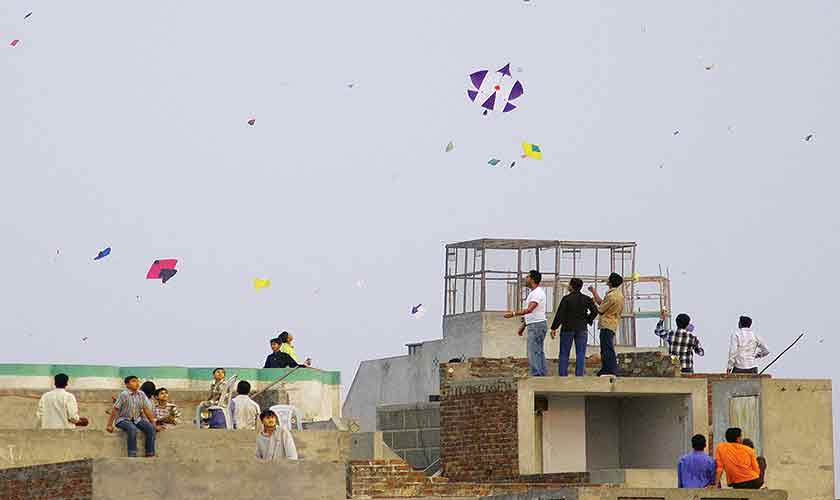
or many in Lahore, Basant brings back memories of a bygone era. For Manazir Ali, a Police Department employee, who once was a passionate kite flyer, Basant’s return to his city brings mixed feelings.
“I used to be a full-time kite buff during the 1990s,” he says. “In 2001, I flew kites for the last time. I was 20 then. Now, I am 45. I don’t feel the same thrill any longer. Perhaps, it is because of the stress in life and at work; perhaps, because I have a family now.”
Safety and regulation
Till December 3, the Punjab Police would issue daily handouts relating to raids on kite sellers, buyers and people holding kite strings. With the government’s announcement regarding the return of Basant to the city, these handouts have stopped.
On December 3, Governor Saleem Haider signed an ordinance allowing Basant after a ban for almost two decades.
The new Basant Ordinance lifts the ban but adds strict rules. Children under 18 cannot fly kites. Parents will be held responsible if children are found violating the rule. Only cotton thread/ string is allowed. Use of metal string blamed for many fatal accidents remains banned.
Those who violate the rules may face three to five years imprisonment and fines up to Rs 2 million. Kite makers and sellers will be regulated as well.
On December 10, Senior Minister Marriyum Aurangzeb posted on X that Chief Minister Maryam Nawaz Sharif had allowed kite flying on February 6, 7 and 8. She wrote that Basant was a beautiful part of Lahore’s culture, admired across the world, adding that kites and spools will be registered and QR coded.
“Basant belongs to the people. Its success is our shared responsibility,” she said.
She also announced that a campaign will be initiated to install safety antennas on motorbikes. “Safety is the CM’s priority. Let every kite fly high, and every ride stay safe.”
Fear and hope
As the government prepares for the festival, many wonder whether today’s youth will move away from their screens to take to the rooftops.
For millennials like Shahbano Naushahi, a Lahore School of Economics graduate, Basant is a half-forgotten if warm memory.
“It is a small glimmer in a sea of memories,” she says. “When I heard that Basant would be celebrated, I had flashbacks of bright clothes, songs—and the sheer joy of it all.”
She also remembers the fear.
“People died because of the use of illegal string. With the colours of Basant come memories of death and tragedy. I hope that this time Basant is safe.”
For younger people like Fatima Malik who studies at Government College University, Lahore, Basant offers a link to history.
“It is exciting to take part in something that belongs to our culture,” she says. She believes the revival may bring people together.
“We always look for activities we can enjoy and that allow people to come together. With QR codes, registration and safety plans, this Basant shows that we are using technology for public good.”
Bargaining for more
People in the kite trade are not entirely satisfied.
Muhammad Amir Rafiq Sheikh, the spokesperson for the All Pakistan Kite Flying Association, says his team worked with the government. He says some of the rules go against the “spirit of Basant.”
He says when talks began, the government was of the opinion that Basant should be allowed in select areas. “But we fought for people. The Basant will be celebrated across Lahore.”
Sheikh says that the association has asked the government to remove the age requirement, adding that they expect a decision soon.
The new Basant Ordinance lifts the ban but adds strict rules. Children under 18 cannot fly kites. Parents will be held responsible if children are found violating the rule. “This festival is being celebrated after 25 years. It is up to the people to show how they feel about it,” says Najam-us Saqib, the WCLA director general.
“For 25 years, workers in the kite and twine trades left Lahore, moving to other cities and vocations to earn a living. Bringing Basant back will help them return.”
Sheikh says safety will be ensured through approval stamps on kites and spools.
“People must be responsible, too,” he says. “Protect yourself and the government will protect you.”
He says the association has also demanded that kite flying be allowed throughout the year.
“If the festival lasts only three days, the leftover stock will waste. So, the association has requested special kite zones after Basant, where people can fly with the permission of the police. These will be monitored areas.”
Sheikh says the excitement is already close to its peak.
“I receive hundreds of calls every day from people asking when they should start preparing for Basant. I tell them to wait for registration.”
Reviving Basant
The Walled City of Lahore Authority has been part of the planning process.
Najam-us Saqib, the WCLA director general, says that the authority worked on the rules along with the Commissioner’s Office and the Home Department.
“We will follow every instruction that the Commissioner’s Office or the Home Department issues,” he says.
As for making Basant memorable, he says that the magic will come from the people. “This festival is being celebrated after 25 years. It is up to the people to show how they feel about it.”
Kamran Lashari, the former WCLA chairman and a key Basant revival advocate, says age limit may not be enforced strictly.
He says that kite flying will only be allowed on February 6, 7 and 8.
“We have been asking for this for 20 years; finally, it is happening.”
If the return of Basant proves a success, he says, the festival may be expanded to seven days. “Things grow with time,” he says.
Asked about safety, Lashari says there are always risks in life.
“As we speak, I am sitting in a car. Anything can happen,” he says. “The aim is to reduce the risks.” He says all aspects of the festival have been addressed, including the law, SOPs, rules and public awareness.
“The biggest danger is for people riding motorbikes. That is where most accidents happen.”
He supports the government’s plan to install antennas on motorbikes. “That will reduce the risk.”
He also says that the citizens must help the authorities.
“Only a few people use the metal string. People must report anyone they see selling or using it,” he says.
Protecting ‘heritage’
For Lashari, Basant is not just a festival but a cultural force that brings people together. He says the festival used to pull Lahore out of its daily grind.
“Every hotel used to be fully booked. All businesses, rickshaw drivers, snack sellers, shopkeepers made money,” he says. “Pakistan has no other festival of this scale.”
Lashari says Basant once broke social barriers.
“People from all classes came together. Families laughed together. It had a positive social impact.”
“This festival is part of our heritage. We must protect it,” he says.
The writer is the editor of Minute Mirror. He may be reached at [email protected]m