Print Story
X




A single manuscript traces a story of the long afterlife of colonial record-keeping
| A |
t the heart of the Lahore Fort once stood a room that shimmered with more than gold and silver; it glowed with the light of knowledge. This was the Toshakhana, the royal treasury of the Lahore Darbar under Maharaja Ranjit Singh. Within its guarded walls lay not only jewels, arms and regalia, but also manuscripts, maps and books that reflected the intellectual horizons of a confident Punjabi empire.

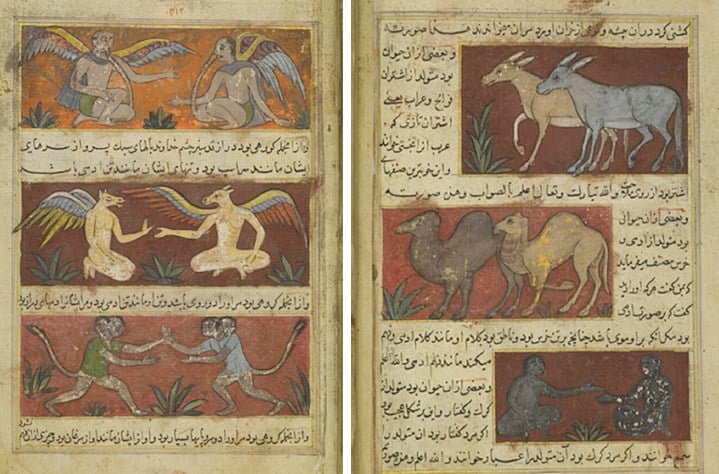
When the East India Company annexed the Punjab in 1849, this treasury became one of the first casualties of empire. What had been a repository of sovereignty was transformed into a bureaucratic depot of curiosity, its treasures catalogued, classified and scattered across imperial institutions. Among these manuscripts was a Persian cosmography titled Tarjumah-i ‘Aj ’ib al-Makhl q t — The Translation of the Wonders of Creation — now preserved in the British Library under the reference Or. 1621.
To understand the manuscript’s importance, one must first understand the statesmanship of Maharaja Ranjit Singh. Known as the Lion of the Punjab, he ruled not only through military power but also through symbolism and the stewardship of culture. His court at Lahore was a living mosaic of traditions — Persian scribes, Kashmiri painters, Punjabi poets, Hindu accountants and European officers all served under his watch.
Ranjit Singh’s Toshakhana was more than a royal storeroom; it was an archive of identity. The Maharaja understood that power was sustained not only by force but also by the preservation of knowledge. He valued books and manuscripts as emblems of legitimacy, continuity and refinement.
By acquiring rare works such as ‘Aj ’ib al-Makhl q t, he placed his rule within the broader cosmopolitan lineage of Indo-Persian kingship, echoing Mughal and Deccan traditions in which rulers were also patrons of learning. The presence of scientific instruments, maps, illustrated Qurans and cosmographies in his Toshakhana signalled that Lahore was not merely a capital — it was also a seat of worldliness and wonder. In Ranjit Singh’s view, the ruler who guarded knowledge guarded the cosmos itself. His sovereignty, therefore, was not only territorial but also intellectual.
This delicate balance between power and knowledge was shattered after the British conquest of the Punjab. In March 1849, the East India Company marched into Lahore, and the city’s treasures were formally confiscated. Dr John Login, a Scottish physician and administrator, was appointed both in charge of Lahore Fort and guardian of the young Maharaja Duleep Singh, the last heir of the Sikh Empire.
Login’s task was not simply caretaking; it was also cataloguing. Under his supervision, officers of the Board of Administration began preparing detailed inventories of the Toshakhana. Jewels, coins and arms were counted. Manuscripts and books were listed but often undervalued, treated as secondary to material wealth. To the colonial eye, these manuscripts were “objects of curiosity,” not living expressions of sovereignty. Thus began the transformation of the royal archive into imperial record.
Among the manuscripts recorded during this process was Tarjumah-i ‘Aj ’ib al-Makhl q t. Originally written by Zakariya al-Qazwini in the 13th Century, this work of cosmography described the structure of the universe, from celestial spheres to earthly creatures. In South Asia, Persian translations such as the one found in Lahore became immensely popular. They blended Islamic cosmology with local imagination, serving as vernacular encyclopaedias of wonder.
For centuries, such works were copied, illustrated and read aloud in courts, mosques and schools. They symbolised a bridge between faith and reason, where astronomy, mythology and spirituality coexisted. The Lahore manuscript’s early history links it to Muhammad ‘Adil Shah of Bijapur (r. 1627–1656), whose royal seal marks its pages. How it travelled from the Deccan to Lahore remains a mystery, perhaps as a diplomatic gift, a war trophy or an antiquarian acquisition. What is clear is that Ranjit Singh recognised its worth and secured it within his Toshakhana, preserving it as part of his cultural empire.
Between the seal of Bijapur and the sale in Lahore lie two centuries of silence.
When the British annexed the Punjab, they systematically dismantled Ranjit Singh’s archival system. In 1851, a small but revealing notice appeared in the Lahore Chronicle: “The collection of books found in the treasury of Lahore, and known by the name of the Durbar Library, has been presented by the Board of Administration, with the consent of the Government of India, to the new College of Amritsar.”
Behind this short statement lies a monumental loss. The Durbar Library, once the intellectual nucleus of the Lahore court, was dispersed and handed over to a new colonial institution in Amritsar. Manuscripts that had served as instruments of sovereignty were now teaching tools in a foreign educational framework. The British administrators, in their zeal to “preserve knowledge,” stripped these works of their original context. ‘Aj ’ib al-Makhl q t was no longer a royal book of marvels, it was catalogued instead as an “Oriental curiosity.”
Dr John Login’s position was emblematic of the colonial paradox. The man charged with protecting the child of Punjab’s sovereignty was also the one overseeing the auctioning of its heritage. His reports detail how items from the Toshakhana were sold, gifted or sent to Calcutta and London. Among these, ‘Aj ’ib al-Makhl q t was reportedly sold to Sir Henry Miers Elliot, a British historian and administrator, for Rs 40. Elliot later became known for compiling The History of India as Told by Its Own Historians, a work built, with irony, on many of the very sources his empire had displaced.
Between the seal of Bijapur and the sale in Lahore lie two centuries of silence. No official record explains the manuscript’s journey through empires and libraries. This absence of documentation, this archival silence, is as revealing as the artefacts themselves. This omission of records is not accidental; it is symptomatic of how empire managed memory. The British created archives that served governance, not preservation. Their aim was control, not continuity. Thus, while we find exhaustive lists of cannons and jewels, the intellectual treasures of the Punjab remain faintly footnoted.
For historians today, this raises deeper questions of provenance and ethics. Who owns the manuscript, the institution that holds it, or the civilisation that produced it? What happens when a work meant to inspire wonder becomes an artefact of empire?
At its core, ‘Aj ’ib al-Makhl q t was not merely a Persian cosmography; it was a vernacular form of global curiosity. Long before modern science popularised astronomy, Qazwini’s work taught readers to see the cosmos as connected, a chain of creation stretching from angels to animals. In the Lahore Darbar, such manuscripts represented South Asia’s participation in the global history of knowledge. They linked the Punjab to Baghdad, Isfahan, Delhi and Samarqand, a world united by scholarship rather than conquest.
Ranjit Singh, by preserving and displaying such manuscripts, asserted that knowledge itself was a symbol of rule. His sovereignty, like his empire, was rooted in pluralism, an understanding that strength lies not only in the sword, but also in the pen, the book and the archive.
Today, the British Library’s digitisation of ‘Aj ’ib al-Makhl q t through the Qatar Digital Library has made it accessible to global audiences once again. Yet digital access cannot erase the questions of loss, movement and ownership that surround it. The task before South Asian scholars and archivists is not merely to recover manuscripts but also to reclaim their meaning, to reinsert them into the cultural and linguistic worlds that gave them life. The Lahore Toshakhana, once a treasury of kings, challenges us to become treasurers of truth.
The journey of ‘Aj ’ib al-Makhl q t, from Bijapur to Lahore to London, is more than a tale of displacement. It is a mirror held up to our history, reflecting how knowledge travels, how power rewrites and how memory survives.
The writer is an assistant professor at Government College University, Lahore.