Print Story
X




Two exhibitions brought artists and architects together, reimagining material possibilities
| L |
ike the Berlin Wall, erected in 1961 in the aftermath of World War II and dismantled in 1989, there once existed a boundary between the realm of art and the field of architecture. Although many art and design schools are grounded in a dialogue between the two practices, and although, as Hans Ulrich Obrist notes in his book, Life in Progress, several European institutions do not recognise a distinction between them, this separation persisted for decades. The same can be said of various branches of design practice and pedagogy, each intermingling and expanding the perceptions of both practitioners and spectators.
A number of architects have also been active visual artists and several well-known painters have designed buildings, Satish Gujral’s Belgian Embassy in New Delhi (1980–83) being one example. In fact, the fortifications between different modes of creative production were largely a result of modern marketing, in which each brand demanded its own label, specifications and sense of uniqueness. By contrast, the history of human civilisation has always been shaped by conversation: among individuals, professions, materials and ideas. It is for this reason that people like Michelangelo and Leonardo da Vinci produced works of architecture alongside paintings and sculptures, as well as contributions to literature and science.
This meeting ground was experienced again during the recently held IAPEX exhibition (December 5-7) at the Expo Centre, Lahore. The large event comprised displays of construction materials, manufacturing units, building fittings and the latest products, with the addition of a section that moved beyond the usual business focus. Its convenor, Ar Umar Khan Kakar conceived Trialogue 25: Converging Art, Design & Architecture, which featured two major art, design and architecture projects. In these, creative practitioners, working individually or in collaboration, produced work that explored illusion and reality, shifts in materiality, traditional systems and ecological crises. Both shows, Dot, curated by Kiran Khan Kakar, and Datum, curated by Saulat Ajmal, presented new possibilities in material use, the rationale of scale and the temporality of a product.
In Dot, curated by Kiran Khan Kakar, a number of recent graduates and established artists exhibited work that was not confined to textile practice or to any single genre. For example, Aiman Gillani installed an ambitious piece fabricated from thread, arranged with such meticulous precision that each line contributed to an illusion of receding space, creating a transcendental environment. Through carefully calculated distances and projected light, the work engaged viewers not only in the moment of encounter but also long after.
Likewise, Zahra Jokhio constructed a large wooden boat covered in disused, discarded and mismatched clothing. With ordinary fabrics sewn and patched together, the work reclaimed, on one level, a female hold over a vessel traditionally situated in the male domain; on another, it unearthed a different version of history, one written by men, by oppressors, invaders and colonisers. This was underscored by a tattered Union Jack hanging limply from a pole beside the structure.
The other exhibition, Datum, explored how multiple forms of expertise, methods and meanings can converge to create work that resists singular interpretation. Curated by Saulat Ajmal, the show brought together visual artists and architects with considerable experience in their respective fields, and with a broad sensitivity to practices beyond their own. Each participant collaborated with professionals from different disciplines, enabling visitors to see how art, architecture and technology can intersect to generate a series of trialogues.
In Oxify: The Living Vessel, Umar Khan Kakar designed a white, delicately layered structure intended to purify air. Placed at the centre of an open space, the sculptural form allowed visitors, standing in what is widely known as the world’s most polluted city, to sense the difference between the ambient air quality and the air around this totemic construction.
In Morphosis, Raza Zahid returned waste paper to the idea of the tree. His large-scale open structure, composed entirely of discarded paper, was described by the architect-designer as “an envelope of slender metal frames, each holding an assemblage of paper branches. Together they define space as a suspended archive of fragments that, when seen in sequence, reconstruct the memory of a tree.” With its interwoven forms and subtle crossovers, the work became a symbiosis of nature and culture. The arch-like contours evoked the trees that once provided shade, shelter and rest in villages and small towns.
Each holding an assemblage of paper branches… a suspended archive of fragments that, when seen in sequence, reconstruct the memory of a tree.
A similar function of nature was reflected in Taimoor Khan Mumtaz’s installation, conceived as a public water fountain, or sabeel, incorporating seating. Mumtaz explained, “The grammar and vocabulary of its form are rooted in the thousand-year-old architectural tradition of this region, with a particular focus on 17th-Century Mughal architecture.”
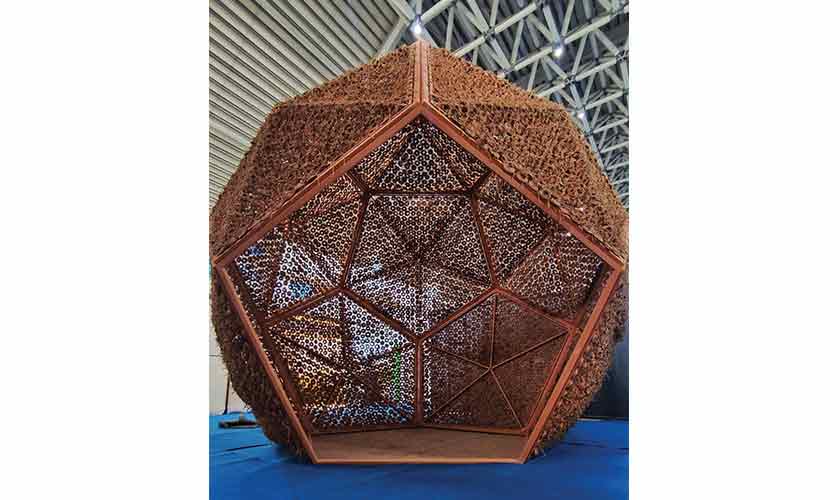
Drawing inspiration from the past, Anique Azhar, in The Courtyard, created a floating terracotta screen (jaali) that echoed elements of Mughal architecture in the subcontinent and the red bricks excavated from Indus Valley sites. The question of how the past meets the present, a dilemma visual artists often confront in their studios, becomes even more critical when it enters architectural practice and contemporary construction. This tension surfaced in Constellation of Clay, assembled by architect Faran Faisal and artist Maisam Hussain. The structure was composed of small, round terracotta shapes, the kind often formed when children throw lumps of clay onto hard surfaces. Once each lump settles, a tiny gap appears. The two collaborators joined these countless pieces with string, attaching them to wooden pentagons to form an open space that invited both entry and the gaze of passers-by.
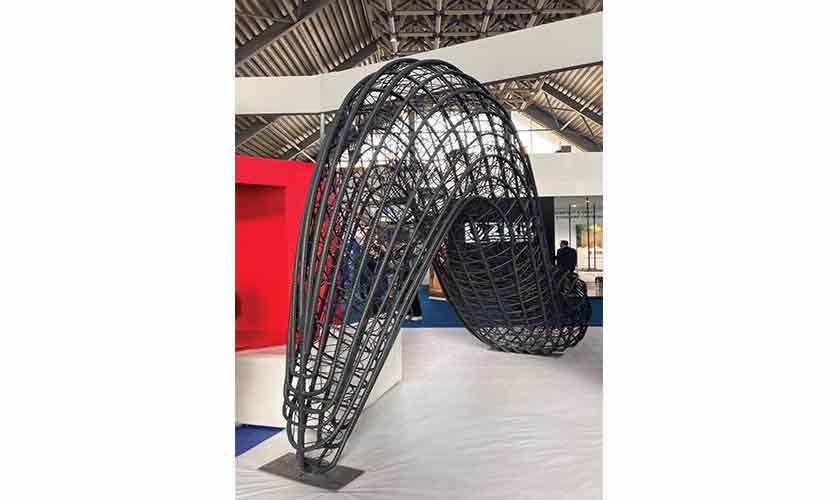
Thread, a recurring motif in Sadaf Naeem’s recent work, appeared in a new material register in her contribution. Made in collaboration with a team, Threads of Steel resembled the architecture of a worm, or the architecture of flow and freedom. From a distance, the familiar substance, hard, rough and forcefully manufactured, seemed softened, beautified and refined. The suggestion of movement also surfaced in Ammar Faiz’s striking kinetic installation Maidaan, featuring “a single lightweight spinning top levitating in mid-air against a matte-black wall.” Operated through a magnet and internal micromotors, the top’s rotation was harmonious, continuous and seemingly perpetual. Viewers were taken aback, as the top appeared slightly, but distinctly, detached from the wall at a 90-degree angle, leaving the mechanism of its suspension an enigma.
Faiz’s work achieved something beyond the initial astonishment at its technical finesse. Through its title, motion and object, the installation stirred childhood memories of playing in empty grounds, spaces long consumed by the rapid expansion of urbanisation. In this way, Maidaan alluded to land acquisition, the dispossession of communities and the erasure of shared histories and social ecosystems, often enacted by a privileged few.
One of the deeper layers, rather than the literal function, of Faiz’s work may be its reminder of lost histories, a gesture towards refurbishing them in new formats and relocating fresh meanings within them. Ammar Faiz, along with the other participants of Datum, appeared to be working towards this purpose through their varied strategies, as did curator Saulat Ajmal through her clear vision and concise curatorial approach.
The writer is a visual artist, an art critic, a curator and a professor at the School of Visual Arts and Design, Beaconhouse National University, Lahore. He can be contacted at [email protected].