Print Story
X




A forgotten Sikh-Hindu landscape on the Pothohar Plateau reveals a past now fading
| D |
During my research on pre-Partition mansions, havelis, maris and choubaras, across the villages of the Gujar Khan tehsil, I documented many structures that now stand in a state of neglect and decay. Most of these historic buildings have been altered or renovated over time, often at the cost of their original architectural character.
One village I visited repeatedly was Karnali, located near Sukho town. Both Sukho and Karnali are historically significant settlements in Gujar Khan tehsil, home to the fading remnants of old Sikh and Hindu havelis. Their weathered walls and altered façades quietly narrate stories of a vibrant past that is steadily slipping away.
After Partition, most havelis, maris and choubaras in Sukho and Karnali were allotted to Muslim migrants arriving from India. During my fieldwork, I met with oral historians, elderly residents and village intellectuals in both Sukho and Karnali to understand the pre-Partition social and economic fabric of these settlements.
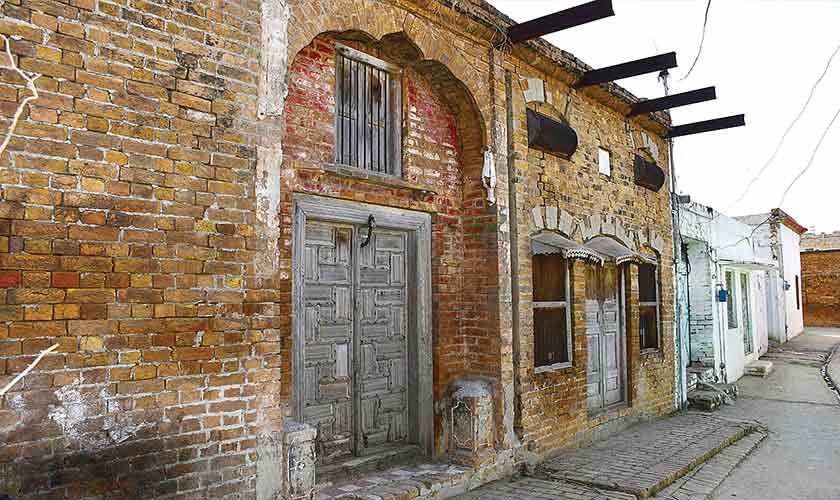
Today, Sukho has grown into a small town. Before Partition, however, it was one of the major marketplaces of Gujar Khan, dominated by the Sikh community. The havelis, shops and bazaars of Sukho were largely owned by Sikhs and Hindus, who shaped its commercial life. Through conversations with local elders, I learned that the raees of Sukho was a prominent figure named Shabram (Shivram).
He was the most powerful person in the Sikh community. He owned much property in Sukho. His younger brother, Gur Bakhsh Singh, was also a notable figure in Sukho. The choubara (mansion) of Shabram Singh was the most imposing structure in Sukho. It was a three-storeyed structure. Today, a single storey of the structure has survived. Currently this building is used as the office of the union council. The choubara of Shabram Singh was noted throughout Sukho for its woodwork and embellishments. Today, only a few wooden doors are extant in the mansion. Near the choubara of Shabram Singh was probably the choubara of his younger brother Gur Bakhsh Singh. This choubara was also noted for its wooden doors and façade. A few other choubaras were also located in the same locality.
A majority of these choubaras have lost their original beauty now. Shabram Singh was from the Bindra family, the most influential family in Sukho, which also actively participated in welfare work in the area. They built hospitals, wells and baolis (stepped wells) for the community. Just as Shabram/ Shivram Singh was the wealthiest person of Sukho, Partab Singh, also called Partabu, was the most powerful and landowner in Karnali village, a village close to Sukho town.
Karnali is a historical village. The remains of an ancient mound testify to its antiquity. From the potsherds scattered on the mound, one can say that it was a significant settlement during the pre-Islamic era.
The village became a prosperous settlement during the colonial period, when Sikhs and Muslims lived in peace and harmony, and the festival of Baba Mohan Das was held every year in pre-partition Karnali. Near Karnali are the remains of dheri, or the samadhi of Baba Mohan Das, one of the most revered places for Sikhs and Hindus of Pothohar.
Baba Mohan Das was a prominent saint of the Udasi tradition. The landscape of the Pothohar Plateau of the Punjab was historically dotted with the samadhis and shrines of Udasi ascetics. The Udasis trace their spiritual lineage to Baba Sri Chand (d 1629), the elder son of Baba Guru Nanak (1469-1539). These ascetics led celibate lives and, like the Nath yogis, established dhunis (campfires) and practiced austerities in caves. The Pothohar is home to many caves where both Nath and Udasi ascetics performed tapas (austerities). Some caves at Katas Raj were also used by both groups. Tilla Jogian, known as the most renowned Nath monastery in Pothohar, attracted ascetics from various religions, including Jainism, Buddhism and Sikhism.
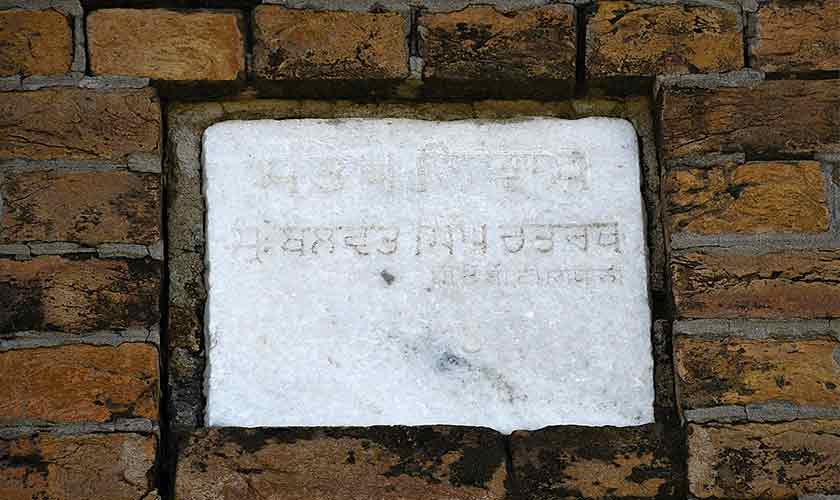
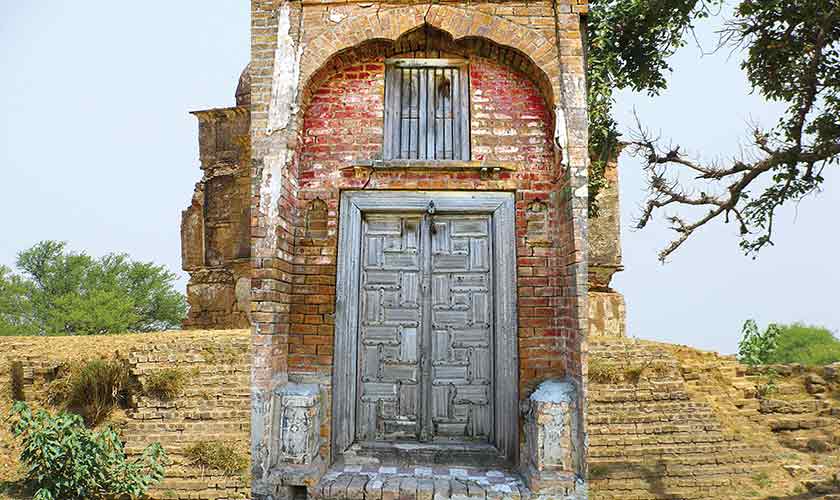
The windows and doors of Santokh Singh’s house stand as silent witnesses to Karnali’s vibrant and pluralistic past.
Following Baba Sri Chand’s passing, the leadership of the Udasipanth was passed to Baba Gurditta and subsequently to his four disciples: Almast, Balu Hasne, Phul and Goinde. These disciples carried on the teachings and philosophies of their mentors in the Punjab, Sindh and other regions.
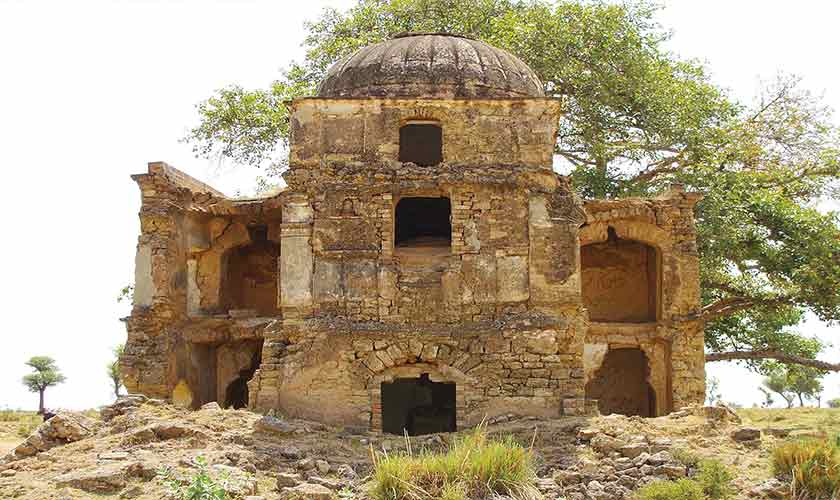
The samadhi located at Karnali is associated with an Udasi ascetic Baba Mohan Das, who was venerated by both Hindus and Sikhs. The samadhis of Udasi saints often featured paintings of Hindu deities alongside Sikh Gurus. This practice can be seen as more syncretic compared to the Khalsa Sikh samadhis, which primarily represented Sikh Gurus.
The samadhi of Baba Mohan Das holds the distinction of being the second largest in Pothohar, following the samadhi of Baba Than Singh, which is the largest and located in Kot Fateh Khan village in Attock’s Fateh Jang tehsil. Among the most famous samadhis are those situated at Dera Bakhshian in Gujar Khan. Gulyana and Bhagpur are home to two samadhis. Another is located on Bagh Saradaran Road in Rawalpindi, among others.
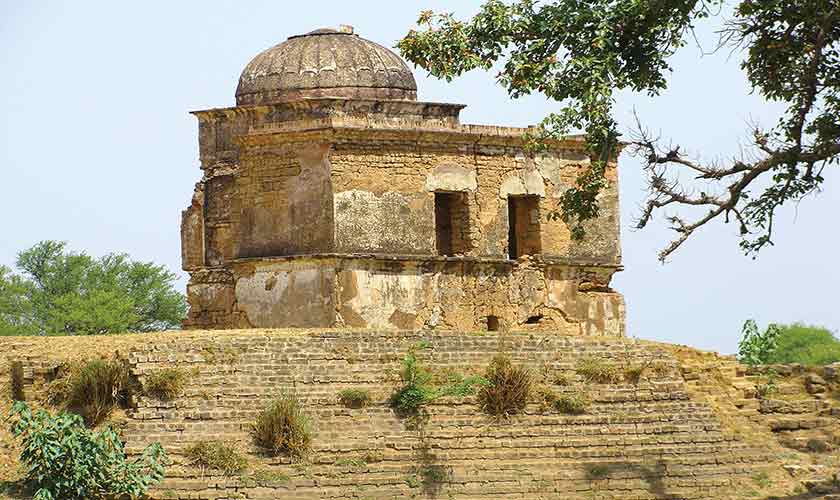
The samadhi of Baba Mohan Das is notable for its two-storey structure topped by a ribbed dome. The building has a square shape, with arched openings on all four sides. The architectural style of Pothohar’s samadhis is heavily influenced by Mughal architecture, as seen in the domes, arches and decorative false jharokhas. Most samadhis in Pothohar were constructed during the Sikh and British eras.
Unfortunately, the western side of the dheri/ samadhi of Baba Mohan Das has collapsed. The burial site has been vandalised with some people digging up his resting place in search of some treasure. Glazed tiles that once adorned Baba Mohan Das’s burial chamber are now scattered throughout the area. Both the northern and southern walls have fallen, and debris from them lies within the samadhi.
There is also an underground chamber that may have been used for meditation by Baba Mohan Das. An archway provides access to this underground area, which could be the cave of Baba Mohan Das referenced in the Rawalpindi Gazetteer. The samadhi was painted both inside and out, and traces of the original paint are still visible on its outer walls.
Located near the remains of dheri or samadhi of Baba Mohan Das is a tank which Sikhs of Sukho and Karnali constructed. I learned during an interview in 2021 with late Chaudhry Sabir Hussain of Karnali that three Sikh brothers used to hold the festival of Baba Mohan Das in pre-Partition days. Among the three brothers, Inder Singh, the eldest, was the most active in organising the festival that attracted thousands of devotees from across the Punjab.
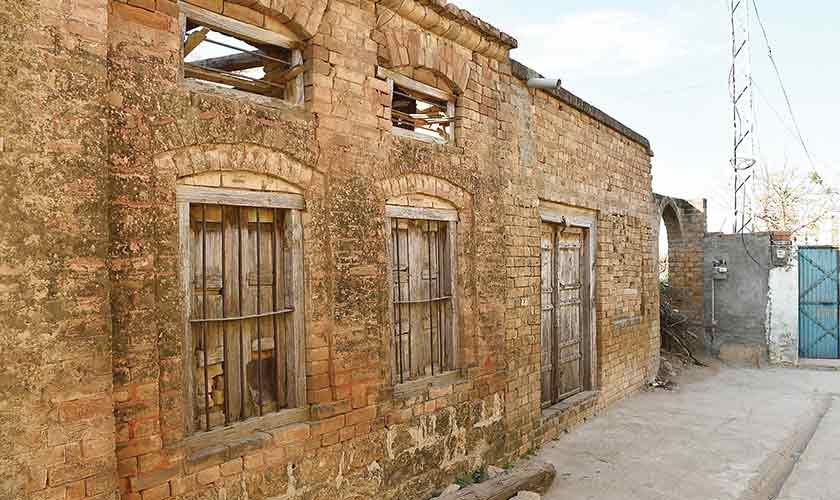
Karnali had several old Sikh and Hindu buildings. According to Chaudhry Sabir Hussain, Partab Singh was the landlord of the village. He had been a subedar in the British army. His choubara (mansion) was noted for its beautiful architecture and art. Prem Singh was another notable of Karnali village whose choubara still exists in Karnali village. He, too, had served in the army. Labha Singh of Karnali was a teacher. There used to be several choubaras of the Sikh community in Karnali. Some of the mansions in the villages included those of Partab Singh, Kartar Singh, Labha Singh, Santokh Singh and Mai Dhobi. Mai Dhobi was an influential lady in Karnali village. Her choubara was noted for its beautiful woodwork. Mai Dhobi had a transport business in Bombay (now Mumbai).
There used to be a dharamshala of the Sikh community that no longer exists. Like the choubara of Mai Dhobi, it has disappeared from the landscape. There are still a few old colonial-era buildings that belonged to Sikhs. These are now owned by Muslims. One can find an inscribed slab on the outer wall of a pre-Partition house written in Gurmukhi. It reads Santokh Niwas S Balwant Singh Chatrath BA, BT, Giani. Santokh Singh was also a teacher and learned scholar (Giani). The windows and doors of Santokh Singh’s house stand as silent witnesses to Karnali’s vibrant and pluralistic past, a time when Muslims, Hindus and Sikhs lived together in peace and harmony.
The crumbling samadhi of Baba Mohan Das and the decaying choubaras of Karnali deserve urgent preservation. Protecting these tangible fragments of the village’s vibrant past is vital not only for revealing their immense potential as heritage tourism sites but also for establishing Karnali as a heritage village.
The writer is an anthropologist at the Pakistan Institute of Development Economics, Islamabad. He has authored 17 books on Pakistan’s cultural heritage and anthropology. He tweets @kalhorozulfiqar. He may be contacted at [email protected]